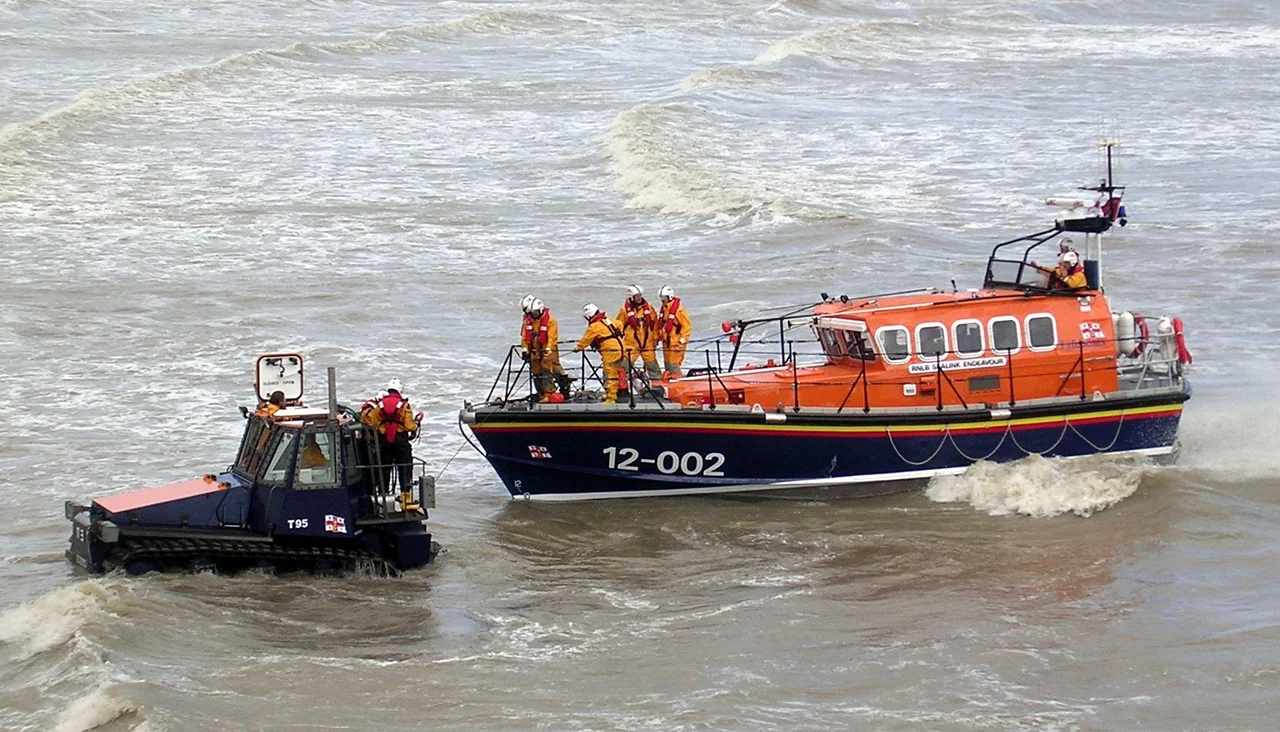

Hastings Lifeboat Station
On 31 March 1943, in a westerly gale and a heavy swell, Coxswain John Muggeridge brought the Hastings lifeboat Cyril and Lilian Bishop alongside the wreck of HM Trawler Caulonia. She had stranded off Jury's Gap, ten miles east of Hastings. Seventeen of her crew had already abandoned ship by liferaft. The lifeboat had nearly been lost in the launch - a great wave caught her on the beach and threw her back, and the launching crew had to clear war-defence obstacles from the shingle to try again. Once at the wreck Muggeridge held position alongside for thirty minutes, in the surf and wreckage, while the remaining seven men were taken off. Both Muggeridge and his motor mechanic William Hilder received the RNLI Bronze Medal for that service. Ten days later, on 10 April 1943, Muggeridge was killed when his fishing boat struck a sea mine in the Channel. Two months after that, Hilder died in an air raid on Hastings. The lifeboat saved seven lives. The two men who saved them did not survive the year.
The First Boat
In 1834, six men of the Coastguard service died at Hastings when their boat was lost in heavy weather. A local fund was raised - £81, a substantial sum then - and the following year a lifeboat was built locally by the boatbuilders Thwaite and Winter and placed on the beach. There are no records of any rescues it performed. By 1851 it was unfit for service. For seven years Hastings had no lifeboat, despite being one of the busiest fishing beaches in southern England. The Royal National Lifeboat Institution stepped in. On Monday 5 April 1858, a new RNLI lifeboat - complete with its launching carriage and equipment - arrived in Hastings by railway, carried free of charge by the London, Brighton and South Coast Railway Company. A team of horses drew her on her carriage through the streets of Hastings and St Leonards-on-Sea in a civic parade to the new boathouse, where the mayor formally named her Victoria. T.S. Hyde was appointed Honorary Secretary; Charles Picknell took the role of Coxswain. The modern Hastings Lifeboat Station begins here.
Pulling, Sailing, Steaming
The early lifeboats were pulled and sailed - long open boats with crews of ten to twelve oarsmen rowing in unison while the helmsman steered and the bowman managed the foresail. The work was brutal. Boats had to be launched off the open beach (Hastings has no harbour), dragged into the surf by horses or men hauling on long lines, then rowed out through breaking seas to whatever vessel was in trouble. Recovery on return was equally hard: the boat had to be brought back to the beach, hauled up the shingle by a team of horses, then turned and re-positioned ready for the next call. Hastings lifeboats won a Gold Medal as early as 1830 - awarded by the Royal National Institution for the Preservation of Life from Shipwreck, the RNLI's predecessor - to Lieutenants John Prattent and Horatio James of HMS Hyperion for an earlier rescue. Bronze and Silver Medals continued to accumulate through the 19th and 20th centuries: Alfred Stonham in 1904, John Edward Muggeridge in 1943, John Henry William Martin in 1975, the entire Hastings lifeboat crew in 1975, John Martin again in 1985.
The Inshore Lifeboat Revolution
In 1964 Hastings became one of the first RNLI stations in the country to receive one of the new D-class inshore lifeboats - small, fast, inflatable boats with outboard engines, designed for quick response to incidents close to shore. The first inshore boat at Hastings was the D-21. For the first decade they were used seasonally, with a succession of boats coming and going. In 1975 an inshore lifeboat was permanently stationed at Hastings for the first time, the D-226. The D-class boats transformed inshore lifesaving in Britain: where the heavy all-weather lifeboats took time to launch and were designed for serious offshore work, the inflatables could be out and back inside minutes for swimmers in trouble, capsized dinghies, kayakers swept off the rocks. Hastings's beach-launched inshore boat has worked steadily for over half a century, alongside the larger all-weather boats kept ready for the worst Channel weather.
The Sealink Endeavour and After
On 21 September 1989, HRH The Duke of Kent, President of the RNLI, named a new lifeboat at Hastings: 12-002 Sealink Endeavour, ON 1125. She had cost £498,625, funded by bequests from Dr William Murphy and Mrs Dorothy Kellet plus a promotion run by Sealink British Ferries - a charity drive that filled lifejackets and life rafts with appeals on the Channel ferries. She served Hastings until replaced by 13-28 Richard and Caroline Colton (ON 1335), an all-weather Shannon-class lifeboat launched off the beach using the modern Shannon Launch and Recovery System: an enormous tracked tractor that drives the boat in and out of the surf. In 2018 the documentary photographer Jack Lowe came to Hastings as part of his Lifeboat Station Project, photographing every RNLI station in Britain using an Edwardian plate-glass camera. His portrait of Sloane Phillips, Deputy Second Coxswain at Hastings, has since been accessioned into the Royal Maritime Museum at Greenwich.
Strategic Review
On 1 October 2025, following a strategic resource review across the RNLI, the institution announced that the Richard and Caroline Colton would be withdrawn from Hastings in 2027 for redeployment elsewhere. The station will instead receive one of the new Mk.4 Atlantic-class inshore lifeboats, increasing capability for the kind of close-in work that has become Hastings's most common call-out. The all-weather boat that has served Hastings for years will move on to where the heavier hull is needed more. The station that began in 1835 with a single pulling boat and an £81 local fund will continue under different colours, the same beach, the same fishing fleet, the same long shingle to launch off and the same Channel weather to launch into. The Stade is, among many other things, one of the oldest continually operating lifeboat stations in Britain. The names of the medal-winners are still on a board in the station house. John Muggeridge's, with the date 1943 underneath, is among them.
From the Air
Located at 50.85°N, 0.59°E, on the Stade beach at Rock-a-Nore, immediately east of the Hastings Fishermen's Museum and below the East Cliff in the Old Town of Hastings. The lifeboat station is easily identified by the large pale modern boathouse building set back from the shingle, with the Shannon-class lifeboat sometimes visible on its launch tractor in front. The black tall net huts of the fishing fleet sit immediately to the west. Nearest airfield is Lydd (EGMD) about 24 km east. Best viewed at 1,000-2,500 ft AGL; the launch tractor and lifeboat are particularly visible when out on the beach, and a launching exercise is one of the more dramatic sights along this coast.
Nearby Stories
- Battle of Lewes 1.5 km away
- Staplehurst rail crash 4.1 km away
- Canterbury Castle 14 km away
- The Carrington Event: The Solar Storm That Could Happen Again 15 km away
- Shorncliffe Redoubt 21 km away
- Le Paradis Massacre 113 km away
- Swanage Lifeboat Station 137 km away
- Cléon 150 km away