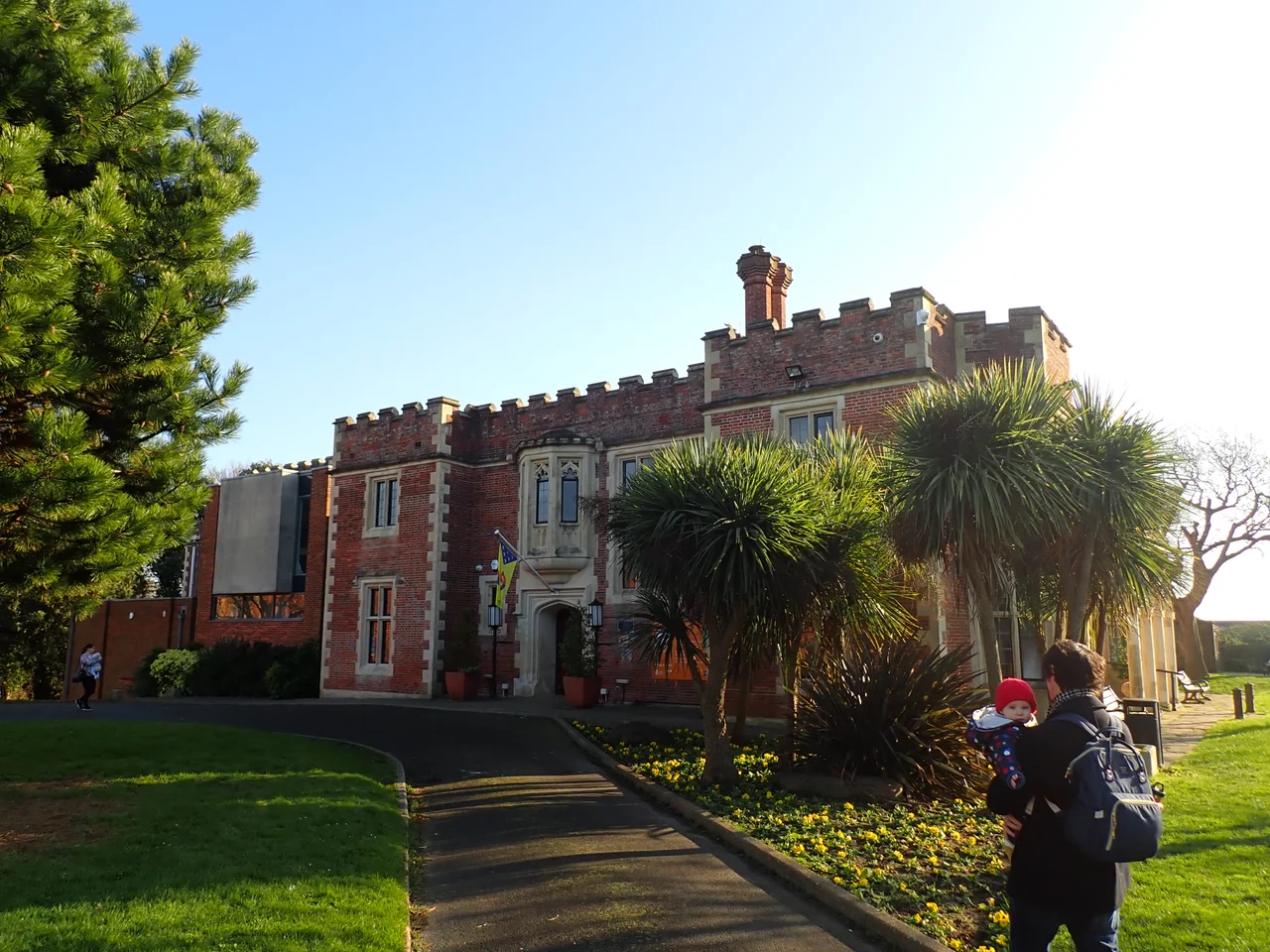

Hastings Museum and Art Gallery
An entire room of an Indian palace sits inside a red-brick house on the Sussex coast. Carved by two woodcarvers brought from the Punjab for the 1886 Colonial and Indian Exhibition in London, the Durbar Hall was meant to be the Prince of Wales's reception pavilion for a single summer. Instead it travelled to Park Lane, then to storage, then to Hastings, where since the 1930s it has hosted weddings, theatre and toddler groups beneath its intricate latticework. The Durbar Hall is only the most theatrical exhibit at Hastings Museum and Art Gallery, a town museum founded in 1892 that quietly houses around 97,000 objects from prehistoric flints to a watercolour by JMW Turner.
John's Place
The museum has lived in two homes. From 1892 until 1927 it sat in the Brassey Institute, an Italianate Victorian pile now serving as the town library. Then it moved up the hill to John's Place, a private house designed in 1923 from red brick with sandstone dressings, a crenelated roofline, columned loggia, oriel window and studded oak doors. Hastings Corporation bought it in 1928 and reopened it as a museum. The house never quite lost its domestic feel, and that is part of its charm: visitors move between dinosaur fossils, Sussex pottery and Native American beadwork in rooms that still feel scaled for human conversation. A 2006-7 refurbishment funded by the Heritage Lottery Fund expanded the floor space by forty per cent, but the building still wears its 1920s eccentricities openly.
A Punjab Palace, Reassembled
Caspar Purdon Clarke designed the Durbar Hall for the 1886 exhibition, but the carving was done on the spot by Mohammed Baksh and Mohammed Juma, two craftsmen brought specially from the Punjab. When the exhibition closed, Thomas Brassey, 1st Earl Brassey, bought parts of the Indian Court and remounted them as an extension to his Park Lane home. In 1919 his son donated the lot to Hastings, where it sat in crates until the 1930s before being reconstructed to match its Brassey-era London arrangement. Today the lower hall hosts civil partnerships and folk concerts while the upper hall serves as a world cultures gallery. There are few comparable spaces in any English town museum, and certainly none quite so improbably situated above the English Channel.
The Boy Who Became Grey Owl
Archibald Belaney was born in Hastings in 1888 and grew up there reading frontier adventure books. He moved to Canada as a teenager, took on the name Grey Owl, and presented himself for decades as a half-Apache, half-Scottish woodsman; only after his death in 1938 was his English birth confirmed. The museum holds a substantial collection relating to his life, and treats the story honestly: he was an Englishman who chose to live as an Indigenous person, and his lectures and books on beaver conservation in the 1930s genuinely helped shift British and Canadian attitudes toward protecting wildlife. The Plains and Subarctic galleries surrounding the Belaney material include the Blackmore Collection and Colin Taylor's high-quality Subarctic pieces, exhibited as the cultural property of First Nations rather than as curiosities.
Lady Brassey's World
Anna Brassey crossed oceans for fun. Between 1870 and her death at sea in 1887, she sailed the family yacht *Sunbeam* around the world, collecting objects, photographing what she saw and publishing accounts that became Victorian bestsellers. Her personal museum was donated to Hastings in 1919, and forms the largest single block of the town's world cultures collection. Most of her objects come from the Pacific and Melanesia, regions she returned to repeatedly. Hastings's ethnographic holdings now include material from India, Burma, China, Japan, Indonesia, the Middle East, the Balkans, Africa, Australia, New Zealand and the Americas. It is more diverse than a town museum of this size has any right to be, and the building's domestic scale keeps it from feeling overwhelming.
Local Things
Most museum visitors come for the local material, and Hastings has it in depth. Mesolithic flints excavated at Hastings Country Park sit alongside Saxon coins from Sussex mints, including Hastings itself. The numismatics holdings include over 700 hop tokens used in the local fields each picking season. The fine art collection is largely topographical paintings of Hastings and its surroundings from the late 18th century onward, including Turner's *Fishmarket on the Sands, Early Morning* of 1824. Archives held here cover the John Logie Baird papers, Robert Tressell material, Charles Dawson's correspondence and documents on the Cinque Ports, smuggling, and the fishing trade. During the COVID lockdown the museum invited more than 120 local people to keep daily diaries, and supported four Black and ethnic minority creatives to respond to the murder of George Floyd. A town museum, in other words, still doing the work of representing its town.
From the Air
Hastings Museum and Art Gallery sits at approximately 50.86 degrees north, 0.57 degrees east, on the heights above the seafront in Hastings, East Sussex. The town occupies a narrow valley between two steep promontories - the East and West Hills - on the south coast of England, about 50 miles southeast of London Gatwick (EGKK). Lydd Airport (EGMD) is roughly 18 miles east. From altitude, look for the long shingle beach, the surviving Hastings Pier reaching into the Channel, and the dense cluster of the Old Town pushing back into its valley.
Nearby Stories
- Battle of Lewes 1.5 km away
- Staplehurst rail crash 4.1 km away
- Canterbury Castle 14 km away
- The Carrington Event: The Solar Storm That Could Happen Again 15 km away
- Shorncliffe Redoubt 21 km away
- Le Paradis Massacre 113 km away
- Swanage Lifeboat Station 137 km away
- Cléon 150 km away