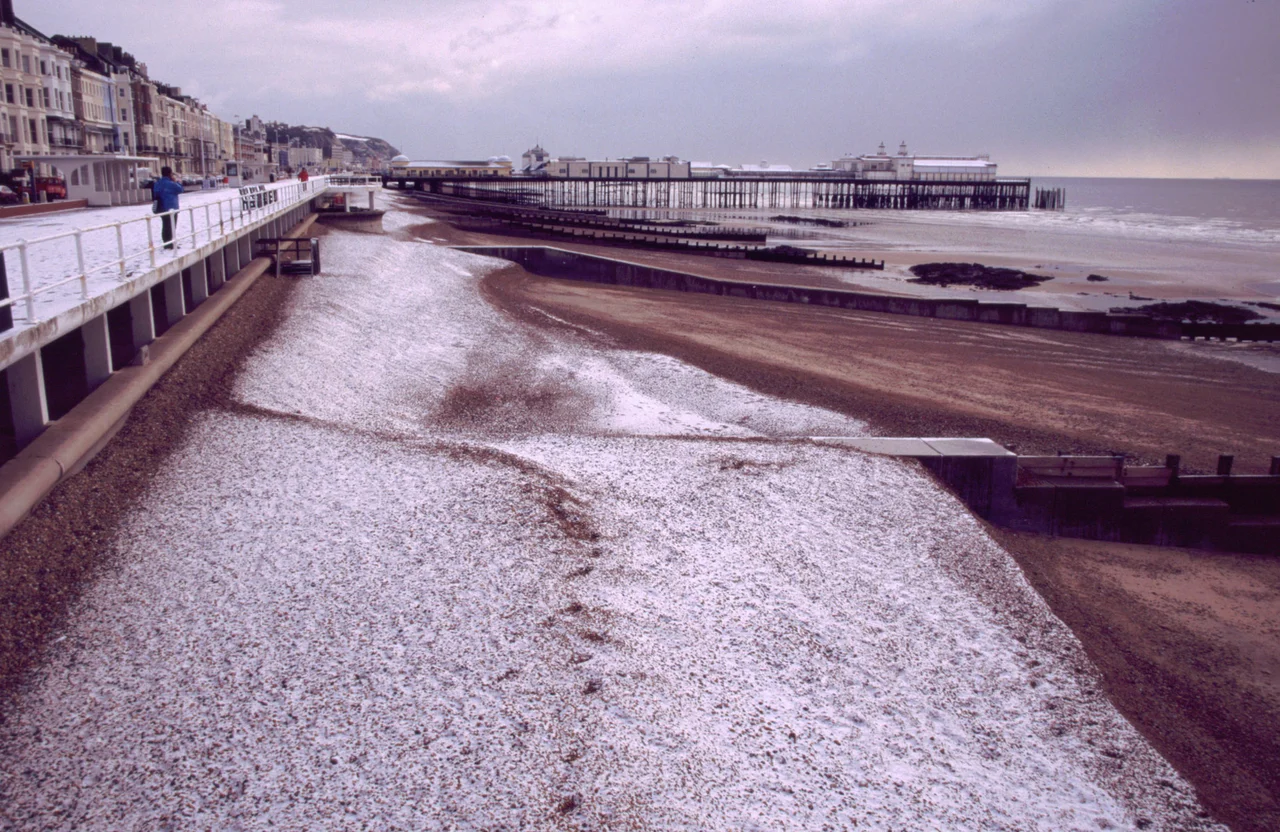

Hastings Pier
On 20 January 1968, Syd Barrett played his last show with Pink Floyd on the seaward end of Hastings Pier. By then his bandmates had already brought David Gilmour in to cover the parts Barrett could no longer manage. Two weeks later, Barrett was out of the band. The pier had hosted Hendrix, the Rolling Stones, the Who and Tom Jones; it would soon host nobody. Storm damage, neglect, an offshore owner, a court closure and finally, in the small hours of 5 October 2010, a fire that consumed ninety-five per cent of the superstructure. What is striking about Hastings Pier is not that it nearly died. It is that a town fought to bring it back, and won the Stirling Prize for the result.
A Pier Built for the Railway Age
Hastings Pier opened in 1872, designed to attract the day-trippers and convalescents being delivered by the new Brighton and South Coast Railway. Its first pavilion seated 2,000 and burned down in 1917; a replacement followed in 1922. Closed during the Second World War to prevent its use as an enemy landing stage, it suffered minor bomb damage and reopened in 1946. The 1930s were the pier's prime, with an art deco facelift and a rebuilt theatre, and 1966 brought a particular flourish: the Hastings Embroidery, a 70-metre tapestry made to mark the 900th anniversary of the Battle of Hastings, was displayed in a temporary white-domed structure on the pier. Grade II listing followed in 1976.
Where Floyd Played and Hendrix Followed
Through the 1960s and 1970s the pavilion was a regional music hub. Jimi Hendrix, the Rolling Stones, the Who, Genesis, Tom Jones, Ten Years After and Pink Floyd all played here. Barrett's 1968 farewell with Floyd has become the line most often quoted, but the venue mattered for the whole circuit: a south-coast Saturday night out, the sea below the floorboards, the pavilion full of cigarette smoke and amplifiers. After the boom faded, the structure changed hands repeatedly and care declined. In 1990 a storm cost a million pounds in repairs. By 1996, when the pier went on the market, structural engineers were warning that potential buyers would need to fund a fundamental rebuild of the supports.
Closed, Then Burning
Ownership had drifted offshore to a company called Ravenclaw Investments by 2004. In July 2006 Hastings Borough Council, finding parts of the structure unsafe, closed the pier. A tenant, Stylus Sports, eventually paid for 300,000 pounds of repairs and the pier reopened in July 2007. It would not last long. By March 2008 the *Hastings Observer* was reporting that two support columns were close to collapse; later that year the last major tenant left and the pier closed for good. Then, at around 01:00 BST on Tuesday 5 October 2010, fire took hold. The crews arrived quickly but the wooden buildings burned fiercely. By morning the seaward pavilion was gone and ninety-five per cent of the superstructure was destroyed. Two people were arrested on suspicion of arson; no charges were ever brought.
The People's Pier
The Hastings Pier and White Rock Trust had been campaigning since before the fire, marching on 17 October 2009 to save what was then 'one good storm away from collapse'. The fire changed the conversation. English Heritage confirmed the surviving substructure retained its heritage value. A Heritage Lottery Fund application for 8.75 million pounds was submitted at the end of November 2010, with a Stage 1 grant of 357,400 pounds released the following May. A community share offer raised the matching million. The borough council pushed through a compulsory purchase order. The London architectural practice dRMM designed the rebuild around a deliberately stripped, open deck rather than a Victorian recreation - the point being to give the town back its space, not to reproduce its ghost.
Stirling Prize, Then Trouble Again
The reopened pier welcomed visitors on 27 April 2016. Six hundred guests sat down to lunch on the deck. Pier of the Year followed in 2017, and the 2017 Stirling Prize - the UK's most prestigious architecture award - went to dRMM for the project. Then in November 2017 the operating charity went into administration. On 15 June 2018 the pier was bought by local businessman Abid Gulzar, who also owns Eastbourne Pier; it reopened that July, closed in December, reopened in April 2019, and has navigated an uneven recent run. The pier remains a working public space, but its story is a reminder that piers are extraordinary things to maintain - 280 metres of timber and steel standing in salt water, on a stretch of coast where the weather does what it wants.
From the Air
Hastings Pier extends from the seafront at approximately 50.85 degrees north, 0.57 degrees east, on the south coast of England. The pier projects roughly southeast into the English Channel below the cliffs of the West Hill. From altitude, look for the long flat deck, the distinctive square pavilion on the seaward end, and the curving pebble beach. Lydd Airport (EGMD) is about 18 miles east, London Gatwick (EGKK) about 50 miles northwest. In clear conditions the pier reads as a thin pale finger against the dark Channel water.
Nearby Stories
- Battle of Lewes 1.5 km away
- Staplehurst rail crash 4.1 km away
- Canterbury Castle 14 km away
- The Carrington Event: The Solar Storm That Could Happen Again 15 km away
- Shorncliffe Redoubt 21 km away
- Le Paradis Massacre 113 km away
- Swanage Lifeboat Station 137 km away
- Cléon 150 km away