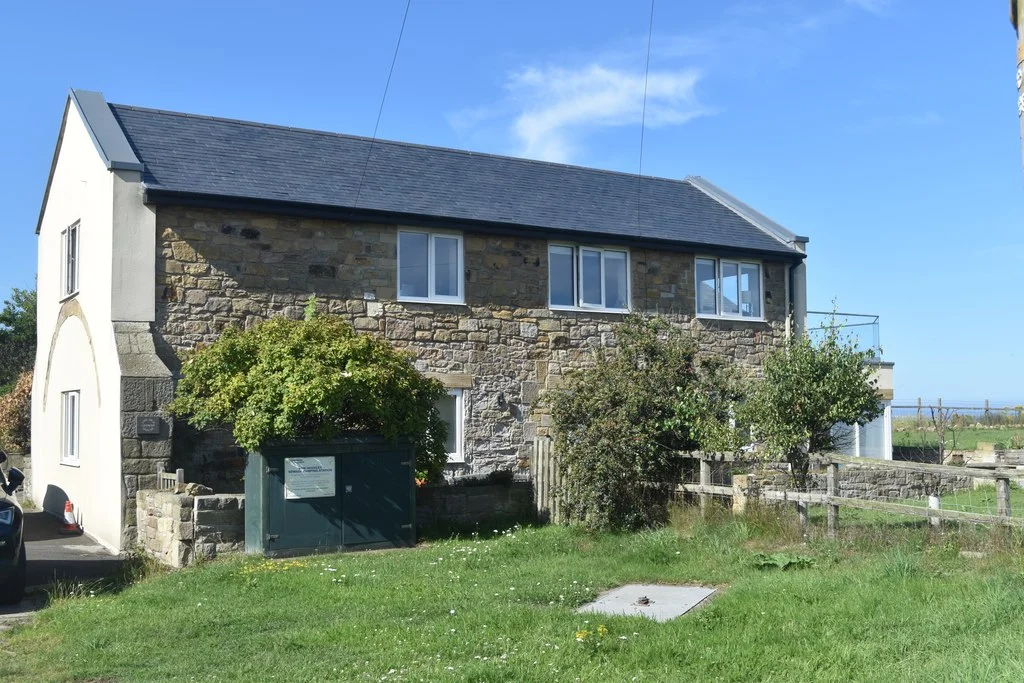

Hauxley Lifeboat Station
Between 6 January and 10 January 1854, the lifeboat Warkworth launched four times into a single storm. On 6 January she pulled all ten men from the Monarch of Guernsey, then turned around and saved six more from the Earl of Newburgh later that same day. On 9 January she rescued four crew from the Heroine of Burnham. On 10 January she launched for the Catherine Maria of Odense - and got there too late. The ship broke up. All hands were lost. Twenty saved, an unknown number of lives unable to be reached: in five days, the new Hauxley lifeboat had proved both the urgency of the work and its limits.
A Duke Pays for a Boat
The Warkworth Harbour lifeboat had originally been stationed at Amble. By 1852 it was clear that Low Hauxley, a couple of miles south, was a better site - the beach offered easier launching than carriage-launches at Amble. The Newcastle Shipwreck Association established the new station that year. Captain S. F. Widdrington provided the site. The boat itself, a 30-foot self-righting lifeboat costing £200, was built by Teasdel of Great Yarmouth and paid for by Algernon Percy, the 4th Duke of Northumberland. The launching carriage, built by Rutherford for £49-11s-0d, was likewise the Duke's gift. The Duke was no incidental patron. He served as president of both the original RNIPLS and, after 1854, the renamed Royal National Lifeboat Institution. When his memorial boat would later need replacement, his widow paid.
The Five-Day Storm
The Warkworth was new when the storm of January 1854 hit. The lifeboat had been at Hauxley barely four months. She launched on 6 January to the Monarch of Guernsey, which had run into trouble close to shore, and brought back her crew of ten. The same day she went out again for the Earl of Newburgh of South Shields and saved six more. The weather did not relent. On 9 January she went out for the Heroine of Burnham and pulled four men from the wreck. The following day she launched for the Danish ship Catherine Maria of Odense. She arrived as the ship broke apart. No one survived. Awards were made afterward; the official tally noted twenty lives saved in five days, with the loss on the Catherine Maria recorded separately. It was a fierce introduction for a new station.
Replacements and Routine
Hauxley's second boat arrived in 1855, an unnamed 30-foot Peake self-righting lifeboat built by Forrestt of Limehouse, transported by the steamship Pioneer to Newcastle and towed north. On 4 January 1857 she launched twice from a position three miles down the coast - first to the Sophie of Oporto, saving eleven, then to the Georgina of Inverness, saving five more. Captain Hipplewhite received an RNLI Silver Medal. In 1865 a third boat, the 34-foot Algernon and Eleanor, was funded by Eleanor Percy, Duchess of Northumberland, in memory of her recently deceased husband. The Great Northern and North Eastern railways carried her north free of charge. Two further boats followed: a 37-foot self-righting in 1888 and the Dungeness-class Mary Andrew in 1902, which served until 1939.
The End at Hauxley
Motor power finished Hauxley as a lifeboat station. The boathouse and beach launching system that had worked perfectly for oared and sailed lifeboats could not handle a motorised vessel. In 1939 the RNLI placed a motor-powered lifeboat at Amble - the same Amble whose station had closed 87 years earlier to make room for Hauxley. Hauxley closed in turn. The Brown family at Cresswell, just down the coast, continued their generations of service for another five years. The boathouse at Hauxley fell silent, the launching tracks rusted into the beach. The 4th Duke of Northumberland's memorial boat is long gone, but the work moved a few miles north, where Amble still keeps a Shannon-class all-weather lifeboat on station today.
From the Air
Located at 55.32°N, 1.55°W in Low Hauxley village, just south of Amble on the north Northumberland coast. Nearest commercial airport is Newcastle (EGNT) about 27 nm south. The former station site sits at the north end of Druridge Bay. Hauxley Nature Reserve, run by Northumberland Wildlife Trust, occupies former colliery land just inland. Bondicar Rocks lie just offshore - the same rocks that wrecked the Empire Breeze in 1941. Best viewed VFR at 1,500-2,500 ft with the seven-mile sweep of Druridge Bay extending south.
Nearby Stories
- Beadnell 3.5 km away
- Great North Museum: Hancock 4.8 km away
- Battle of Otterburn 7.5 km away
- Battle of Flodden 10 km away
- Housesteads Roman Fort 14 km away
- Saltburn Pier 49 km away
- German submarine U-2367 74 km away
- Alexander L. Kielland (Platform) 278 km away