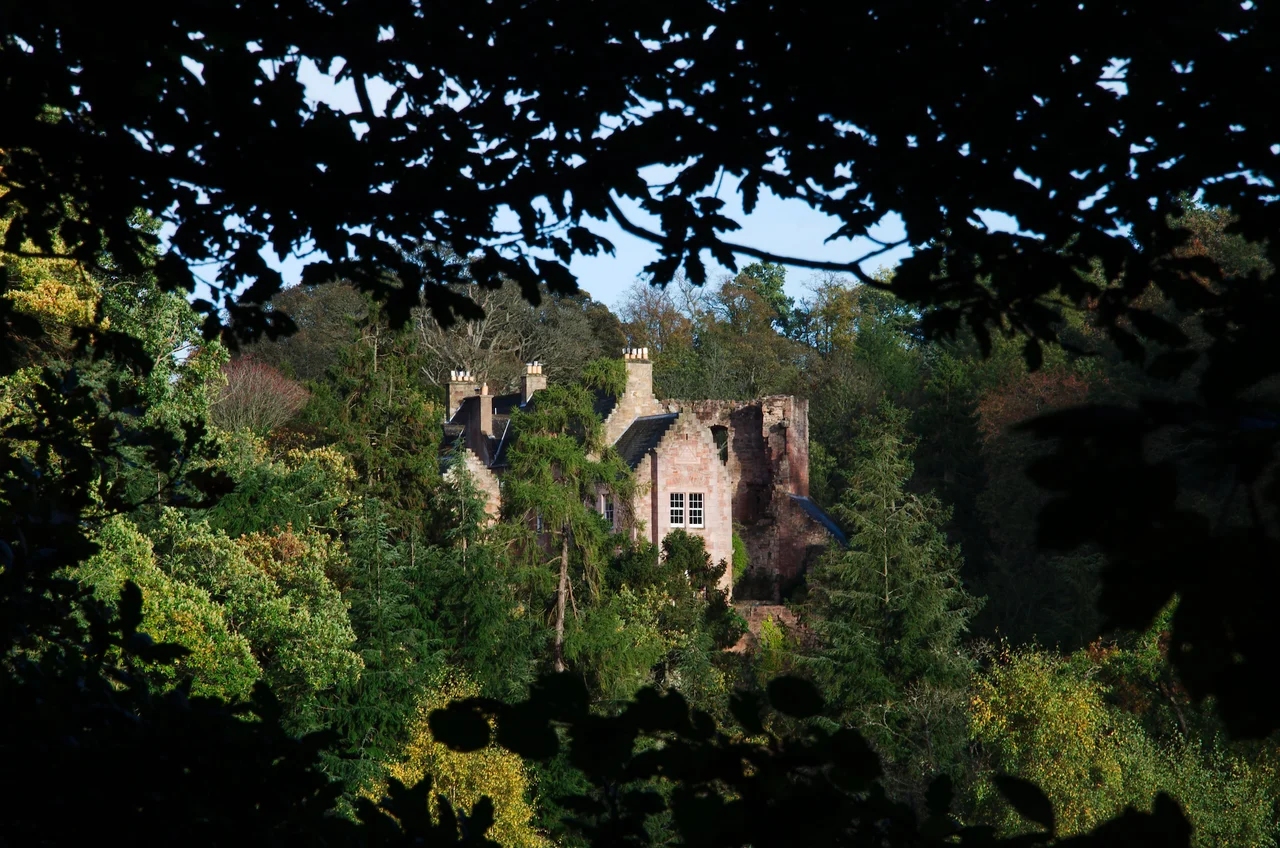

Hawthornden Castle
In the autumn of 1618, Ben Jonson walked four hundred miles north from London to drink with a Scottish poet on a cliff above the River North Esk. The host was Sir William Drummond. The setting was Hawthornden, a 15th-century tower clinging to a rocky promontory in Midlothian, with man-made caves carved into the sandstone beneath it. Jonson stayed for weeks. Drummond took notes on the conversations, and those notes survive as some of the only first-person impressions we have of England's swaggering poet laureate. Four centuries later, writers still come to Hawthornden to vanish into silence, and the caves below still hold their secrets.
The Tower on the Promontory
Hawthornden's oldest stones date from the 15th century, when the Abernethy family - lords here since the 13th century - built a three-storey tower at the southeast corner of a triangular courtyard. The site itself does the defensive work: the North Esk wraps a rocky bluff on three sides, leaving only one approach to fortify. Beneath the tower is a rib-vaulted pit prison, a reminder that medieval Scottish lordship was not always neighborly. The castle changed hands more than once. The Douglases acquired it in the 14th century. The Earl of Hertford sacked it twice during the Rough Wooing of 1544 and 1547 - Henry VIII's brutal campaign to force the betrothal of his son to the infant Mary, Queen of Scots, by burning everything the Scots loved until they relented. The Scots did not relent.
The Poet and the Caves
Sir William Drummond of Hawthornden was born in the castle in 1585 and made it the heart of his literary world. He added the L-plan north range dated 1638 - a renaissance-style doorway, an iron knocker with his son's initials, gunports flanking the entrance for politeness's sake. He wrote elegies and madrigals, corresponded with the best minds in Britain, and famously transcribed his conversations with Jonson during that long visit of 1618-19. The conversations reveal Jonson as bombastic, opinionated, and astonishingly indiscreet about his peers. Drummond preserved it all, deadpan. Beneath the castle, man-made caves honeycomb the cliff. One contains a doocot with 370 pigeon compartments, a precision medieval larder. Tradition holds that Robert the Bruce sheltered in another. A third is still called Wallace's Cave, after William Wallace himself. Whether the legends are true matters less than the fact that the rocks have hidden Scots since long before anyone thought to build a castle on top.
The Heinz Years and the Silent Room
In the 20th century Hawthornden passed through unlikely hands. The last Drummond left it to his butler. Then it went to an Edinburgh antiques dealer, Douglas Adamson, who opened it to the public. After Adamson's death, it was bought in 1982 by Drue Heinz, the New York-born widow of H. J. Heinz II - yes, of the ketchup empire. Heinz was a patron of literature, and she conceived a different fate for the castle: she made it a retreat where writers could disappear. The Hawthornden Literary Retreat enforces strict silence during working hours. Architects Simpson and Brown carried out the restoration, even sourcing reclaimed stone from Edinburgh's demolished Princes Street railway station to patch the walls. Today novelists and poets receive fellowships to live here in monastic quiet, look out at the same glen Jonson and Drummond saw, and write. The castle and its caves are Category A listed - the highest grade of Scottish historic protection.
Roslin's Quieter Neighbor
Hawthornden sits a mile downstream from Roslin Castle, with which it shares both a river and a watershed of legend. Roslin gets the fame - Rosslyn Chapel and Dan Brown's tourists - but Hawthornden has always been the quieter literary cousin. Approaching by foot through Roslin Glen, the castle appears as a layered architectural diary: ruined medieval tower at one end, harled 17th-century range at the other, a single-storey western addition from the early 19th century. The arms of the Abernethy family were re-installed above a door in 1795 by William Abernethy Drummond, Bishop of Edinburgh, who also added a memorial to his ancestors. Each generation left its mark and then handed the building on. The North Esk keeps cutting deeper into the gorge, indifferent.
From the Air
Hawthornden Castle sits at 55.861 degrees N, 3.142 degrees W, perched above the River North Esk in Midlothian. Edinburgh Airport (EGPH) lies roughly 10 nautical miles to the north-northwest. The castle is just downstream from Roslin Castle and Rosslyn Chapel, which together form a compact heritage cluster visible at low cruising altitudes. Best viewed from 2,000-4,000 ft AGL in clear weather; the surrounding Roslin Glen is heavily wooded, so the silver-grey roof of the restored north range is the easiest landmark from the air.
Nearby Stories
- Burngrange Mining Disaster 5.9 km away
- Battle of Philiphaugh 6.5 km away
- Ravenscraig Castle 11 km away
- Crawford Castle 12 km away
- Battle of Nesbit Moor (1402) 12 km away
- Battle of Dollar 14 km away
- College Valley 18 km away
- HMS Pathfinder (1904) 19 km away