
Hengoed Viaduct
Thomas Kennard had already lost the contract to build the Hengoed Viaduct in iron - the chief engineer Charles Liddell had decided that here, unlike at the windswept Ebbw valley four miles east, the local stone was good enough and the wind tame enough for masonry. So the young Scottish engineer took the next-best prize: design the stone bridge instead. Kennard set sixteen arches across the Rhymney valley at Maesycwmmer, 120 feet at its tallest point, 284 yards from end to end. It opened in 1858 with a passenger train picking up coal from the Rhymney pits. It closed in 1964 with a Beeching axe blow. After 1964 the railway company offered the entire viaduct for sale at a nominal sum of one pound - and nobody bought it.
The Coal Owners' Revolt
The viaduct was built to break a monopoly. By the 1840s the Taff Vale Railway controlled the only practical route to ship coal down to Cardiff Docks, and the mine owners of the South Wales valleys had had enough of its rates and its delays. The London and North Western Railway, ambitious to reach the productive Rhondda and Rhymney coalfields, saw an opportunity. By controlling the Llanfihangel and Grosmont railways and the Shrewsbury and Hereford line, it already had a corridor from the industrial Midlands as far as Pontypool. What it needed was a westward connection across the Welsh valleys to break the TVR's stranglehold. Parliament approved the Taff Vale Extension on 3 August 1846. The LNWR merged three small companies into the new Newport, Abergavenny and Hereford Railway, raised the capital, and put Charles Liddell in charge of the engineering. Liddell had two valleys to cross. The first, the Ebbw at Crumlin, would be Britain's tallest iron viaduct. The second, four miles further west across the Rhymney, would be Hengoed.
Stone Where Iron Would Not Do
Crumlin and Hengoed are only four miles apart on the map, but they posed different problems. At Crumlin the valley pinched between steep cliffs and funnelled the wind so fiercely that a thick stone bridge would have been a hazard - the wind compressing around its piers could blow a train off the rails. So Liddell specified iron lattice work for Crumlin, slender pylons that the wind could pass through. At Maesycwmmer the valley was kinder. The hillsides sloped away gently, the wind dispersed, and good Pennant sandstone could be quarried from a few miles up the road. Stone it would be. Kennard designed the structure to do more than cross the river. The first arch had to skew over the Brecon and Merthyr Railway's Hengoed station; the line then needed to curve gently across the valley to form a junction with that railway on the far side, before plunging into the 398-yard Bryn Tunnel. Sixteen arches, slightly curved at one end, costing 20,000 pounds in 1858 money - equivalent to over a million in modern terms. One man died building it.
A Single Line, a Final Train
The viaduct opened in 1858 as a double track. Five years later the Great Western Railway absorbed the line through the 1863 amalgamation with the West Midland Railway. The Welsh valleys produced through the great years - the 1880s, the 1890s, the years before the First World War when more coal moved through south Wales than through any other coalfield on earth. By 1928 the trade had thinned enough that the Taff Vale Extension was downgraded to a single track. The pits closed one by one. The last passenger train crossed Hengoed Viaduct on 15 June 1964, in the wave of closures known as the Beeching cuts, named after the British Railways chairman whose 1963 report identified the lines that no longer paid their way. The tracks came up later that year. The viaduct stood empty above an empty valley. British Rail tried to sell it for a pound - it was an asset they no longer wanted - and there were no takers.
A Lottery, a Path, a Wheel
For thirty-six years the viaduct stood unused above Maesycwmmer, slowly weathering. Then in 2000 the structure was opened for public access, repurposed for National Cycle Route 47 as part of the Sustrans network that turned redundant railway lines into greenways. In April 2004 the Heritage Lottery Fund granted Caerphilly council 870,000 pounds for a programme of restoration: repointing the pier bases, fixing the parapets, patching the arches, repairing the remains of the old Hengoed High Level Station at the western end. New lighting went up. Fencing and viewing platforms followed. The viaduct, Grade II* listed, became one of the most photographed structures in the South Wales valleys.
The Stargate
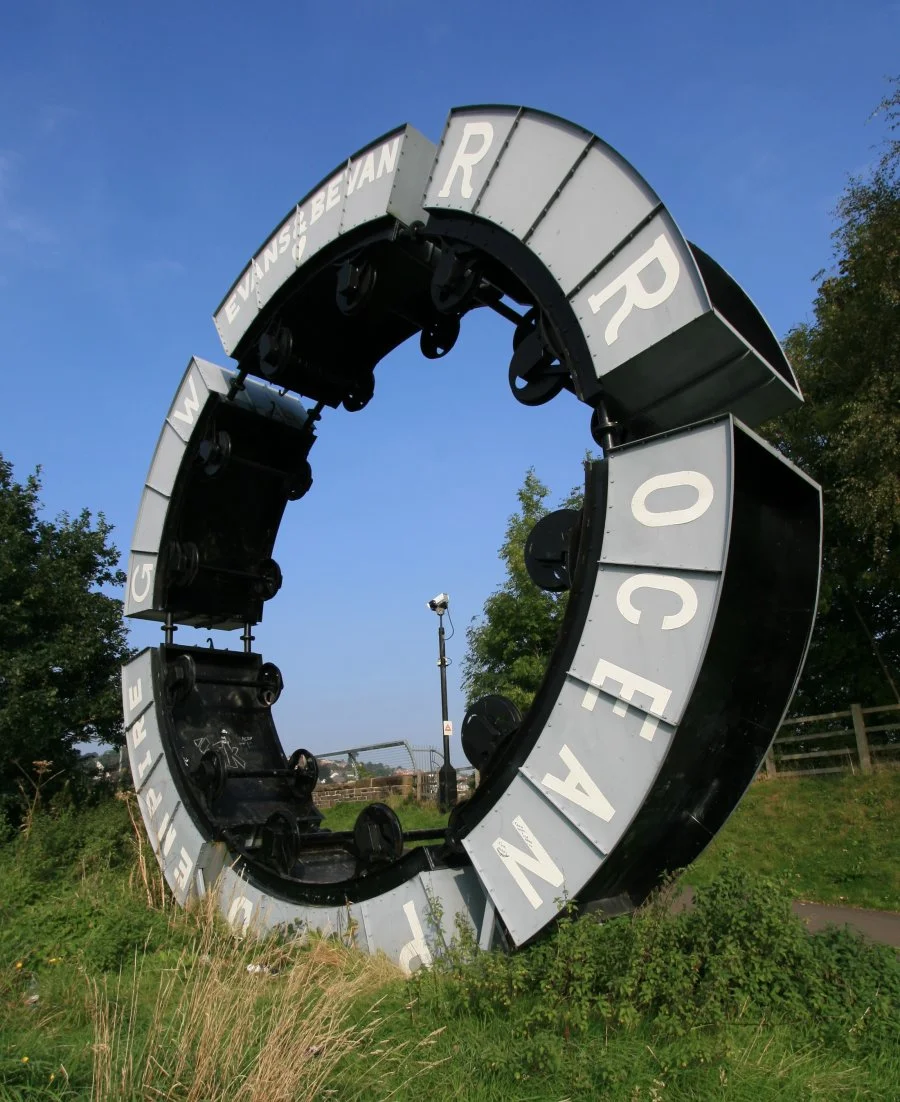
At one end of the refurbished viaduct, artist Andy Hazell installed a sculpture called Wheel o Drams. The drams were the small four-wheeled wagons that miners used to push coal along the underground roadways, and Hazell's piece is a great steel circle of these dram-wagons rising above the path, lit at night, framing the sky. The locals immediately christened it the Stargate. Cyclists pause beside it; walkers stop to read the plaque. The valley below holds the remains of a hundred and fifty years of coal: the slag heaps tidied into hillsides, the railway beds turned to footpaths, the river running clearer than it has in a century. Sixteen arches still stride across all of it. Thomas Kennard, who lost at Crumlin and won at Hengoed, died in 1893. His other bridge fell down in 1965, hit by a runaway barge. His Hengoed viaduct, almost 170 years on, looks as if it might stand for ever.
From the Air
Hengoed Viaduct sits at 51.64682 degrees north, 3.22367 degrees west, spanning the Rhymney River between Hengoed and Maesycwmmer in Caerphilly county borough. The structure is best seen from low-altitude visual flight in clear conditions - sixteen stone arches, 284 yards long and up to 120 feet tall, with the distinctive Wheel o Drams sculpture at the western abutment. Cardiff Airport (EGFF) lies about 13 nautical miles south-southwest; Bristol (EGGD) lies about 28 nautical miles east-southeast across the Bristol Channel. The viaduct is closed to motor traffic but open as a foot and cycle path on National Cycle Route 47.
Nearby Stories
- Tidal Lagoon Swansea Bay 2.6 km away
- Skenfrith Castle 3 km away
- Caerwent 3.7 km away
- Brecon Beacons National Park 5.2 km away
- Cheddar Gorge 6 km away
- Battle of Cadfan 9.3 km away
- Minehead Lifeboat Station 16 km away
- Ilfracombe Lifeboat Station 22 km away