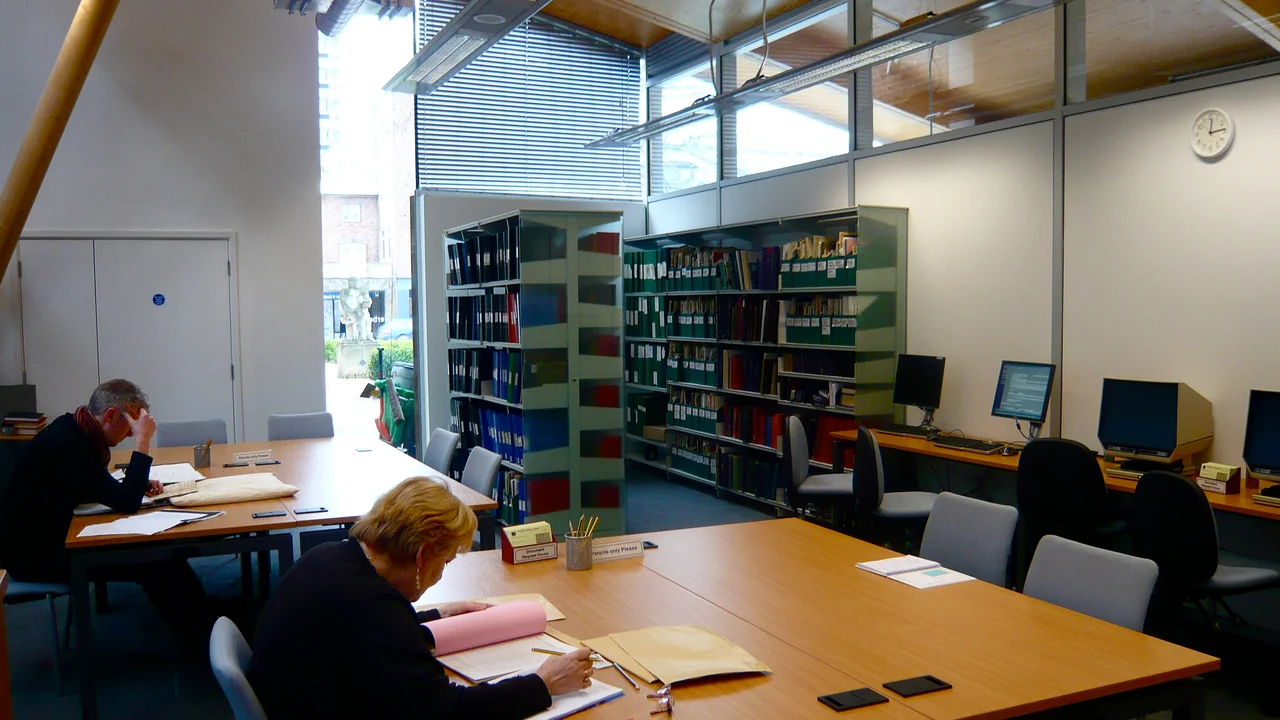

Herbert Art Gallery and Museum
The basement was the only part finished when the bombs came. The Herbert Art Gallery and Museum had broken ground on Jordan Well in 1939, with £100,000 from Sir Alfred Herbert, the machine-tool manufacturer whose Coventry-based firm armed factories across the Empire. Then Germany invaded Poland, and Alfred Herbert's machine-tool industry pivoted instantly to war production. The Coventry Blitz of November 1940 levelled the surrounding city centre. The Herbert site was abandoned mid-build for the duration. When peace came, post-war austerity diverted civic budgets to housing in the suburbs. The foundation stone Sir Alfred wanted to see was not laid until 1954, when he was 87, and he donated another £100,000 to push the building over the line. He died in 1957. The museum named for him opened in 1960, three years too late for its founder to walk through the doors.
The Industrialist's Gift
Sir Alfred Herbert, born in 1866, built up the Alfred Herbert Limited engineering firm into the largest machine-tool company in the British Empire by the First World War. The Coventry industrial complex he helped create was at its peak in the 1930s, and so was the gap between his city's wealth and its civic culture. Coventry had no dedicated municipal art gallery. Its collection of art treasures was scattered across various buildings, including the museum of the medieval Coventry City Guild and the Benedictine Museum that J.B. Shelton had opened in the 1930s. In 1938 Sir Alfred gave £100,000 to the corporation to build a proper home for it. The plans were drawn up by his cousin, Leicester architect Albert Herbert. Building began in 1939. By the time the bombing started a year later, the foundations and the basement walls were all there was to bomb.
Built After the City Was Rebuilt
Coventry's reconstruction had a particular shape, drawn first by City Architect Donald Gibson during the war itself. Gibson's plans became wartime propaganda; the BBC and the Ministry of Information held them up as a vision of what Britain could become after victory. The reality of post-war finances forced him to start with suburban housing first. The Herbert's site sat boarded up beside the cathedral ruins through the 1940s and into the 1950s. New plans were drawn in 1952. Sir Alfred laid the foundation stone in 1954 and provided the additional money. The first phase opened in 1960. The building was a long, low, modernist gallery in the architectural language Gibson had imposed on the city centre, set back from the medieval streets but acknowledging them. In 2008 a £14 million second phase added a new Bayley Lane entrance and a 500 square metre glass-covered court.
Godiva, Watercolours, Shakespeare's Ring
The collection is what a regional civic museum should be: rooted in its place and ambitious enough to reach beyond it. The permanent galleries include Sculpture, Old Masters, Art Since 1900, Godiva, Social and Industrial History, and Elements covering natural history. The Godiva gallery centres on John Collier's 1897 oil painting of the legendary ride, perhaps the single most reproduced image of the city, showing the long-haired countess on her horse against the empty streets. The costume collection from around 1800 includes ribbon-weaving samples from the Coventry industry that once employed thousands of weavers in the nearby suburb of Chapelfields. Shakespeare's ring, displayed in 2010 alongside a sixteenth-century tapestry and other Warwickshire artefacts, drew over a thousand people in a single day. The Coventry Album, a collection of paintings made of the city in 1819 by William Henry Brooke, was acquired through a public fundraising campaign in 2011.
Free, Open, Adapting
The Herbert is free, which still matters in a country where most national museums charge nothing and most regional ones charge. In 2010 the museum and gallery received over 300,000 visitors, won the Guardian Family Friendly Award, and was shortlisted for the Art Fund Prize. The temporary exhibitions programme has brought in shows from the British Museum, the Victoria and Albert, the Southbank Centre, and the Natural History Museum. In 2009 the Herbert hosted fifty watercolours by Turner and Rossetti. In 2018 it ran ARTIST ROOMS: Anselm Kiefer, the major travelling exhibition of the German post-war painter whose work picks through the buried strata of national memory, themes that resonate particularly in a city whose own buried strata were exposed in 1940. The 2018 PLAY exhibition, built in collaboration with the Twycross-based video game studio Rare, dropped visitors into a fad wall and the history of British video games. The Herbert is part of Culture Coventry, the charitable trust that also runs the Coventry Transport Museum, the Old Grammar School, and the Lunt Roman Fort at Baginton.
From the Air
Located at 52.4072°N, 1.5062°W on Jordan Well, immediately south of Coventry's cathedral quarter in the city centre. Best viewed from 1,000 to 1,500 feet above ground level, where the modernist gallery building forms a low rectangular complex distinct from the surrounding ring-road quadrant. Coventry Airport (EGBE) lies 3 miles to the south-east; Birmingham Airport (EGBB) is 12 miles to the west. The cathedral ruins and the new Spence cathedral stand 200 metres to the north.
Nearby Stories
- Round Oak Steelworks 1.7 km away
- RAF Gaydon 6.6 km away
- Ashby-de-la-Zouch 7.3 km away
- Battle of Naseby 7.3 km away
- Stafford Castle 7.5 km away
- Siege of Worcester (1646) 7.8 km away
- Asfordby Colliery 9.7 km away
- Silverstone Circuit 15 km away