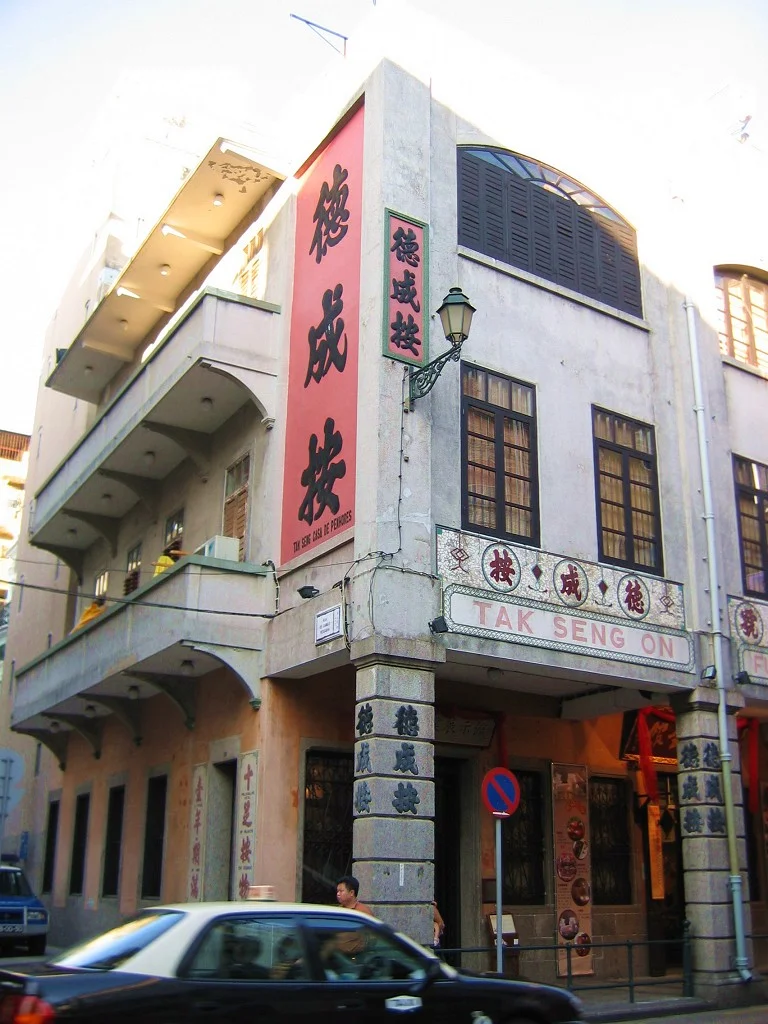

Heritage Exhibition of a Traditional Pawnshop Business
Pawnbroking is an economy of desperation and practicality, and for much of the 20th century Macau had no shortage of both. In 1917, Kou Ho Neng and Wong Hung Shan established the Virtue and Success Pawnshop — Tak Seng On — in the Sé district, a name that carried both commercial ambition and a quiet acknowledgment of what the business actually provided: temporary relief for families who had run out of other options. The building they constructed to house that transaction is still standing, and what it contains now tells a different kind of story.
The Architecture of Collateral
Pawnshop buildings in early 20th-century Macau and southern China were designed with a specific logic. The front block — three stories of public-facing commercial space — handled the transactions: the counter where customers presented their goods, the clerks who assessed value, the receipts that represented the hope of redemption. Behind it rose a seven-story storehouse, deliberately tall and deliberately secure, where pledged items were held until redeemed or forfeited. The height was not aesthetic; it was practical. A tall, narrow storehouse was harder to rob and easier to defend. The Tak Seng On building follows this two-block formula precisely, and its architecture is a physical record of how pawnbroking organized itself as a profession — calculating risk in every wall and floor.
The Long Decline and the Decision to Remember
The shop operated for 76 years before closing in 1993, a casualty of the same economic transformation that had rendered pawnshops increasingly marginal across East Asia. Rising incomes, accessible banking, and changing social attitudes toward debt had hollowed out the industry, leaving behind buildings that no longer served their original purpose. The Secretariat for Social Affairs and Culture made a different calculation: rather than allow the building to be repurposed or demolished, it restored the structure to its original design. When the Heritage Exhibition of a Traditional Pawnshop Business opened to the public on 21 March 2003, it had been returned to something close to its 1917 appearance — counters, storehouse, and the physical mechanics of the pawn transaction preserved for a generation with no lived memory of needing them.
Recognition Beyond Macau
Heritage preservation rarely travels far from the city it happens in, but this building received international notice. In 2004, UNESCO awarded the exhibition an Honorable Mention in the Asia-Pacific Awards for the Conservation of Cultural Heritage — recognition that the project had achieved something beyond simple restoration, that it had preserved not just a building but an understanding of how ordinary economic life worked for ordinary people. Six years later, Shanghai World Expo 2010 selected it as an Urban Best Practices Area, citing its approach to integrating heritage conservation with community memory. Both recognitions point to the same quality: the museum treats pawnbroking not as a curiosity but as a serious subject, worth understanding on its own terms.
What the Storehouse Remembers
Standing inside the seven-story storehouse today, the scale of it makes the social weight of the original business tangible. Families brought jewelry, clothing, tools, furniture — anything that could be assessed and held — and received cash that covered rent, food, medical expenses, the gap between wages and survival. Many items were never redeemed. They accumulated in storage, representing the precise value of what people could not afford to lose and could not afford to keep. The museum does not sentimentalize this history, but it does not flinch from it either. The Tak Seng On was a commercial enterprise, and it was also, for thousands of Macau residents across three-quarters of a century, a place where the arithmetic of daily life was worked out in the most concrete possible terms.
From the Air
The Heritage Exhibition is located in the Sé district of the Macau Peninsula at 22.195°N, 113.538°E, within the UNESCO World Heritage buffer zone of the Historic Centre of Macau. The area is densely urban, with the Cathedral of the Nativity of Our Lady and Senado Square within walking distance. Nearest airport is Macau International (VMMC) on Taipa island, approximately 3 km to the south. At 1,500 feet approaching from the southwest, the Sé district's lower elevation and older urban fabric are visible against the casino towers to the north and east.
Nearby Stories
- 2024 Shenzhen Stabbing 0.8 km away
- Lantau Peak 1.5 km away
- Kweilin Incident 2.4 km away
- Taishan City 7 km away
- Wanshan Archipelago Campaign 38 km away
- Hong Kong 12 68 km away
- Battle of Nanpeng Island 82 km away
- Erhai Lake 1335 km away