.jpg)
High Bridge (Appomattox River)
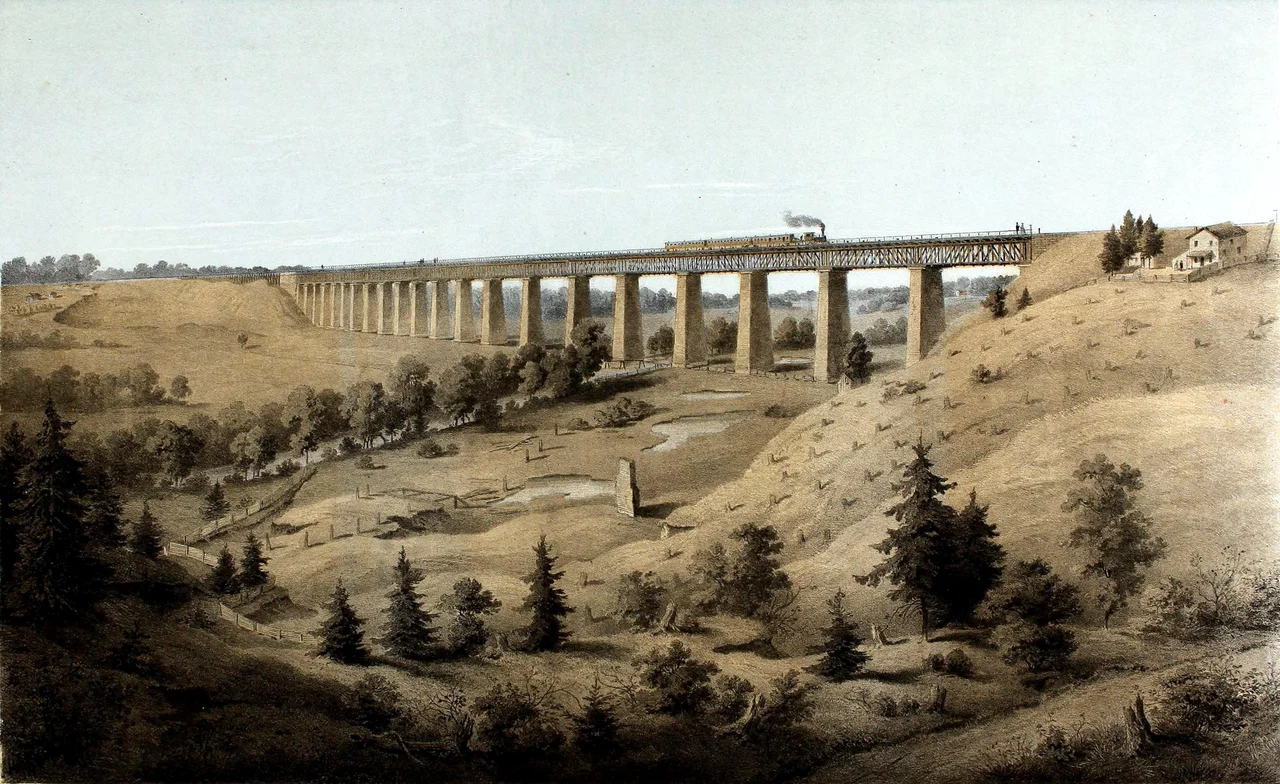
Four million bricks went into the piers. Twenty of them, each one rising more than a hundred feet from the river bottom, marching in a slow procession across the Appomattox River valley. When the High Bridge opened to trains in 1854, it was 2,400 feet long and 125 feet above the water at maximum height. Eleven years later it would become the most fought-over piece of timber in central Virginia, set on fire by men running for their lives, saved by men running after them, and rebuilt by the same Confederate engineers who had tried to destroy it.
Four Million Bricks
The Southside Railroad built it because Farmville's citizens had paid for the privilege. The original survey for the line between Petersburg and Lynchburg, completed by 1854, called for a lower-grade route bypassing Farmville to the north. Farmville's commercial interests raised the money to bring the line through town, but the route required an expensive crossing of the Appomattox River valley about six miles east of town. The result was the High Bridge. Twenty piers of locally-fired brick supported a wooden superstructure with a pedestrian walkway along the rail line. A separate lower wagon bridge crossed beneath it. The bridge was finished in 1852; the full line opened two years later. For a decade it carried freight and passengers between Petersburg and the Blue Ridge foothills.
April Sixth and Seventh
On April 6, 1865, after the catastrophe at Sailor's Creek, the Confederate survivors of Anderson's and Gordon's corps raced for High Bridge. A Union raiding force of about 800 men under General Theodore Read had been sent to burn it from the east, hoping to trap Lee's army south of the river. Confederate cavalry intercepted them at the eastern end of the bridge on the morning of April 6, killing or capturing nearly the entire Union detachment in a sharp engagement remembered as the first Battle of High Bridge. The bridge survived. The next morning, April 7, as the last Confederate units crossed northward, they set fires meant to destroy both the railroad bridge and the wagon bridge beneath it. Union II Corps troops under Francis Barlow reached the eastern bridgehead at about seven a.m. while the fires were still spreading. They saved the wagon bridge intact and prevented the complete destruction of the railroad bridge above it. That outcome let the II Corps cross and pursue, which led directly to the fight at Cumberland Church that afternoon and to the surrender at Appomattox two days later.
Mahone Rebuilds What He Tried to Burn
After the war, Robert E. Lee directed the Confederate engineers who had attempted to destroy the bridge to rebuild it. The work was overseen by William "Billy" Mahone, the former Confederate general who before the war had been the Southside Railroad's president. Twenty-one new Fink-truss spans went up on the original brick piers in 1869. A year later Mahone combined the Southside with the Norfolk and Petersburg and the Virginia and Tennessee railroads to form the Atlantic, Mississippi and Ohio, a four-hundred-mile system stretching from Norfolk to Bristol. The Panic of 1873 broke the AM&O; new owners bought it and renamed it the Norfolk and Western in 1881. The N&W replaced the Fink trusses with Pratt trusses in 1886, swapping one span at a time without ever interrupting traffic. The whole bridge was rebuilt again in 1914.
The 1989 Accident
By the late twentieth century the bridge had become a hazard as well as a landmark. On August 9, 1989, nine young people walking out on the bridge were surprised by a westbound train moving at 40 miles per hour. Five made it to safety on the east end. Three others reached a small platform on the side. One man was struck and killed by the train. A young woman fell from the trestle to the rocks below and was critically injured. Norfolk Southern agreed afterward to install fences, post warning signs, and require crews to blow whistles approaching the bridge. A lawsuit settled with the dead man's parents in 1999. The accident accelerated discussions about whether the bridge had a future at all.
Trail
Cost made the decision. Maintaining the High Bridge was expensive, and Norfolk Southern had a parallel low-grade line, completed in 1916, that handled freight more efficiently. By 2005 the company had abandoned the corridor and donated 31 miles of right-of-way, including the bridge, to the Virginia Department of Conservation and Recreation. The renovated bridge opened to the public on April 6, 2012, the 147th anniversary of the day Confederate engineers had first set fire to it. The High Bridge Trail State Park now runs sixteen miles in each direction from the bridge. Walk across it today and you are 125 feet above the Appomattox River on a structure whose oldest pieces are 170 years old. The forest along the trail is mostly second growth, the same recovering Piedmont woodland that Lee's army passed through in 1865, looking for ground that would let them keep going west.
From the Air
High Bridge crosses the Appomattox River at 37.31 N, 78.32 W, about six miles east of Farmville. The 2,400-foot viaduct is impossible to miss from the air; at 125 feet above the river it stands above the tree canopy across the entire river valley. Best viewed at 2,000 to 3,000 feet from the south. Nearest field is Farmville Regional (KFVX), 8 miles west. Crewe-Burkeville's Crewe Municipal (W81) is 15 miles south-southeast. Lynchburg Regional (KLYH) is 38 miles west.
Nearby Stories
- Appomattox Court House National Historical Park 4.9 km away
- Red Hill Patrick Henry National Memorial 15 km away
- Chesterfield County, Virginia 15 km away
- Fork Union Military Academy 16 km away
- Lewis Ginter Botanical Garden 20 km away
- Cactus Hill 35 km away
- 2023 Virginia Cessna Citation Crash 47 km away
- Fort Christanna 52 km away