
Historic Centre of Macau
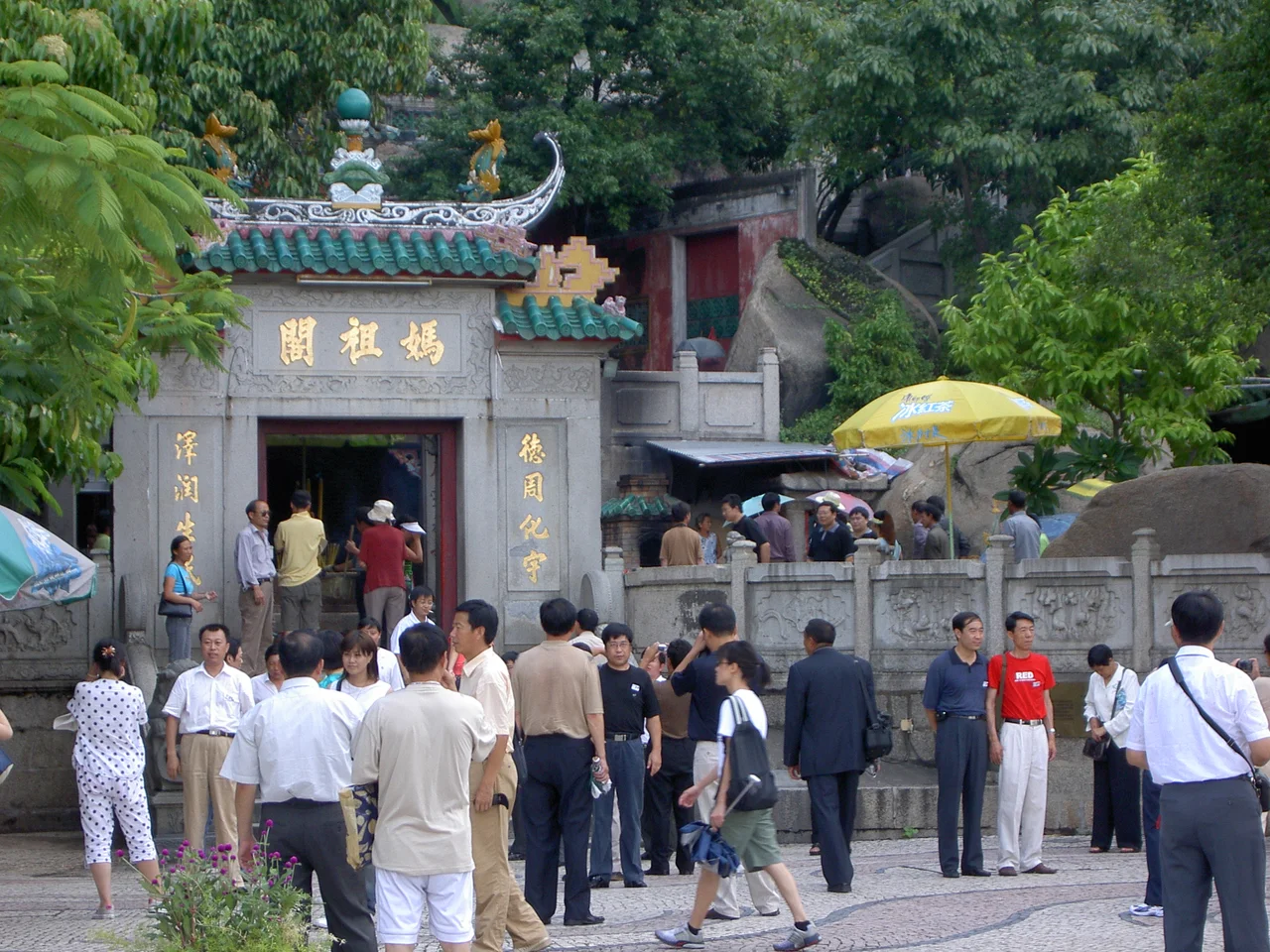
The city's name may come from a goddess. The A-Ma Temple, built in 1488 at the southern tip of what is now the Macau Peninsula, was dedicated to Matsu, the deity of seafarers and fishermen. When Portuguese sailors arrived in the 16th century and asked the local people what the place was called, the answer — something close to "A-Ma Gao," meaning bay of A-Ma — gave the Portuguese their spelling, and eventually the world its name: Macau. That temple still stands, and it is one of more than twenty historic sites now recognized as the Historic Centre of Macau, inscribed on the UNESCO World Heritage List in 2005.
Four Centuries of Shared Ground
Macau was the first permanent European settlement in East Asia and, after 1999, the last to be handed back. For roughly 450 years, the Portuguese administered a territory that was also, always, a Chinese community — and the architecture of the Historic Centre reflects that duality with unusual honesty. Churches and temples, mandarins' residences and colonial government buildings, baroque facades and Chinese courtyard homes all exist within a few minutes' walk of each other, not as curated museum pieces but as working parts of a living city. UNESCO described the collection as providing "a unique testimony to the meeting of aesthetic, cultural, architectural and technological influences from East and West" and as bearing "witness to one of the earliest and longest-lasting encounters between China and the West, based on the vibrancy of international trade."
The Sites Themselves
The Historic Centre is organized into two core zones on the Macau Peninsula, each surrounded by a buffer zone. Zone 1 runs between Mount Hill and Barra Hill in the south; Zone 2 occupies the historic city center to the north. The list of included sites reads like a compressed history of the territory: the A-Ma Temple and Moorish Barracks in the south; the Mandarin's House, St. Lawrence's Church, and St. Joseph's Seminary working northward; then the cluster around Senado Square — the Leal Senado Building, Holy House of Mercy, Cathedral of the Nativity of Our Lady, and St. Dominic's Church. Further on, the Ruins of St. Paul's, the Monte Forte, and the Old Protestant Cemetery mark the northern extent. Each site represents a specific chapter: colonial administration, Catholic evangelism, Chinese merchant culture, military presence, and Protestant missionary activity all leaving their stone evidence within the same compact urban grid.
The Ruins That Became a Symbol
Of all the sites in the Historic Centre, the Ruins of St. Paul's is the most visited and the most immediately recognizable. What remains is the elaborately carved stone facade of a Jesuit church and college complex, gutted by fire in 1835, standing alone against the sky at the top of a long staircase. The facade is covered in religious imagery, saints, and symbolic figures that blend European and East Asian iconography in ways that are distinctly Macanese. It should, perhaps, look like a ruin. Instead it looks complete — a front wall with nothing behind it, which is somehow more present than a whole building would be. It has become the emblem of Macau's particular history: the grandeur of the colonial project, the vulnerability of it, and the strange persistence of what remained.
Where Heritage Meets Pressure
The 2005 UNESCO inscription brought both recognition and obligation. Macau's rapid development in the years following the opening of its gaming industry to foreign operators in 2002 created intense pressure on the urban landscape surrounding the historic core. Construction height limits exist around the World Heritage buffer zones, but enforcement has been contested: in 2016, the Macau government approved an 81-meter construction limit for a residential project that critics said still violated regulations designed to protect sightlines to the Guia Lighthouse, itself part of the World Heritage site. The tension is ongoing. Macau's casino economy, one of the largest in the world, shares a small peninsula with monuments that predate the United States. Finding the balance between the two has not become easier with time.
The Other Side of the Square
Senado Square is the civic heart of the Historic Centre — a curved expanse of hand-laid Portuguese mosaic pavement, black and white wave patterns flowing underfoot, surrounded by pastel-painted colonial facades. On an ordinary morning, before the tour groups arrive, it is possible to sit at a cafe on the square and watch the city go about its business: deliveries to the shops along the adjacent lanes, elderly residents on the benches, the light changing across the tiled surfaces. At the far end, the Leal Senado Building — whose name, meaning Loyal Senate, refers to Macau's loyalty to Portugal during the Spanish occupation of 1580–1640 — faces the square with the authority of four centuries of civic use. The meeting rooms inside are still in use. The history is still present. The square is still the square.
From the Air
The Historic Centre of Macau is distributed across the Macau Peninsula, centered near 22.191°N, 113.536°E. The Ruins of St. Paul's facade is the most visible landmark from low altitude — look for the hilltop stonework on the peninsula's northern rise. Senado Square and the cathedral district are in the central peninsula. From 2,000 feet approaching from the southwest, the dense colonial-era street grid contrasts clearly with the reclaimed land and casino towers to the north and east. Nearest airport is Macau International (VMMC) on Taipa island, approximately 4 km to the south. Hong Kong International (VHHH) is approximately 60 km northeast.
Nearby Stories
- 2024 Shenzhen Stabbing 0.8 km away
- Lantau Peak 1.5 km away
- Kweilin Incident 2.4 km away
- Taishan City 7 km away
- Wanshan Archipelago Campaign 38 km away
- Hong Kong 12 68 km away
- Battle of Nanpeng Island 82 km away
- Erhai Lake 1335 km away