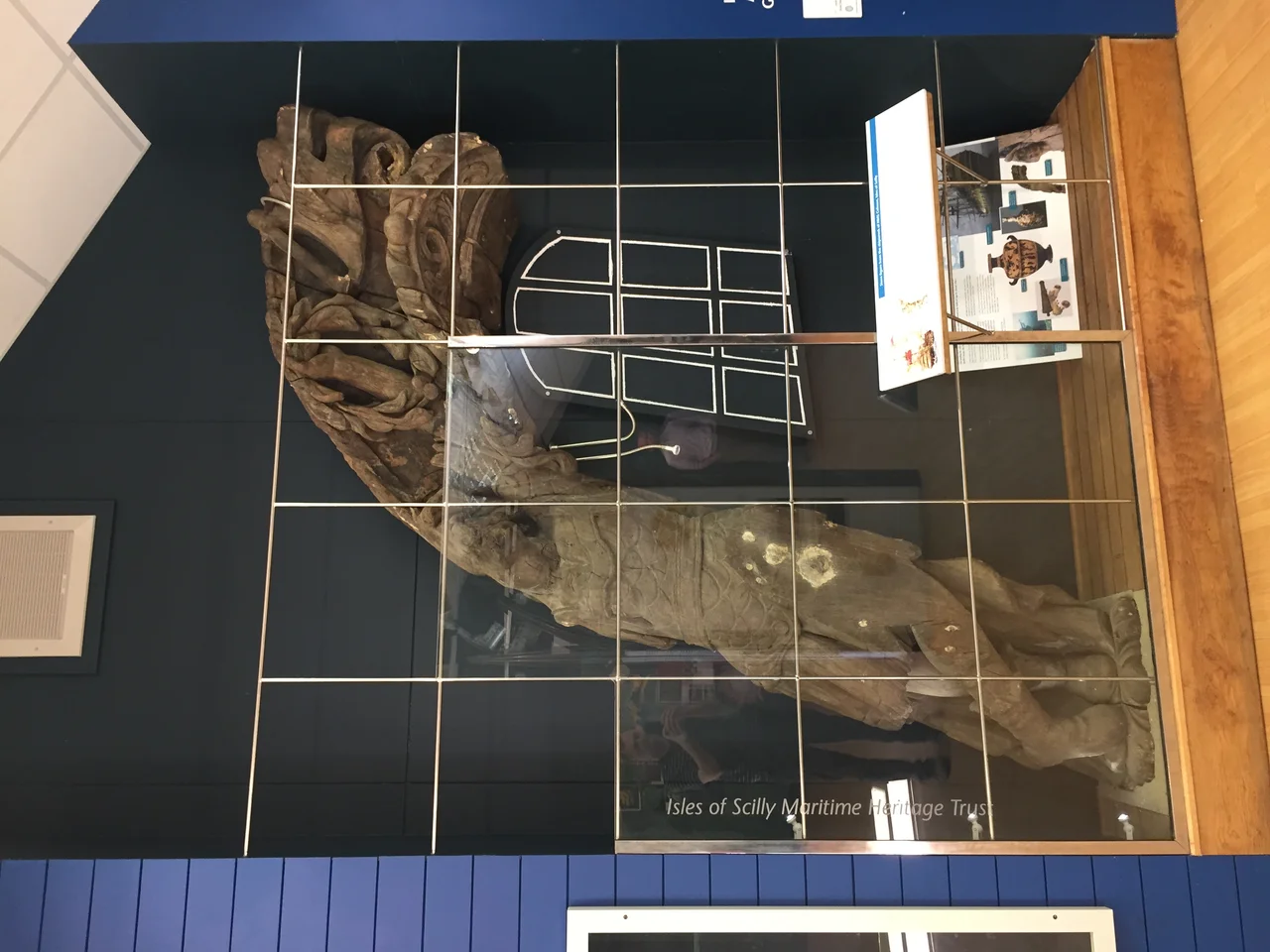

HMS Colossus (1787)
HMS Colossus was a 74-gun Royal Navy ship of the line, built at Gravesend in Kent and launched in 1787. She fought at the Battle of Cape St Vincent in 1797 under Admiral Sir John Jervis. A year later, in December 1798, she was anchored off the Isles of Scilly carrying Sir William Hamilton's collection of Greek vases home from Naples when she dragged her anchor in a gale and was driven onto the rocks off the island of Samson. She broke up over the following weeks. No further salvage proved possible and the vessel sank entirely in early January 1799. Hamilton's antiquities - some of the finest classical Greek pottery ever assembled by a private collector - went down with her. The wreck was rediscovered in 1974, and the British Museum is still slowly reassembling what the divers find.
Roland Morris and the Antiquities
Roland Morris was a Cornish diver and marine salvor who became fascinated by the lost cargo of HMS Colossus in the late 1960s. He knew the wreck must lie somewhere in the shallow water around Samson, and he knew that what she had been carrying was extraordinary: thousands of fragments from Sir William Hamilton's second collection of Greek vases, sent home from his post as British envoy at the Court of Naples. Hamilton had built the first collection over many years - the British Museum bought it in 1772 for 8,410 pounds - and the second collection, intended to fund his retirement, never reached him. In 1974 Morris located the wreck and began bringing up fragments. The pieces were eventually delivered to the British Museum in London, where conservators have spent decades patiently reassembling them. Many of Hamilton's vases are again standing in glass cases in Bloomsbury, looking very much as they did when an English diplomat in Naples first picked them up.
The Stern, Found Twice
In 2000, a Scilly diver named Todd Stevens reported new wreckage to the Receiver of Wreck - the office that handles shipwreck recoveries under English law. The remains turned out to be the stern of the ship, which had separated from the main wreck at some point and lay some distance from the original site Morris had worked. The stern held a large carved figure from the port quarter gallery - the ornate wooden trim that decorated the rear of an eighteenth-century warship. The carving had reportedly been discovered by local diver Carmen Stevens, though it was not reported until the following year. The find triggered the wreck's designation on 4 July 2001 under the Protection of Wrecks Act, meaning diving or interference within 300 metres of the site became illegal without a licence. The Isles of Scilly Museum in Hugh Town was handed a collection of further artefacts from the new discovery, and they remain on display there.
The Carving Returns to Tresco
The stern carving was carefully recovered from the seabed in 2002, in a project filmed for a special episode of the Time Team archaeology series broadcast in October that year. The Mary Rose Trust - the conservation team that had spent decades stabilising the Tudor warship Mary Rose - took charge of preserving the figure. After eight years of treatment, the carving was returned to Scilly in 2010 and placed on display in the Valhalla figurehead collection at Tresco Abbey Gardens. Valhalla is a long, low gallery on the south side of the Abbey grounds that houses ship's figureheads salvaged from wrecks around the islands - a small museum of the maritime disasters that have made the Scillies' history. The Colossus carving joined a collection that already included figures from American clippers and East Indiamen, all of them victims of the same Western approaches.
Ongoing Excavation
The Cornwall and Isles of Scilly Maritime Archaeology Society - CISMAS - has been inspecting and recording the wreck site routinely since 2001. Their work is funded and endorsed by Historic England. In May 2012 CISMAS launched a focused excavation of part of the stern, focusing on finds related to the gun deck and starting a long-term reburial trial to preserve material that could not be raised. New wreckage discovered in 2014 prompted further excavation in 2015, and the wrecking process itself was reinvestigated in 2017 - producing a revised theory of how the ship had actually broken up. In 2018 Historic England published the conservation results from a small concentration of personal items recovered in 2014: 50 buttons, a bone brush or shoe horn, and a textile fragment. The objects were analysed at the Historic England conservation lab at Fort Cumberland in Portsmouth - tiny pieces of the lives of the men who went down with the ship, recovered one fragment at a time.
From the Air
The wreck of HMS Colossus lies at 49.9245 N, 6.34175 W, in shallow water on the eastern side of Samson, between Samson and Tresco. From the air at low altitude in clear water the wreck site can sometimes be glimpsed as a darker patch on a lighter sand bottom, though most of the remaining material is buried or scattered. The location is between Samson (uninhabited) and Bryher to the north, with Tresco to the east. Nearest airport St Mary's (EGHE) is about 4 nautical miles southeast. The wreck site is a protected wreck under the Protection of Wrecks Act 1973 - 300-metre exclusion zone around the site without a licence. The whole Scilly archipelago is unmistakable in clear weather: cluster of low green islands ringed by white sand and turquoise shallows. Best viewing altitude 1,000 to 2,000 ft AGL.
Nearby Stories
- SS Vigrid 6.2 km away
- SS Georgia (1890) 32 km away
- SS Irma (1905) 35 km away
- 1979 Fastnet Race 45 km away
- Great Wheal Charlotte 53 km away
- SM U-27 55 km away
- Wolfpack Prien 151 km away
- Tower of Hercules 715 km away