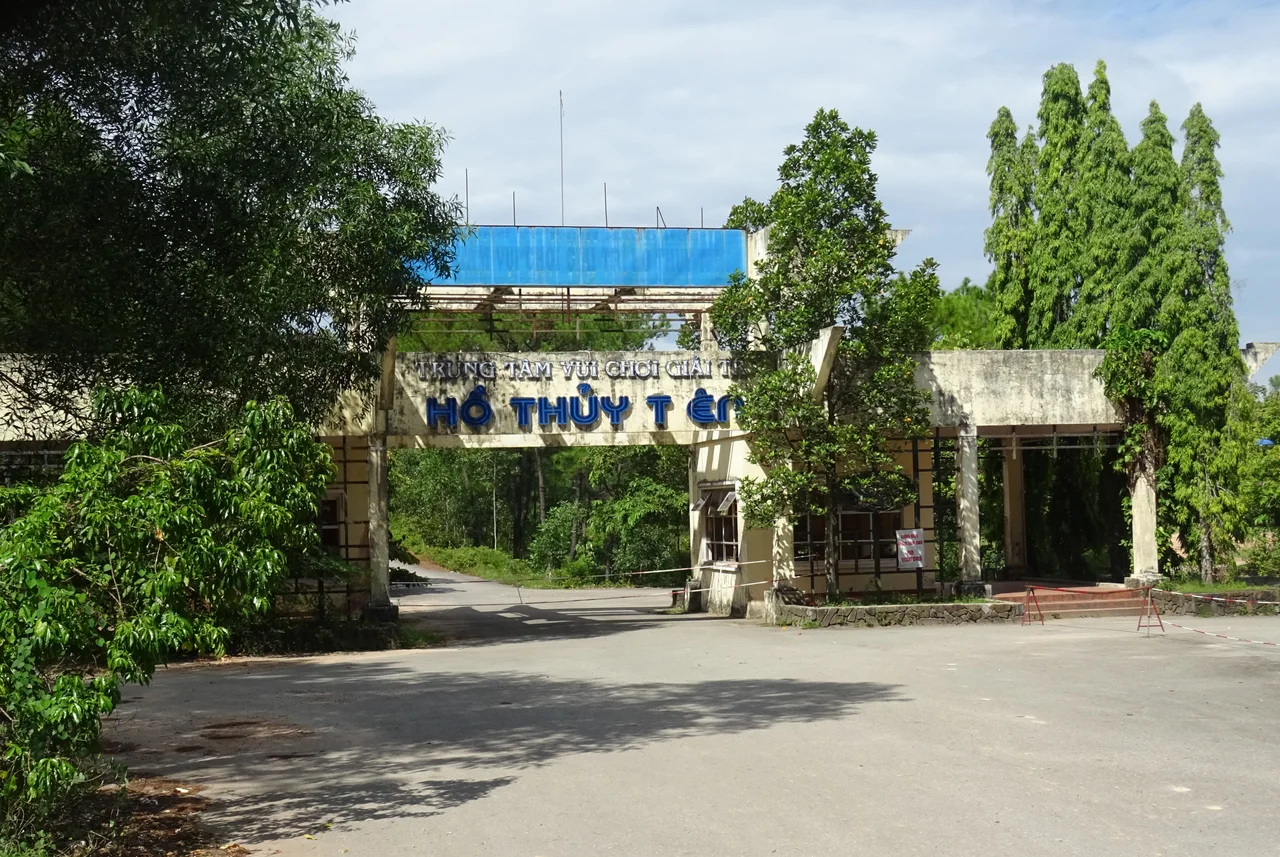

Hồ Thủy Tiên
For most of its existence, Hồ Thủy Tiên was more famous closed than it ever was open. The water park ten kilometers south of Huế launched in 2004 on a budget of more than three million US dollars and reportedly half-finished. It attracted visitors while it lasted, then shut down after a few months. What followed was two decades of a different kind of fame: the park's crumbling slides, overgrown pathways, and a concrete dragon statue rising from the middle of the namesake lake became regular features in international travel media, rated among Asia's eeriest abandoned places. Vogue sent a photographer. Business Insider ran a photo essay. The Washington Post listed it among the world's scariest travel destinations. None of this made the park financially viable. But it kept the dragon famous.
Built Near a Hill That Already Had a Name
The park sits near Thiên An hill, already a destination for the monastery and forested landscape it had sustained for generations. Construction began in 2000 on land near the hill's lake — Hồ Thủy Tiên, the Fairy Lake — with the state-funded tourism company expecting to build a family water park drawing visitors from the ancient imperial city nearby. The site was opened to the public in 2004.
It was not finished. By most accounts the infrastructure was incomplete at opening, which may explain why the park closed after only a few months of operation. The investment company Haco Hue took over and reopened it in 2006, this time with plans for an eco-tourism complex. By 2011 those plans had also failed. The province attempted another revival a few years later, but Haco Hue's mounting debts made attracting new investors nearly impossible. The government eventually barred entry for safety reasons, leaving the park to weather and vegetation.
The Dragon in the Lake
What drew photographers and urban explorers was not the slides, which were ordinary. It was the dragon — a large concrete sculpture built into the middle of the lake, its coiled body and gaping mouth still clearly visible as jungle reclaimed the paths around it. The contrast between the fantastical sculpture and the silent, encroaching vegetation was precisely the kind of image that travels well online.
By 2016, when HuffPost ran a feature on the park, interest had already spread well beyond backpacker forums. The park appeared in an Italian band's music video. It made lists of abandoned places alongside American theme parks and Soviet-era facilities. Visitors continued arriving despite the prohibition on entry, drawn by the photographs more than any formal promotion.
The Long Road Back
In 2020, the provincial government announced plans to redevelop the site. The announcement ran into the same problem every previous attempt had encountered: Haco Hue's unresolved debts made clear title difficult to establish, and no investor wanted to inherit the liability. A 2022 announcement promised reopening by March 2023 after spending the equivalent of $844,100 on renovation. By August 2023, Vietnamese state media was still describing the park as abandoned and providing instructions on how to visit it unofficially.
The eventual resolution came through a less glamorous mechanism: the municipal government reclaimed the property, sold off the assets to clear accumulated debts, and handed the site to the Thuan Hoa District Green Park Center to manage as public green space. The center cleared debris, paved and repaved walking paths, and added a new path around the lake. The park reopened in 2025.
What Was Kept
When the restoration was completed, the authorities made one decision worth noting: the graffiti that had accumulated on the dragon statue over its years as an unofficial urban exploration site was preserved. Whether this was sentiment, pragmatism, or an acknowledgment that the dragon's fame had always been bound up with its neglected state, the result is a community park that carries a visible record of its strange interlude.
Hồ Thủy Tiên is back on the map as a neighborhood park near Thiên An hill, available to the families and cyclists and afternoon walkers for whom it was presumably always intended. The dragon still holds the center of the lake, wearing its graffiti. The Fairy Lake has, after twenty years, become ordinary again — which is, in its own way, a kind of success.
From the Air
Hồ Thủy Tiên sits at 16.4079°N, 107.5785°E, roughly 10 km south of Huế's city center near Thiên An hill. At 2,000 feet, the wooded hillside setting distinguishes the site from the flatter city grid to the north; the Perfume River is visible as a broad silver band running through central Huế. Nearest airport: Phú Bài International (VVPB), approximately 4 km to the east-southeast — the site lies almost in the airport's approach corridor, so low overflight is not recommended. Da Nang International (VVDN) is roughly 85 km southeast.
Nearby Stories
- Battle of Fire Support Base Ripcord 4 km away
- Sơn Trà Mountain 5.8 km away
- Quảng Trị Citadel 7.3 km away
- Battle of Nam Dong 10 km away
- Hội An wreck 56 km away
- Battle of Cua Viet 65 km away
- Saravan 100 km away
- Hainan Island Incident 342 km away