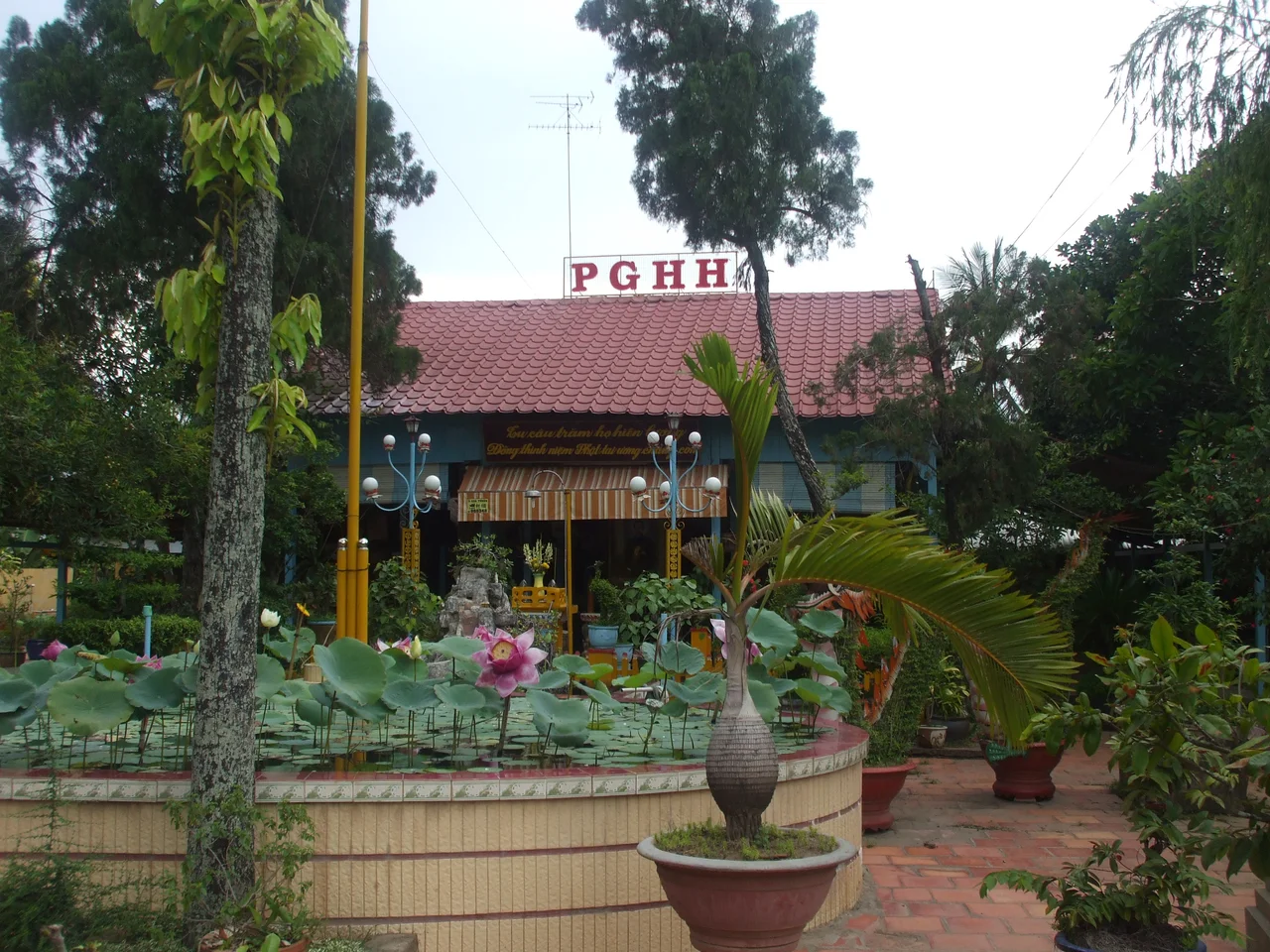

Hòa Hảo
Drive through Phú Tân and you will pass thousands of them without registering what they are: a plain wooden tablet, forty centimetres square, on a post about chest height in the yard in front of the house. No statue, no roof. The offerings are water for cleanliness, flowers for purity, and a pinch of incense against bad spirits. This is the bàn thông thiên, and the fact that it stands outdoors is the whole argument: the believer prays under open sky, feet on the ground, in direct communion with heaven, needing no monk, no temple and no money to do it. The faith that put those posts across the western delta was founded in 1939 by a sick young man from a village a few kilometres from here, and it has been at war with somebody for most of the time since.
The Healer from Hòa Hảo Village
Huỳnh Phú Sổ was born on 15 January 1920 in the village of Hòa Hảo, near Châu Đốc, to a family of modest landholders. Illness took hold of him at fifteen and did not let go. He had no formal education and no contact with Saigon's Westernised intelligentsia; what he had was the Bảy Núi range sixty kilometres away, a landscape of isolated peaks full of hermits and healers, where he absorbed an unorthodox composite of Buddhist teaching. He came back apparently cured and began to preach. His followers date the founding to the eighteenth day of the fifth lunar month of kỷ mão - mid-1939. He declared himself a prophet, travelled the delta practising herbal medicine and acupuncture on patients who said he cured what French medicine could not, and gave away his teachings as cheap verse pamphlets. He also predicted a great war in the Far East and the expulsion of Europeans by Asians, an eccentric thing to say in 1939 and an obvious truth by 1942. Ten thousand followers in that first year became a hundred thousand by 1940 and near a million by late 1944.
Poor Man's Buddhism
The doctrine reworked an older regional tradition, Bửu Sơn Kỳ Hương, traced to the nineteenth-century master Phật Thầy Tây An. It is Buddhist at its core, blended with ancestor veneration, animist practice and Confucian ethics, and shaped for peasants. There is no monastic order to support, no elaborate ritual, no expensive statuary. Prayer happens four times daily at home, and a believer who has lived correctly needs only a simple funeral. Sổ preached against the sale of child brides, against gambling, alcohol and opium, and against usury; he distrusted cities as places of competition and display that dissolve communal obligation. Underneath sits a millenarian clock borrowed in part from the Chinese White Lotus tradition: three great eras, the present one grinding toward catastrophe, then the Assembly of the Dragon Flower, where Maitreya presides over a world morally remade. Outsiders called it the poor man's Buddhism. It was meant to be.
The Faith Acquires an Army
Colonial authorities read this as sedition waiting to happen. In 1940 the Vichy governor Jean Decoux had Sổ committed as a lunatic at Bạc Liêu, where he converted his own psychiatrist; French doctors declared him sane in 1941 and he was exiled anyway; Bạc Liêu promptly became a pilgrimage site. By 1942 the French shipped him to Laos, and the Japanese, who understood exactly what they had, intercepted him and installed him in Saigon under military protection. The first Hòa Hảo militias appeared in late 1943 as village self-defence units and hardened fast into something else. When Japan surrendered, the delta became a four-way fight, and in September 1945 fifteen thousand Hoahaoists armed with hand weapons attacked the Việt Minh garrison at Cần Thơ and were slaughtered. The reprisals were as ugly as the massacre that provoked them. Communist cadres were bound together and drowned in the canals; corpses were left in public, and villagers who flinched at the sight were marked as sympathisers.
A Body Nobody Could Find
In April 1947 the Việt Minh invited Sổ to a reconciliation meeting in the Plain of Reeds. He refused their terms and started home, was stopped on the river near Long Xuyên, and killed. He was twenty-seven. Knowing that a grave would become a shrine and a shrine a rallying point, his killers quartered his body and scattered the pieces; the remains were never recovered. Vietnamese police records later placed the death in December that year, complete with a trial - a fabrication, the historian Shawn McHale argues, invented to make a murder look like justice. A leader who simply vanished cannot be confirmed dead, and Hoahaoists mark the twenty-fifth day of the second lunar month not as his death but as his disappearance. His followers split into rival armed factions and fought the Communists for another three decades.
Still Here, Still Watched
After 1975 the movement was dissolved, its leaders imprisoned, Sổ's writings banned and public reference to him forbidden, though private worship at the household altar was tolerated. Official recognition came only in 1999, and half a million believers gathered in An Giang that July. It was partial recognition: the state sanctions one branch, and the unregistered ones live under surveillance, checkpoints on festival days, bans on public readings of Sổ's texts, and arrests. Government figures count 1.3 million adherents; other estimates run to several million, concentrated almost entirely around Chợ Mới, Phú Tân, Châu Đốc and Long Xuyên. The largest community abroad is in Santa Ana, California, where the altars stand in front yards too.
From the Air
Centred at 10.60°N, 105.35°E over Phú Tân, the Hòa Hảo heartland in An Giang, roughly 35 km southeast of Châu Đốc. The terrain is a near-island: the Tiền River bounds it to the east, the Hậu to the north and northwest, and the short Vàm Nao channel - the natural crossover between the Mekong's two great delta arms - closes it off to the south. From 3,000-5,000 ft that river geometry is unmistakable, and the founder's home village, renamed Phú Mỹ, sits on the Tiền bank as the local centre. Terrain is flat and at sea level; the only relief in the region is the Bảy Núi range about 45 km west-southwest, isolated granite peaks rising abruptly from paddy. Nearest fields: Cần Thơ International (VVCT) about 40 nm south-southeast, Rạch Giá (VVRG) about 55 nm southwest, and Tân Sơn Nhất (VVTS) about 95 nm east-northeast. Best visibility December through March; the June-October monsoon floods the whole plain, turning the district into a mosaic of water with roads and house-lines standing proud of it.
Nearby Stories
- Long Xuyên 14 km away
- Battle of Tri Phap 17 km away
- Búng Bình Thiên 25 km away
- Hà Tiên 42 km away
- Koh Ach Seh 49 km away
- Vĩnh Tràng Temple 61 km away
- Ben Duoc Memorial Temple 75 km away
- Cambodian campaign 82 km away