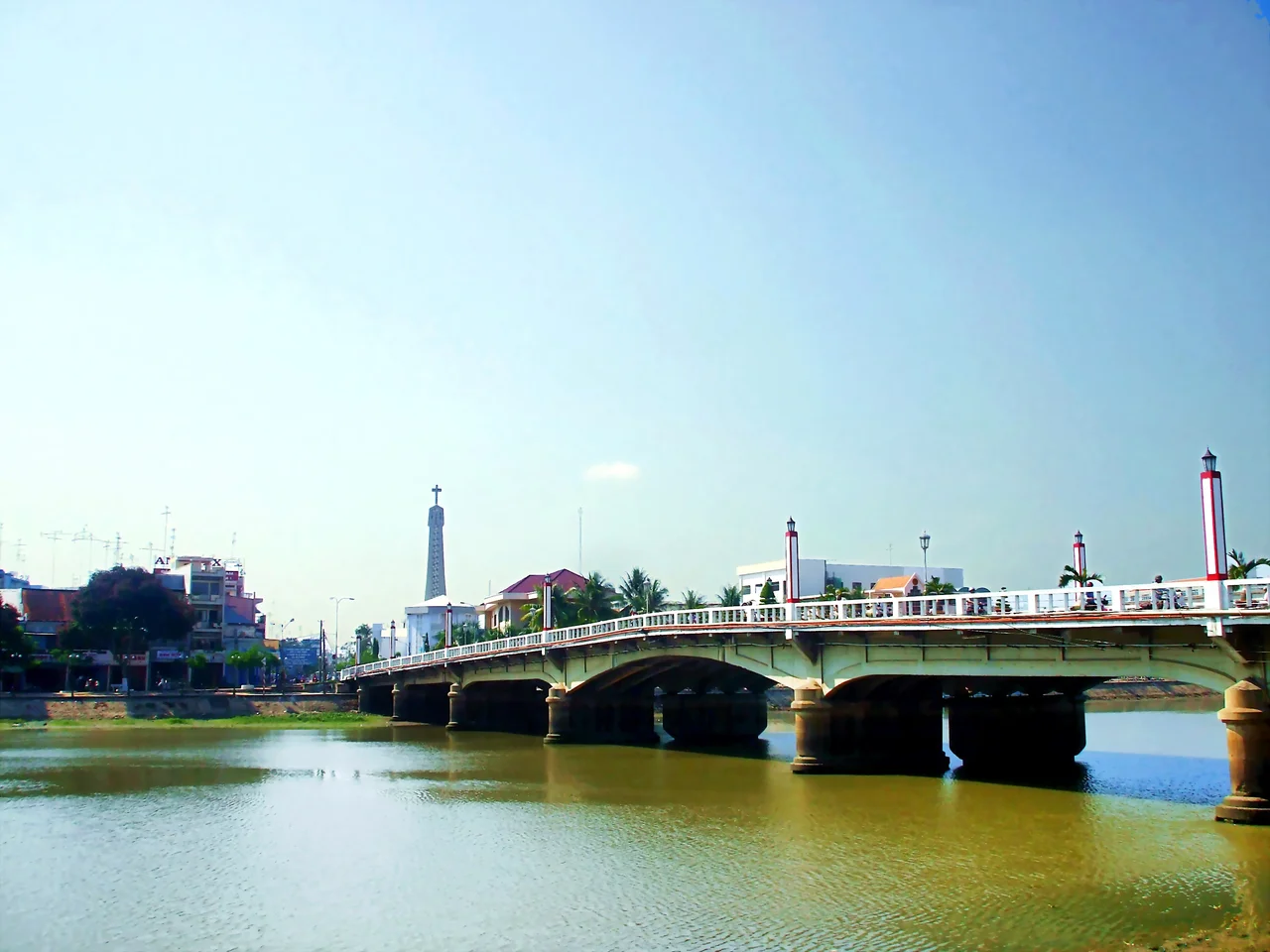

Long Xuyên
The city lost an argument with its own marketplace. In 1789 a party of settlers cut an outpost into the bank of the Tam Khe canal and called it Đông Xuyên; the formal name on the paperwork was Thủ Đông Xuyên. Then somebody opened a market nearby and called it Long Xuyên, and by the 1860s boatmen coming up the Hậu River were asking for the market, not the post. The market won. Long Xuyên spent another 133 years growing into the name before Vietnam got around to designating it a city in 1999 — by which point it had been the working heart of the upper delta for the better part of two centuries.
Water Where Roads Would Be
Long Xuyên sits on the Hậu River, the western of the two great Mekong branches that split Vietnam's delta, roughly 190 kilometers from Ho Chi Minh City and 45 from the Cambodian border. Its 115 square kilometers hold something near 286,000 people across thirteen commune-level subdivisions, and the thing that organizes all of it is not the street grid but the canal grid. A working port sits in the middle of town. Barges tie up three deep. Rice comes downstream from the Long Xuyên Quadrangle — the vast reclaimed floodplain the city anchors — and basa, the delta's export catfish, goes out from pens along the river. The canals made this economy possible and continue to complicate it. Cutting more of them has been a reliable way to raise output, and a reliable way to move whatever is happening upstream — floodwater, effluent, salt — straight into town.
Snakehead, Tamarind, Palm Sugar
Order bún cá in Long Xuyên and you get the city's argument for itself in a bowl: snakehead fish poached and flaked, a broth soured with tamarind and stained yellow with turmeric, rice noodles, and a fistful of herbs and shredded banana blossom you tear in yourself. Vendors sell it from the curb starting before dawn. The other local staples are mắm thái, a shredded fermented-fish preparation the delta treats as a condiment and outsiders treat as a dare, and the smoky brown sugar boiled down from thốt nốt palm sap in the fields toward Cambodia. The Gulf of Thailand is two hours west, the Cambodian border less than an hour north, and Long Xuyên's kitchens have spent generations taking what passes through.
The Rice School
An Giang University enrolls more than 10,000 students, making it the second-largest university in the Mekong Delta, and for years its rector was Võ Tòng Xuân — an agronomist whose reputation rested on getting new rice varieties out of research plots and into the hands of farmers who could not wait for a bureaucracy to approve them. That instinct fits the place. Long Xuyên is also home to the Thoại Ngọc Hầu high school, a selective institution of more than 2,000 students named for the Nguyễn-dynasty general who dug the canals that made this land farmable, and to a teacher-training college. In a province where rice is not a crop but the entire proposition, the schools are infrastructure.
Two Men from One City
Tôn Đức Thắng was born on 20 August 1888 on Mỹ Hòa Hưng, the river island opposite the city that everyone calls Cù Lao Ông Hổ, Tiger Island. He trained as a mechanic, went to sea, and later described taking part in a 1919 mutiny in the Black Sea aboard a French cruiser — an episode the historian Christoph Giebel has argued was constructed after the fact to bind Vietnamese communism to the Russian Revolution. What is not disputed is the sentence: arrested in 1929, he spent sixteen years in the prison colony on Côn Đảo, until 1945. He became President of North Vietnam on Hồ Chí Minh's death in September 1969, first president of the reunified country in July 1976, and died in Hanoi in 1980 at ninety-one. His birthday is still marked on the island. Nguyễn Ngọc Thơ, vice-president of the Republic of Vietnam in Saigon, came from the same small city — two careers begun in the same riverside town and finished on opposite sides of the same war.
A City of Several Faiths
Long Xuyên's skyline is a survey of southern Vietnamese religion. There is a Cao Đài temple, one of relatively few this far into the delta, with the all-seeing Divine Eye above its doors. The Catholic diocese of Long Xuyên counted some 230,000 members when it marked its sixtieth anniversary in 2020, and its churches are ordinary features of the neighborhoods. Hòa Hảo Buddhism, founded in 1939 by the young prophet Huỳnh Phú Sổ at Hòa Hảo village upriver in what is now Phú Tân, has its densest concentration of followers in these districts — this is its heartland, if not quite its birthplace. And with Cambodia so close, a substantial Khmer population lives here, bringing Theravada practice into a city otherwise shaped by Mahayana. Four traditions, one riverbank, no particular friction.
From the Air
Long Xuyên lies at 10.369°N, 105.423°E on the right bank of the Hậu (Bassac) River in An Giang province. The nearest fields are Cần Thơ International (VVCT), about 45 km east, and Rạch Giá Airport (VVRG), about 45 km south; Ho Chi Minh City's Tân Sơn Nhất (VVTS) is roughly 190 km northeast. Terrain is negligible — the surrounding delta sits within a few meters of sea level — so 1,500-3,000 ft gives an excellent view. Identify the city by the wide brown Hậu River, the long island of Mỹ Hòa Hưng splitting the channel opposite downtown, and the dense barge cluster at the central port. Beyond the built-up area the Long Xuyên Quadrangle stretches away as an almost perfectly ruled grid of canals. Expect haze and smoke from field burning in the February-April dry season, and towering convection on rainy-season afternoons from May through November.
Nearby Stories
- Hòa Hảo 8.6 km away
- Kiên Giang province 14 km away
- Battle of Tri Phap 31 km away
- Hà Tiên 33 km away
- Sóc Trăng 39 km away
- Phnom Sorsia 49 km away
- An Thoi Naval Base 82 km away
- Tet Offensive Attack on Tan Son Nhut Air Base 94 km away