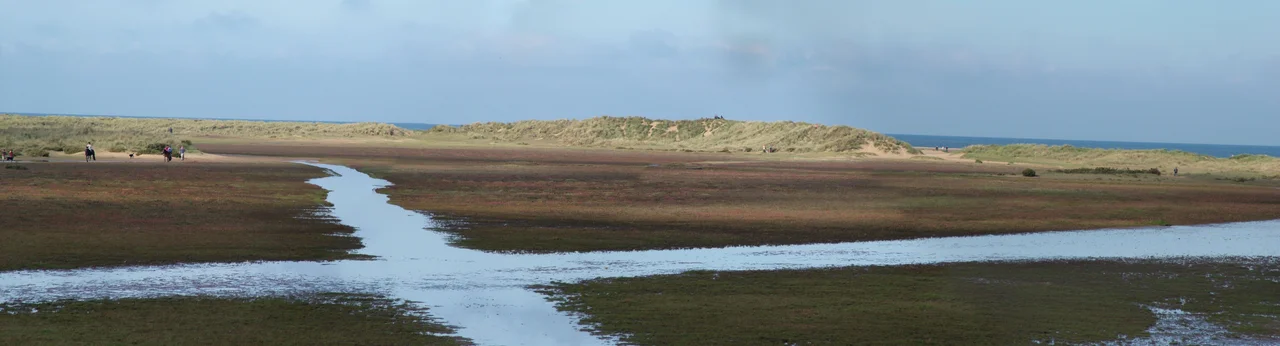

Holkham
Holkham is a village of barely two hundred people, but the Coke family who built the Palladian pile at its centre changed the face of English agriculture. Thomas Coke, first Earl of Leicester of the seventh creation, became famous as Coke of Norfolk for the way he rebuilt his estate around four-course rotation, marled fields and improved livestock. He hosted annual sheep-shearing gatherings at Holkham that drew agricultural reformers from across Britain. The hall those reforms paid for still anchors the village. Behind it, a salt marsh creek that once let small boats reach Wells was diked and reclaimed for sheep and barley, and what remained became a deer park, a lake, and a four-mile beach so vast that film crews keep coming back to use it as somewhere else.
The Hall the Family Built
Holkham Hall is one of the most important Palladian houses in England, designed in the 1730s for Thomas Coke, an earlier earl who had spent six years on the Grand Tour soaking up Italian architecture. The yellow brick state apartments, the marble hall rising through coffered domes, the art collection lining the gallery: all of it was assembled to argue that Norfolk could match Rome. Coke died in 1759 before the work was finished, leaving his widow, the Countess Dowager, to see it through. The hall passed to a great-nephew who became the famous Thomas Coke, the agricultural reformer. Today the 8th Earl, born in 1965, lives there. The deer park around the hall still grazes red and fallow deer, and the lake to the west of the house is built on the trace of the original tidal creek.
A Saxon Saint and an Older Name
Long before the Cokes, Holkham was the home of Saint Withburga. Hagiographic tradition makes her the youngest daughter of Anna, the Christian king of East Anglia killed in 654 fighting the last pagan king of Mercia. According to the saints' lives, she was raised at Holkham, founded a Benedictine nunnery at East Dereham, and was buried at Ely in 743. The Anglo-Saxon Chronicle reports that in 798 her body was found uncorrupted at Dereham. The parish church on the estate is still dedicated to her, sitting on a tall circular mound that archaeologists suspect predates the Saxons. The church guide translates Holk-ham as homestead in a hollow, though one persistent suggestion links Holk to an Old English word for holy, after the saint herself.
Lady Anne's Drive to the Sea
From the coast road, Lady Anne's Drive runs north across reclaimed salt marsh to Holkham Gap, a break in the pine-fringed dunes that opens onto the beach. The pines were planted in the 19th century to stabilise the sand. Today they shelter wintering pink-footed geese on the freshwater marshes inland, and the whole sweep from Holkham to Wells is a National Nature Reserve. The beach itself is enormous: at low tide it stretches for what feels like miles before you reach the surf. At the west end, a stretch is reserved for naturists. To the east, the pines fade into Wells Woods. The light here is the wide, low light of the North Sea coast, the kind that floods in horizontally and makes everything photograph beautifully.
Filming on the Sand
Directors keep coming back to Holkham because the beach is large enough to stand in for anywhere. Operation Crossbow in 1965 used Holkham Gap for its Peenemuende sequences, with male extras recruited from Wells; the film played at the Wells cinema for several weeks a year through the late 1960s, locals spotting themselves on screen. The Eagle Has Landed brought Michael Caine, Donald Sutherland and Robert Duvall to the pinewoods in 1976. Joseph Fiennes and Gwyneth Paltrow filmed the final scene of Shakespeare in Love here in 1998, walking alone across the sand. The music video for All Saints' Pure Shores was shot here for The Beach in 2000. Keira Knightley filmed The Duchess inside the hall. Natalie Portman wandered the pines for Annihilation in 2016. None of them named Holkham.
Pottery, Pinewoods, Pink-Footed Geese
In 1951 the estate started Holkham Studio Pottery inside the hall itself, the first stately home in Britain to manufacture pottery on-site to sell through its own gift shop. At its peak the operation employed a hundred people, and Holkham earthenware travelled the world. The pottery closed in 2007. The estate carried on with the older Norfolk industries that matter most: the deer in the park, the cattle in the grazing marsh, the geese on the freshwater marshes. The granite obelisk in the park lists the names of Holkham men who did not come home from the First World War. The village is small, and the names are not many. Each was added to the marble plaque inside St Withburga's, where Coke memorials going back centuries already crowded the walls.
From the Air
Holkham sits at 52.96N, 0.82E, two miles west of Wells-next-the-Sea on the North Norfolk coast. From altitude the hall and its park are unmistakable, set in a square of trees south of the A149 with the long ribbon of beach and the pine belt stretching east-west to the north. Norwich Airport (EGSH) is about 30 miles south-east. The reclaimed grazing marshes between hall and beach show as a flat rectilinear patchwork distinct from the salt marsh further east.
Nearby Stories
- Wroxham 3.2 km away
- East Dereham Windmill 8.5 km away
- Alford Windmill 11 km away
- Mundesley 14 km away
- Batemans Brewery 14 km away
- Wisbech 15 km away
- HMS Cobra 24 km away
- SM U-97 118 km away