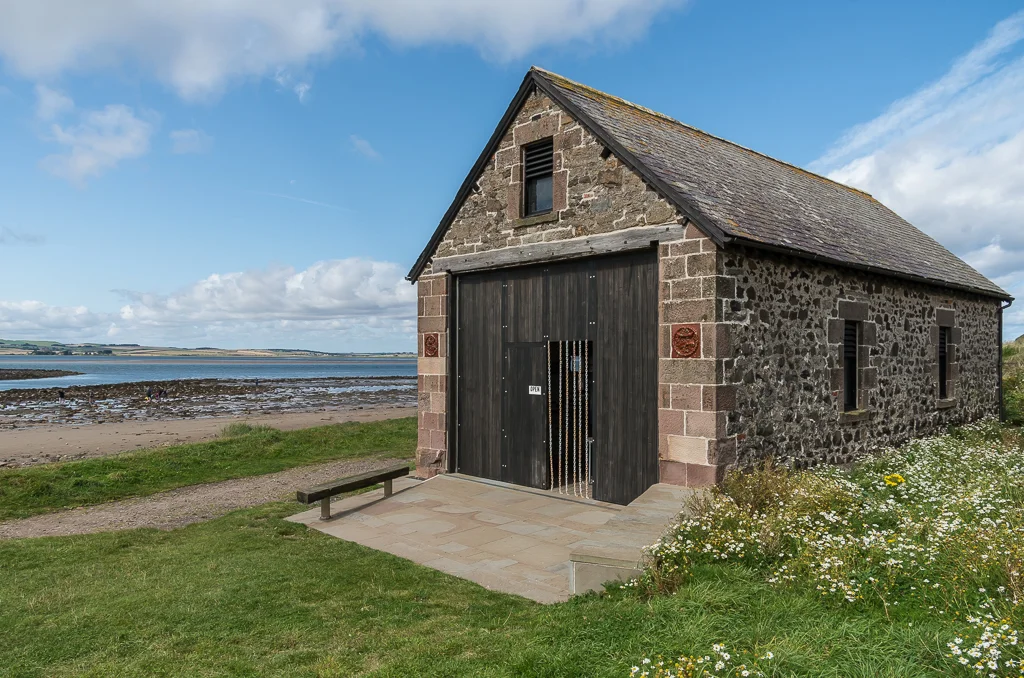

Holy Island Lifeboat Station
A century and a half before the RNLI existed, a Bishop of Durham left money in trust for the poor of Northumberland, and that money eventually became a lifeboat. In September 1802 a 31-foot rescue boat built by Henry Greathead was delivered to Bamburgh Castle, and the following year it was hauled across the causeway to Holy Island, becoming one of the earliest lifeboat stations in the world. For the next 166 years, crews of fishermen and farmers ran toward storms that everyone else was running from, and brought sailors home alive when they could.
The Crewe Trustees
Nathaniel Crewe, Bishop of Durham, died in 1721 leaving a charity that would still be giving away money three hundred years later. By 1802 the Trustees had decided that one of the things Northumberland needed was a lifeboat, and they ordered one from Henry Greathead, the South Shields boat-builder whose Original of 1789 had effectively invented the modern lifeboat. Mr. Selby of Lindisfarne gave them a site for a boathouse and let them quarry the stones to build it. The Greathead boat came down the coast and was established on the island in 1803. Twenty-one years before the institution that would become the RNLI even existed, Holy Island had a lifeboat.
The Gallant Master Joy
On 30 October 1825 the sloop John and Jessie wrecked on Parton Stell in a violent gale. Six people were swept away at once, including the master and four young women. George Joy, master of the Revenue cutter Mermaid, arrived to find a hundred spectators standing on the shore, refusing to help the three remaining crew who clung to the mast in the surf. Joy organised his own men and a handful of local fishermen, dragged a boat overland to a launchable spot, and rowed into seas that were trying to kill him. They were driven back repeatedly. They kept going. The three men came off the mast moments before it was washed away. Joy received the RNIPLS Gold Medal, then the highest civilian award for life-saving at sea, and earned every grain of it. Between 1825 and 1839, Holy Island earned seven medals for gallantry. The story of who refused to help and who finally went, on that beach in 1825, is the story this station told for the next 143 years.
Grace Darling
By 1884 the Holy Island boathouse needed a new lifeboat, and the late Miss Ann Egdell of Alnwick had left money in her will to pay for one. The 34-foot self-righting boat was named Grace Darling - after the lighthouse-keeper's daughter from the Farne Islands, who in 1838 had rowed out with her father in heavy seas to rescue survivors from the wrecked SS Forfarshire and became one of the great folk heroes of Victorian Britain. The 1884 Grace Darling was officially recorded as ON 1, the first boat on the RNLI's new register. The boat would be replaced in 1909 by Lizzie Porter, then in 1925 by Milburn, then in 1946 by Gertrude, a 46-foot Watson-class motor lifeboat that would serve until the station closed.
Storm of 1890
On 6 November 1890 a hurricane raked the Northumbrian coast and the No. 2 station at Ross Links launched its lifeboat - for the only time in its history - to help the schooner Flower of Ross. The boat was hammered. By the time they reached the schooner the lifeboat was badly damaged, and at one point it was probably in worse shape than the vessel it was trying to save. The crew of five came home alive. So did the crew of the Flower of Ross. Sometimes one launch was all a station needed to justify its existence. The Ross Links station closed in 1908, eighteen years later. The Snook station, on the other side of the island, closed in 1934. The main station at Holy Island closed in 1968.
What Remains
The boathouses are still there. The tidal causeway still floods twice a day, cutting Lindisfarne off from the Northumbrian coast on a schedule the moon writes. Modern lifeboat coverage in this stretch of water now comes from Seahouses, a few miles to the south, where an Atlantic 85 inshore boat and a Shannon-class all-weather lifeboat stand ready. But for 166 years a community of crofters and fishermen on a small tidal island took it upon themselves to launch when the worst weather came, sometimes for strangers, sometimes for neighbours. Seven gold and silver medals hang against that record. So do the names of the boats: Grace Darling, Lizzie Porter, Milburn, Gertrude. So do the sailors they pulled out alive.
From the Air
Holy Island (Lindisfarne) at 55.67°N, 1.80°W, on the Northumbrian coast about 8 nm south-east of Berwick-upon-Tweed. Recommended viewing altitude 1,500-3,000 ft AGL to see the tidal causeway, the castle on its volcanic plug, and the priory ruins. Lindisfarne Castle and the priory are the obvious landmarks. The causeway is only passable at low tide - check tide tables before crossing by road. Nearest ICAO airport: EGNT (Newcastle) 50 nm south; EGPH (Edinburgh) 60 nm northwest. The Farne Islands lie 5 nm south, with their seabird colonies and Grace Darling's Longstone lighthouse visible on clear days.
Nearby Stories
- German submarine U-1274 3.9 km away
- Eyemouth Disaster 6 km away
- Mellerstain House 6.4 km away
- Rothbury 7 km away
- Battle of Dunbar (1296) 9.5 km away
- SM UB-115 17 km away
- Kielder Observatory 18 km away
- Alexander L. Kielland (Platform) 286 km away