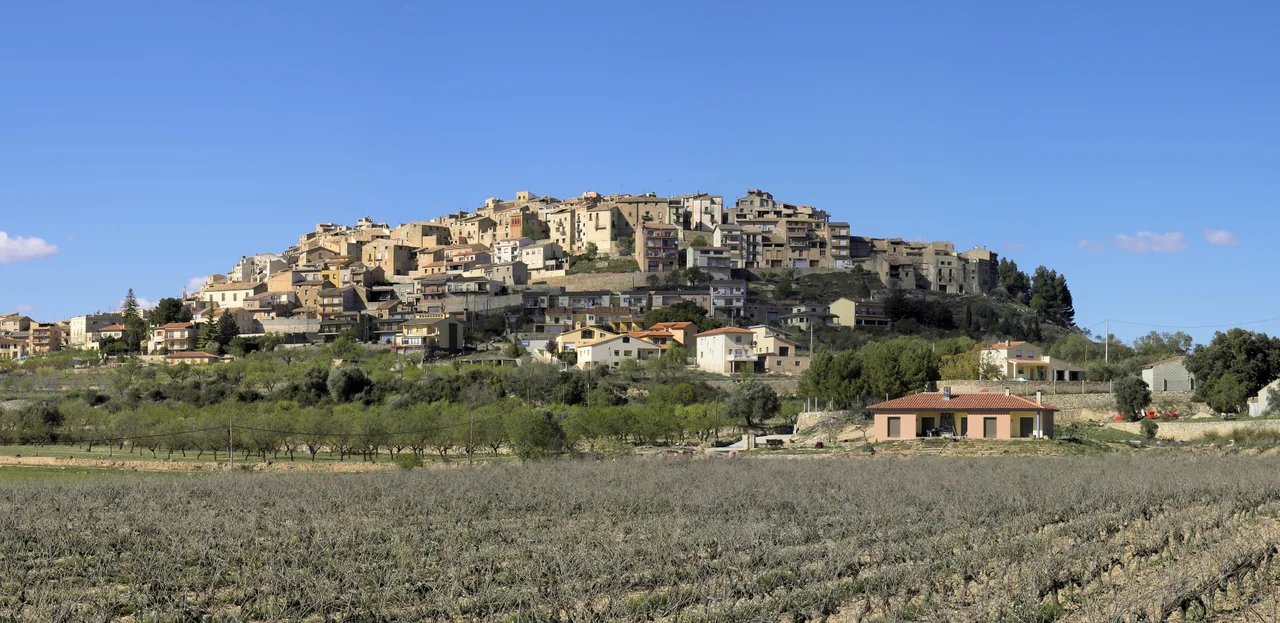

Horta de Sant Joan
In 1898, a sickly teenager from Barcelona came to this hilltop village to recover his health, and left with something else entirely. His name was Pablo Picasso, and years later he would say of the place, "Everything I know I learned in Horta." He was not talking about a school. He meant the olive terraces and the bare mountains, the rhythm of a farming village, the long hours spent drawing beside his friend Manuel Pallarès, whose family home this was. Horta de Sant Joan has been many things across the centuries, but it is this—the making of a painter—that gives the little town in the comarca of Terra Alta its outsized place in the story of modern art.
Everything I Learned in Horta
Picasso first arrived still in his teens, at the invitation of Manuel Pallarès, a local by birth and a lifelong friend. The two spent months in the surrounding hills—drawing, painting, and living rough—and the young artist soaked up the landscape's stripped-down geometry. He returned in 1909, by then a very different painter, and the canvases he made that summer, angular and faceted views of the village and the mountains, helped push him toward the fractured planes of Cubism. The village has not forgotten. A Centre Picasso now organizes exhibitions, symposiums, and publications devoted to the artist, tracing the line between the teenager who came to get well and the master who came back to take painting apart. It is a rare thing for a small farming town to hold a genuine claim on the history of art. Horta holds two visits, three decades apart, that both mattered.
A Hill With Its Own Spring
Horta sits on a small hill, and near its top rises a natural spring—an accident of geology that shaped centuries of life here. In an age of sieges, a town that did not have to fetch its water from the rivers below held a decisive advantage, and so people stayed. The Iberians were here first, until the Romans came. In the eighth century Horta, like most of the peninsula, fell under Muslim rule, which lasted some four hundred years until Christian forces took the region in the twelfth century. That long presence still stands, quite literally, in the surrounding groves: ancient olive trees, including the venerable Parot—reckoned to be a thousand years old—were planted in those centuries and remain living, fruit-bearing survivors of a vanished world. Few monuments outlast an empire. This one is still pressing oil.
Benet's Rocks and the Dog's Head
From the village, the eye is pulled toward the great pale forms of Benet's Rocks, the most striking landmark in the northern reaches of the Ports of Beceite mountains. There are three main rock masses; the leftmost, seen in profile, so resembles a hound's muzzle that it has long been called the Dog's Head. Below Santa Bàrbara mountain stands the monastery of Sant Salvador d'Horta, also known as the Convent of Angels, its stone weathered to the colour of the hills. Much of the municipality lies within the natural park itself, so the boundary between village and wilderness is thin. Step past the last houses and you are in a country of crag and pine and open sky—the same terrain that fascinated Picasso and that still draws walkers to the northwestern foothills of the massif.
Olives, Almonds, and the Garbí
Where the park releases its grip, the land turns to farmland—broad tracts of olive, almond, and fruit trees, and vineyards worked much as they have been for generations. Three rivers frame the terrain. The Algars runs to the west, tracing the old border between Catalonia and Aragón; its tributary, the Estrets, feeds into it; and to the north the Canaletes eventually joins the Ebro, the largest river in Spain. The climate is the hard Interior Mediterranean sort, with genuinely cold winters and blistering summers—but the mountains soften the worst of it. On summer evenings, a cooling breeze the locals call the Garbí slips down from the ranges, a kind of natural air conditioning that makes the heat bearable. Farming still anchors the economy, with tourism a growing second thread, drawn by the same hills, olives, and light that a young painter once tried to hold on canvas.
From the Air
Horta de Sant Joan perches at 40.96°N, 0.32°E on the northwestern flank of the Ports massif, near the Catalonia–Aragón border. From 5,000–7,000 ft AGL the pale, triple-humped mass of Benet's Rocks stands out clearly just south of the village—the surest landmark—while the hilltop old town, ringed by olive and almond groves, sits above the surrounding farmland. Lleida-Alguaire (LEDA) lies roughly 60 km to the north, Reus (LERS) to the east-southeast, and Barcelona (LEBL) up the coast. Valley haze is thickest on hot summer afternoons; clear, still winter mornings give the sharpest views of the rock formations.
Nearby Stories
- Sant Mateu 16 km away
- Cartoixa d'Escaladei 17 km away
- Vandellòs I nuclear incident 17 km away
- Mequinenza 29 km away
- Battle of Belchite (1937) 38 km away
- Teruel 68 km away
- Battle of Teruel 86 km away
- Portinatx 180 km away