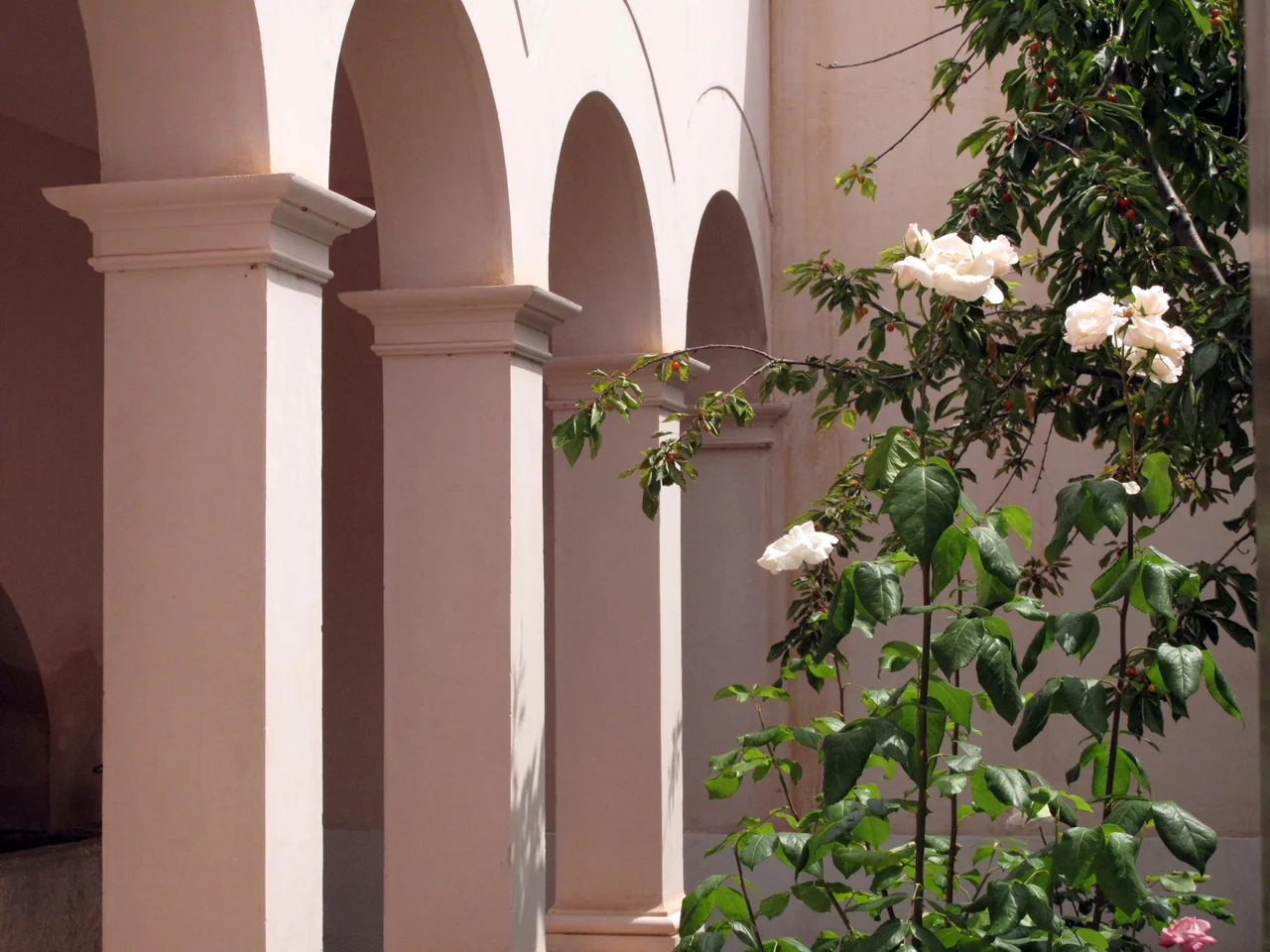

Cartoixa d'Escaladei
A shepherd, so the story goes, told the monks he had seen angels climbing a stairway into the clouds above Montsant. The Carthusians took it as a sign. They built their monastery at the foot of that mountain and called it Scala Dei, the Stairway of God, and for more than six centuries the name held true: a place of silence and solitude reaching, quite literally, toward heaven. From this remote valley in southern Catalonia the monks would plant the first vines of what is now one of Spain's most celebrated wine regions, before their charterhouse met a violent and abrupt end.
The Stairway of God
The monastery was born of conquest and quiet. King Alfonso II of Aragon founded it in 1194 as the first Carthusian house on the Iberian Peninsula, part of a deliberate effort to repopulate the recently reconquered lands of Catalunya Nova. The Carthusians, an order devoted to silence, solitude, and nature, could hardly have found a better setting than this valley beneath the Montsant range. The founding legend gave the place its soul as well as its name. When the first monks arrived, a shepherd is said to have described his vision of angels ascending a heavenly stairway into the clouds at the summit above, and the monks, hearing an invitation in it, made that image the identity of their new home.
The Monks Who Planted Priorat
By 1218 the community was firmly rooted, and King Jaume I granted it dominion over a cluster of nearby villages: La Morera, Gratallops, Torroja, Porrera, Poboleda, and Vilella Alta. Those names mean something to wine lovers today, because it was the monks of Scala Dei who introduced viticulture to this rugged country, raising their first vines in 1263. The villages under the monastery's care grew into the modern wine region of Priorat, whose steep slate terraces now produce some of Spain's most sought-after reds. There was a fitting rhythm to it all. The order's founder and the monastery's patron, Saint Bruno of Cologne, has his feast day in the first week of October, exactly when the grape harvest begins.
A Charterhouse of Painters and Books
Silence did not mean idleness. A rebuilding campaign begun in the 16th century and carried through the 17th and 18th gave the charterhouse a Baroque and Neoclassical grandeur, and Scala Dei became a genuine artistic center. It nurtured the Escaladei school of painting, whose masters included friar Lluís Pascal and friar Ramón Berenguer, and above all Joaquim Juncosa, who took his vows here in 1660 and became one of the great painters of the Catalan Baroque, filling the monastery with portraits and frescoes since lost. The monks were bookmakers too. One of only two surviving Catalan cookery manuscripts, El llibre de la Cuina de Scala-Dei, was written here in the early 17th century, and the scholar Alonso Tostado had trained as a novice in these walls two centuries earlier.
Burned in Two Days
The end came with brutal speed. In 1835, the government decrees of Mendizábal ordered the seizure of monastic property across Spain, and the monks of Scala Dei were forced to abandon the home their order had kept for over six hundred years. In the wave of anticlerical riots that swept Catalonia that year, mobs burned monasteries one after another, among them Poblet, Sant Cugat, and Scala Dei. Just one day after the monks departed, their charterhouse was sacked, and within days it was set ablaze. What had taken centuries to build was almost entirely destroyed in a matter of two days. The men who had lived in vowed silence here scattered, and their frescoes, their library, and their cloisters went up together.
From Ruins to Renewal
Even in ruin, the place kept working. In 1843 the surviving buildings were auctioned to five local families, who the following year founded a wine company, Sociedad Agrícola La Unión, carrying the monks' viticultural legacy into a new age. The stones themselves waited longer for care. In 1989 the former owners donated the ruins to the Catalan ministry of Culture, and in the years since the monastery has been partly renovated and opened to visitors. Today you can walk the roofless cloisters and imagine the community that prayed and painted and pressed wine here, while all around, on the terraced hillsides they first planted, the vines of Priorat still climb toward Montsant.
From the Air
The Cartoixa d'Escaladei lies at 41.257N, 0.810E, in the Priorat wine country at the foot of the Montsant range, inland and northwest of Tarragona. From 4,000 to 7,000 feet the dramatic limestone wall of Montsant is the key landmark, with the monastery ruins and the terraced vineyards of Priorat below its southern flank. Reus (LERS) is about 22nm southeast, Lleida-Alguaire (LEDA) roughly 32nm northwest, and Barcelona (LEBL) some 65nm northeast. Clear inland skies over the Montsant massif usually give excellent visibility of the mountain and the surrounding vineyard valleys.
Nearby Stories
- Vandellòs I nuclear incident 1.2 km away
- Horta de Sant Joan 3.1 km away
- Mequinenza 18 km away
- Battle of the Segre 18 km away
- Abric Romaní 24 km away
- Castellers de Vilafranca 28 km away
- Barbastro 64 km away
- Banyalbufar 170 km away