
Hotel de Ville, Boulogne-sur-Mer
Walk into the Place Godefroy de Bouillon - the square is named for the man who became the first Latin ruler of Jerusalem in 1099 - and the building in front of you tells the whole layered story of Boulogne in one glance. On the left, a square belfry of pale stone, stocky and ancient, built when Henry II of England still ruled half of France. Bolted onto its side, a long facade of red brick and stone trim from the 1730s, expanded in the 1850s and again in the 1930s. The belfry was the dungeon of the Counts of Boulogne. The brick is where Charles de Gaulle was welcomed in 1945. Eight centuries of municipal government, all in one wall.
The Belfry the Counts Built
The belfry came first - by more than five hundred years. Renaud I, count of Dammartin, commissioned it in the late twelfth century as part of the residence of the Counts of Boulogne. It was, in essence, the count's dungeon - the keep tower of his urban castle, his private symbol of judicial and fiscal power over the town. When Boulogne joined the royal domain in the late fifteenth century, the count's residence was repurposed for the common business of the burghers; the dungeon became the town's belfry. In 2005, UNESCO designated it part of a single World Heritage cluster of fifty-six belfries of Belgium and France, all in northeastern France and the Low Countries, all witnesses to the medieval rise of municipal power against feudal lords. The original spire burned down in 1712. Etienne Martinet replaced it with the octagonal capping tower that still crowns the structure today, finished in 1734.
The City Hall of 1734
By the early 1730s, the old town hall had become dilapidated. The mayor, Achille Mutinot, laid the foundation stone of a new building on 7 April 1734. Etienne Martinet - the same architect rebuilding the belfry tower - designed the new hall in a restrained neoclassical style: red brick with pale stone dressings, originally only six bays wide along the place. The interior held the Bureau du Maire, the mayor's parlour, and the Salle des Gouverneurs - a Rococo room decorated with portraits of Antoine d'Aumont, 1st Duke of Aumont, and his five successors as governors of the town. The building was a modest two storeys with a large attic. It has been added to twice since: an extra bay and an extra floor between 1854 and 1857 under Albert Debayser, who added the Doric porch and balcony to balance the facade, and an east wing by Pierre Drobecq opened in October 1934.
Three Paintings, Three Refusals
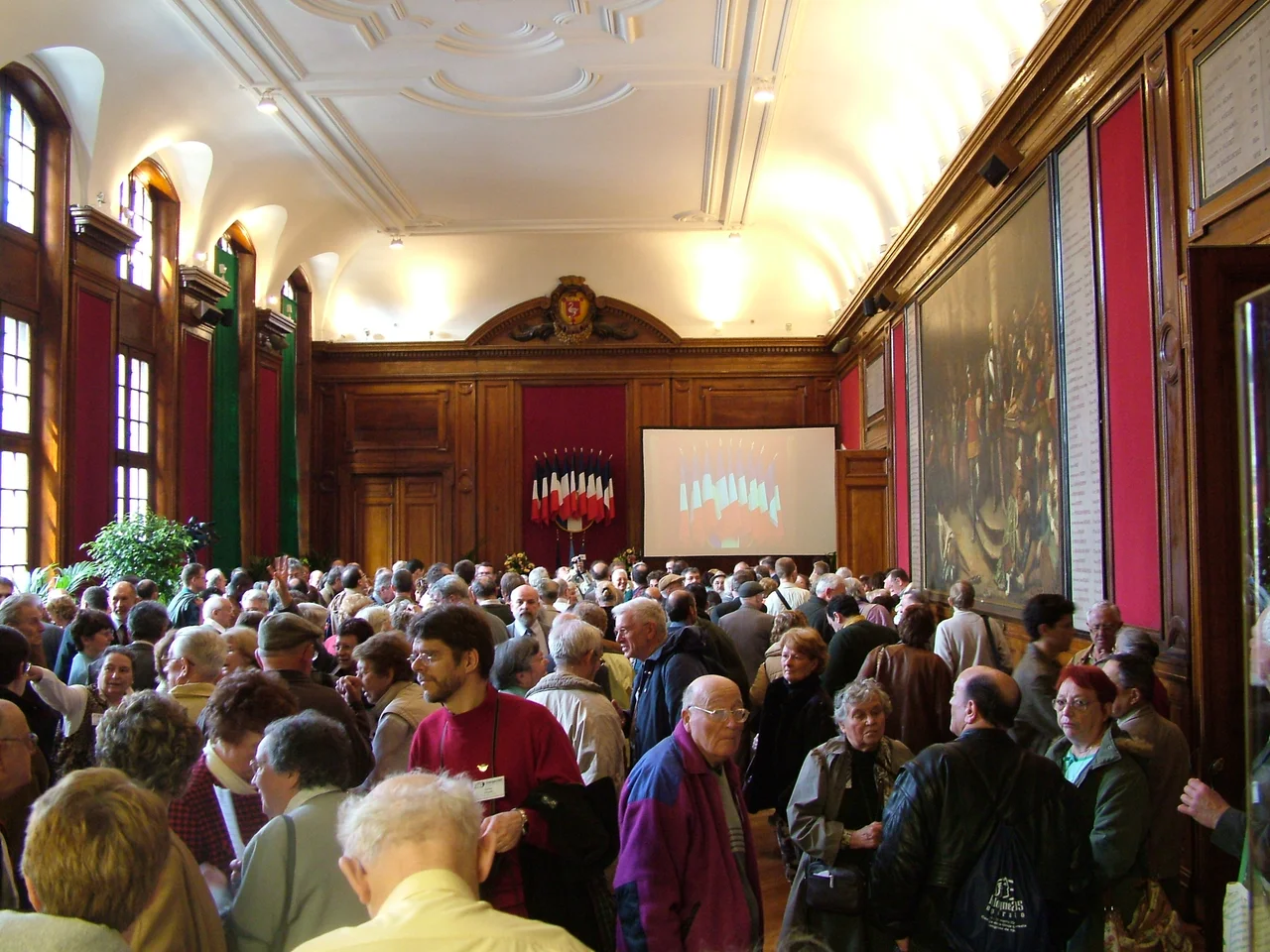
The paintings inside the hall tell stories the building cannot. In the Salle des Fetes, an enormous canvas by Claudius Jacquand shows the mayor Antoine Eurvin refusing to sign Boulogne's surrender to Henry VIII's English army during the siege of 1544. Another painting, by Francois Schommer, commemorates the visit of President Sadi Carnot in 1889 - five years before he was assassinated in Lyon. A third, by the lyrical-abstraction painter Georges Mathieu (a son of Boulogne, born 1921), depicts the medieval Battle of Tiberias, painted in 1958 and installed permanently in the hall in 1992. The paintings are political theatre: a city telling itself stories about resisting English kings, welcoming French presidents, and venerating its native artists - all in the room where the council still meets.
Liberation and de Gaulle
Boulogne's twentieth-century hour came on 22 September 1944, when the 3rd Canadian Division liberated the town as part of Operation Wellhit. The city had been catastrophically damaged - four years earlier the Battle of Boulogne had ended with Stukas demolishing block after block; in the four years between, German occupiers had ringed the town with Atlantic Wall fortifications, and Allied bombing had levelled much of what remained. The town hall survived. In August 1945, General Charles de Gaulle was welcomed inside by the mayor, Henri Henneguelle. De Gaulle returned in September 1959, this time as President of France, and went back into the same building. The post-war French Republic, the medieval county and the eighteenth-century municipality have all shared this address.
Climbing the Belfry
Today the belfry is open to visitors. The climb is steep - this was a thirteenth-century dungeon, not a tourist attraction - but at the top the view rewards everything below. To the west, the basilica's enormous dome. To the south, the cobbled streets of the Haute Ville and the line of complete medieval walls Philippe Hurepel rebuilt in the 1220s. To the east, the chateau-musee at the corner of those walls. Down below, the brick city hall steps out into the square named for Godfrey of Bouillon - the man who, with his brother Baldwin, took Jerusalem in 1099 and is buried, by his own account, beside the Holy Sepulchre. From an octagonal tower in a small French port, you can almost see the whole sweep of Boulogne's long argument with the world.
From the Air
Coordinates 50.725°N, 1.6133°E. View from 1,500-2,500 feet AGL. The Hotel de Ville sits in the medieval Haute Ville on Place Godefroy de Bouillon, with the belfry's octagonal tower (rebuilt 1734) the distinguishing feature. Just west, the basilica's 101-metre dome dominates the skyline. Nearest airfield: Le Touquet-Cote d'Opale (LFAT), 30 km south. The complete medieval city walls around the Haute Ville are clearly visible from the air.
Nearby Stories
- Siege of Gravelines (1644) 1.7 km away
- Battle of Dungeness 4.8 km away
- 1996 Channel Tunnel fire 6.3 km away
- Battle of Saint-Omer 11 km away
- Dungeness Lighthouse 23 km away
- Courrieres Mine Disaster 56 km away
- Cléon 126 km away
- Battle of Cocherel 156 km away