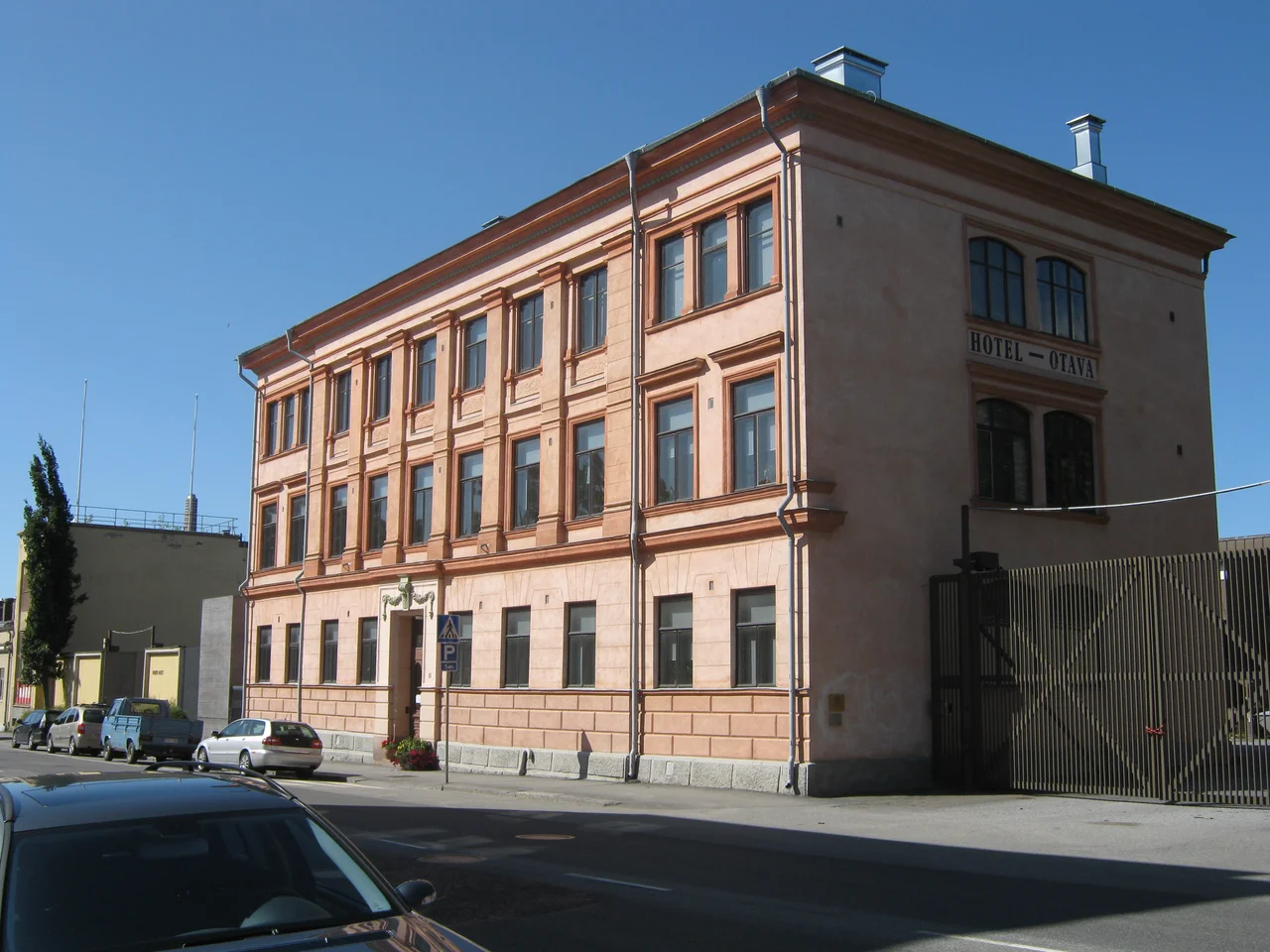

Hotel Otava
On the evening of 13 October 1872, in the auditorium of a provincial hotel in a Finnish timber and tar port, a touring company calling itself Suomalainen Teatteri gave its first performance. That company is now the Finnish National Theatre, and it takes that night in Pori as its beginning. Finland was a Grand Duchy of the Russian Empire then, Swedish was still the language of law, commerce and the educated classes, and the idea of serious drama performed in Finnish struck a good many people as either provincial or seditious. It started here, in Hotel Otava, a building that had been open for fifteen years and would keep taking guests for another 113.
Named for the Plough
The hotel went up in 1857 to a design by C. J. von Heideken, the Swedish architect who had come to Pori as city architect in 1853, one year after fire consumed three quarters of the town. He gave it a Neo-Renaissance face and two storeys, containing rooms for guests and a drawing room that was later reworked into a theatre. The name is a small piece of poetry. Otava is the Finnish name for the constellation figure that English speakers call the Big Dipper or the Plough - a group of stars that in northern latitudes is visible almost every clear night of the year, wheeling around the pole and never setting. Naming a hotel after it was a promise of a kind: this is a fixed point, you will always be able to find it.
The Bergboms' Long Tour
The company that opened in the Otava's auditorium was run by two siblings, Kaarlo and Emilie Bergbom. Kaarlo directed until 1906 and Emilie stayed until 1917, and for their first thirty years the theatre had no home at all. It toured. It played wherever a hall could be found, in a country where the language it performed in had no established dramatic tradition and had to build one performance by performance. Not until 1902 did it get a building of its own, Onni Tarjanne's National Romantic pile beside Helsinki's central railway station, which opened on 9 April that year - the moment the company was renamed the Finnish National Theatre. The Otava's own stage had a shorter career. In 1882 the theatre room was converted into a concert hall and dance hall, and the drama moved on.
A Block Built of Stone and Beer
The Otava does not stand alone. Its block holds the Pori Brewery, whose predecessor a merchant named Gustav Adolf Backman established in 1853, and Pori Theatre, which opened in 1884 - so within a few dozen metres you have the birthplace of Finnish-language theatre, the building that replaced it, and the place that supplied the interval drinks. The brewery had a long run. It made Karhu beer from 1929, put the first canned beer on the Finnish market in 1961, passed to Sinebrychoff in 1972 and stopped brewing in September 2009. All of it belongs to Kivi-Pori, the stone town that rose after the 1852 fire, which the Finnish National Board of Antiquities lists as a cultural environment of national significance. In 1891 the Otava gained a third storey, giving it the height von Heideken had originally intended. He had died three years earlier, and the work fell to Johan Erik Stenberg, the architect of the theatre next door.
Officers in the Guest Rooms
War brought the building tenants it had not chosen. During the Continuation War, German staff officers were quartered at the Otava while their airbase operated at Pori airfield a few kilometres from the door. When the fighting ended and Finland changed sides, the rooms did not empty for long. Officers of the Allied Control Commission - in practice a Soviet body - moved into the same hotel to supervise the terms of the armistice. Within a handful of years the Otava had housed the staff of one great power and then the staff of its enemy, in the same corridors, served by the same people, who presumably said very little to either. Nothing in the fabric of the building records any of this. Hotels absorb history without commenting on it.
Closing the Ledger
The Otava took its last guests in 1985. At that point it had been operating continuously for 128 years and was the oldest hotel-restaurant in Finland still in business, which is an honour that arrives at exactly the moment it stops mattering. The city of Pori bought the property in 1997. Restoration began in 2000, cost three million euros, ran six years, and returned the building to its original dimensions; it reopened in 2006 as offices for the city administration. It has not been an entirely quiet retirement. In the summer of 2016 the ceiling of one room came down, the building was placed under a use ban while every other ceiling was checked, and staff were only able to move back at the end of that year. It stands now on its block with the brewery and the theatre, holding municipal desks in rooms where a Finnish-speaking audience first watched a play in their own language.
From the Air
Hotel Otava stands at 61.489N, 21.791E in the Kivi-Pori stone quarter of central Pori, western Finland, close to the south bank of the Kokemaenjoki. The river is the navigation anchor, running west and fanning into the largest river delta in the Nordic countries before reaching the Gulf of Bothnia about 10 km downstream. Pori Airport (EFPO) sits roughly 3 km northwest of the building - the same field that held the German airbase whose officers were billeted at the hotel during the war. Tampere-Pirkkala (EFTP) is about 100 km east-southeast and Turku (EFTU) about 130 km south. Fly 1,200-2,500 feet to pick out the block, which reads as a dense masonry island inside the airy post-1852 grid of wide esplanade parks. Expect coastal low cloud and haze in spring and autumn, snow showers off the sea in winter, and only a few hours of usable daylight in December.
Nearby Stories
- Church of the Holy Cross, Rauma 7.5 km away
- Kirkkokari 9.9 km away
- Kokemäki Castle 20 km away
- Oura Archipelago 21 km away
- Ikaalinen 49 km away
- Archipelago Sea 97 km away
- Battle of Bomarsund 144 km away
- Härnösand Cathedral 194 km away