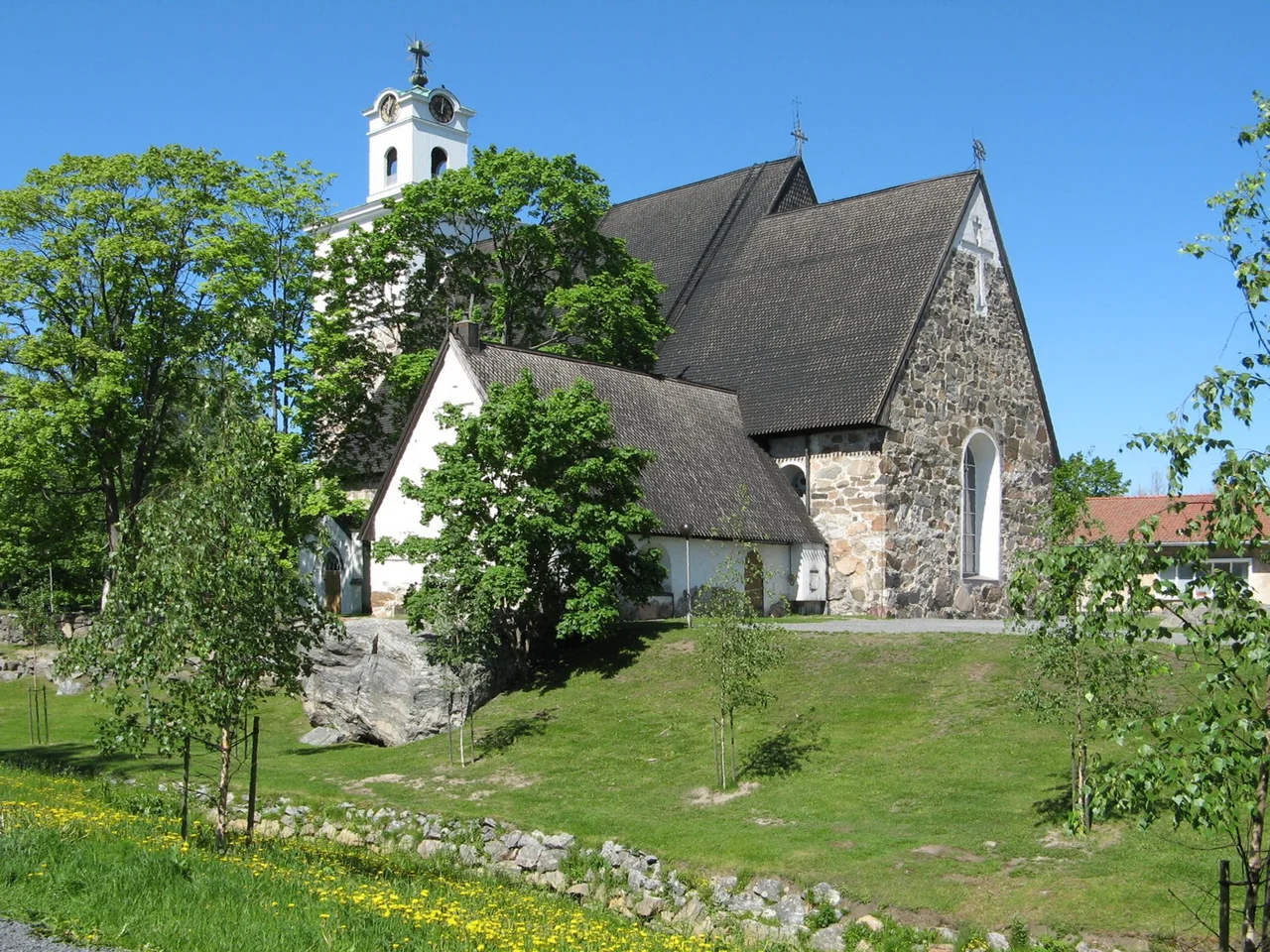

Church of the Holy Cross, Rauma
The church stood empty for a hundred years, and what eventually saved it was a disaster somewhere else in town. When the Swedish Reformation dissolved the Rauma Franciscan Friary in 1538, the brothers went and their church lost both its community and its purpose. Grey granite is patient. The building simply waited by the Raumanjoki, roofed and locked and useless, while the town got on with the sixteenth century. Then in 1640 fire tore through Rauma and destroyed the Church of the Holy Trinity, which had been serving the parish, and the townspeople needed somewhere to worship the following Sunday. The old monastery church down by the stream was still standing, and it has been in use ever since.
Boulders, Gathered and Stacked
The Franciscans established their friary in Rauma in the early fifteenth century and put up a wooden church around 1420. The stone building that replaced it is harder to date than you would expect of something this large: the exact age is unknown, historians place its completion somewhere in 1515–1520, and at least one account gives an inauguration as early as 1512.
What is not in doubt is how it was made. This is a fieldstone church — grey granite boulders collected off the surrounding ground, roughly shaped and laid up in lime mortar rather than quarried and dressed into neat blocks. Finnish medieval masons worked with what glaciers had left them, and the result has a lumpy, geological quality that dressed ashlar never achieves. Inside, the plan is two-aisle: two naves side by side, rather than the single hall most visitors expect.
Painted for a Bishop Who Drowned
The choir carries fresco-secco murals — pigment laid on dry plaster rather than wet — telling the Biblical story of salvation across the vault. They date from the episcopate of Arvid Kurck, Bishop of Turku from 1510 to 1522 and the last genuinely Catholic bishop Finland had.
Kurck did not die peacefully. He backed Sten Sture the Younger against the reimposition of Danish rule, and he survived the Stockholm Bloodbath of 1520 only by declining to attend Christian II's coronation, where a great many of his political allies were executed. Two years later he joined the rising against the Danish king, the rising failed, and Kurck fled toward Sweden. He drowned in a shipwreck off Öregrund on 22 July 1522, at around fifty-eight. Within a generation the church he had helped decorate belonged to a faith he had spent his career defending against. The paint on the vault outlived the world that commissioned it.
The Year the Brothers Left
The dissolution came in 1538, part of the wider Swedish Reformation that stripped the monastic orders of their houses and their income. For the friars this was not a theological debate but an eviction. Men who had entered the order as young and expected to die in it were turned out of the only institution they had, in a country where a mendicant with no house had few options. Tradition on the coast north and south of here holds that some of them went on to raise churches in the small island parishes, including at Pyhämaa.
Behind them they left a church nobody was allowed to use. For a hundred years it took no services, held no congregation and buried nobody. Rauma is a town that has burned repeatedly — 1640 and 1682 both took most of the wooden houses — and the fact that this stone shell was standing, unused and undamaged, when the parish suddenly needed it is the closest thing in its history to luck.
A Tower Built From a Ruin
The church was re-established as a Lutheran parish church in 1640, straight after the fire. Its rival did not recover: the Church of the Holy Trinity, also fifteenth-century, was left as ruins.
Those ruins were eventually put to work. When a bell tower was added here in 1816, it was built out of stone hauled from the Holy Trinity site — the burned church physically absorbed into the surviving one, course by course. The tower was finished with a white steeple, and that steeple became a navigation mark. Crews working in from the Bothnian Sea toward Rauma looked for the white point above the low roofs and knew where the harbour was. A church built by friars, emptied by a king, refilled by a fire and topped with a landmark for sailors is a fairly complete summary of what this coast does to buildings.
The Only Old Stone Left
Old Rauma went onto the UNESCO World Heritage List in 1991 — twenty-nine hectares, some six hundred buildings, roughly eight hundred residents — as the best surviving example of a Nordic wooden town on its medieval street plan. Almost everything in it is timber, almost all of it one storey, and almost none of it predates the eighteenth century, because the fires kept resetting the clock.
The Church of the Holy Cross is one of only two ancient stone structures still standing in the district; the Old Town Hall of 1776 is the other. Walk in off the narrow lanes and the temperature drops, the noise stops, and you are suddenly inside the one part of Old Rauma that was there before any of it.
From the Air
The Church of the Holy Cross stands at 61.1297°N, 21.5122°E, beside the Raumanjoki stream in the UNESCO-listed wooden quarter of Old Rauma. From 1,500–3,000 feet the district reads as a tight, irregular grid of small red, ochre and pale-green roofs, noticeably finer-grained than the modern blocks around it; the church's white steeple is the tallest thing in that grid and the easiest single point to identify. The Rauma shipyard and port lie about 3 km southwest on the coast, with Kylmäpihlaja Lighthouse a further 6 nm out to sea. Nearest controlled fields are Pori (EFPO) about 22 nm north-northeast, Turku (EFTU) about 43 nm southeast, and Eura (EFEU) about 20 nm east. Summer light here is long and low, which makes the wooden town glow in late evening; winter brings short days, frequent low cloud and snow cover that flattens the roofline into a single white plane.
Nearby Stories
- Uusikaupunki Automobile Museum 9.5 km away
- Köyliönjärvi 11 km away
- Kurjenrahka National Park 17 km away
- Jusélius Mausoleum 17 km away
- St. Olaf's Church, Tyrvää 42 km away
- Archipelago Sea 58 km away
- Battle of Bomarsund 108 km away
- Härnösand Cathedral 218 km away