
Jusélius Mausoleum
In 1867 tuberculosis killed Fritz Arthur Jusélius's father. He was twelve years old. Thirty-one years later the same disease took his daughter Sigrid, who was eleven. She had caught measles, and the tuberculosis followed it into her lungs. Jusélius was by then one of the largest timber exporters in Finland, a member of parliament for Pori and a man with the means to do almost anything he wanted. What he did was build his daughter a tomb, hire the greatest Finnish painter of the age to decorate it, and — three decades later — leave everything he owned to medicine.
Sigrid
Sigrid Maria Jusélius was born in 1887 and died in 1898. That is nearly all the public record holds about her, which is the ordinary fate of children who die young: the buildings outlast the biography.
Her father commissioned the architect Josef Stenbäck, and between 1901 and 1903 a Gothic Revival mausoleum rose at the edge of Pori's Käppärä Cemetery, which had itself only been laid out in 1884. It is a small, steep, spired building of stone, more chapel than monument. Sigrid's sarcophagus, cut from white Italian marble to a design by the architect Jarl Eklund, lies in the basement, and it is visible from the floor above — so that anyone standing in the painted chamber is standing directly over her. The bronze door was made by the sculptor Alpo Sailo. The Sigrid Jusélius Foundation's own history of her father records that he visited his daughter's coffin every day.
The River of the Dead
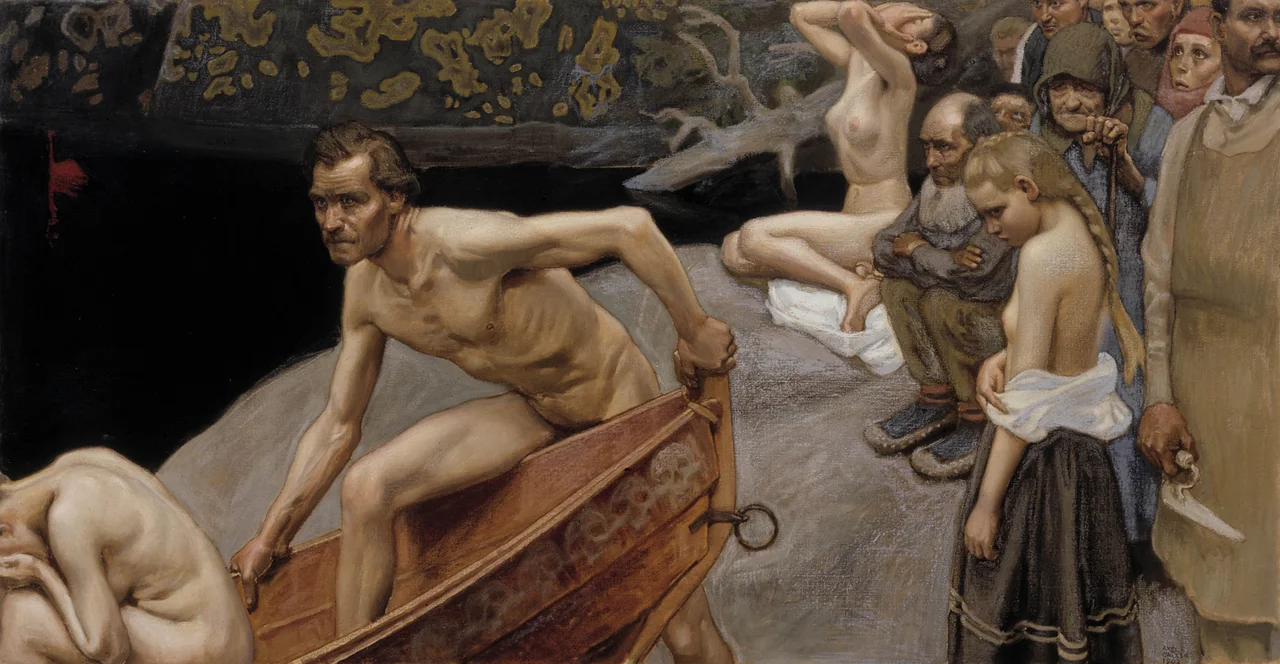
For the interior Jusélius engaged Akseli Gallen-Kallela, the painter who more than any other gave Finland a national visual language. Gallen-Kallela worked on the chamber between 1901 and 1903, drawing on biblical material, on Finnish folk mythology and on plain allegory. The cycle included *Kevät* (Spring), *Syksy* (Autumn), *Talvi* (Winter), *Rakennus* (Construction), *Hävitys* (Destruction) and *Tuonelan joella* (By the River of Tuonela).
That last title carries the weight of the room. Tuonela, in the Kalevala and in older Finnish belief, is the land of the dead, reached across a dark river. A grieving father asked a painter to put the crossing on the wall above his daughter's grave, alongside the turning of the seasons and the building and unbuilding of everything. The photographs of Gallen-Kallela at work on *Spring* in 1903 show a man on scaffolding in an unfinished stone box, painting for an audience of one.
Damp, Then Fire
The paintings began to fail almost at once. The mausoleum was unheated and unventilated, its walls built of porous sandstone, and the Finnish climate did the rest: moisture worked through the stone and dissolved potassium nitrate in the mortar behind the plaster. Within a few years the frescoes were visibly deteriorating.
Then, in December 1931, a fire destroyed them completely. Neither of the two men most invested in them lived to see it. Jusélius had died in February 1930, at seventy-four, and had been buried in the mausoleum's side chapel, near Sigrid. Gallen-Kallela died in March 1931, of pneumonia, on his way home from a lecture in Copenhagen. The building that had been made to hold one death was, within a generation, holding the loss of the work itself.
The Son's Commission
Akseli Gallen-Kallela's sketches for the cycle had survived, and the task of repainting the chamber from them went to his son. Jorma Gallen-Kallela, born in 1898 — the year Sigrid died — was a painter in his own right who had worked alongside his father on the Kalevala frescoes in the lobby of the National Museum of Finland in 1928. He began at Pori in 1933 and was still at it in 1939.
On 1 December 1939, the second day of the Winter War, Lieutenant Jorma Gallen-Kallela was inspecting a downed Soviet aircraft with Captain Adolf Ehrnrooth when the two came under ambush. He threw himself over Ehrnrooth. The captain lived; Gallen-Kallela died of his wounds, aged forty-one. The mausoleum reopened in 1941, two years after the man who had repainted it was killed.
What the Money Was For
Jusélius had made his own arrangements long before. On 3 May 1927 he signed away his entire estate, and his reasoning is in the document itself: because his loved ones had suffered illness and premature death more often than most, the money should go to medical research. He wrote it, in effect, as a bill sent back to the diseases.
The Sigrid Jusélius Foundation was confirmed in May 1930, weeks after his death, and made its first grants in 1949. It is now the largest private funder of medical research in Finland, distributing millions of euros a year to researchers and institutes working on the illnesses that kill people. The mausoleum and the surrounding Käppärä Cemetery are listed as a cultural environment of national significance. Visitors come for the frescoes, which are extraordinary. What they are actually standing inside is one man's refusal to let his daughter's death mean nothing at all.
From the Air
The Jusélius Mausoleum sits at 61.4877°N, 21.7594°E in the Käppärä district of Pori, on Finland's Gulf of Bothnia coast. It is a small spired stone building and will not be picked out from cruise altitude; instead navigate by the Käppärä cemetery itself, a distinct rectangle of dense mature trees and open ground within the Pori street grid, a little southeast of the city centre. Useful sightseeing height is 1,000–2,000 ft AGL. Pori Airport (EFPO) lies roughly 5 km west-northwest, making this one of the easiest heritage sites in Finland to reach by light aircraft; the broad Kokemäenjoki river and its delta run west of the city toward the Yyteri dunes and the sea. Coastal fog and low cloud are frequent in spring and autumn, and Villa Mairea at Noormarkku is only about 15 km northeast for a two-stop visit.
Nearby Stories
- Church of the Holy Cross, Rauma 7.5 km away
- Kirkkokari 9.9 km away
- Kokemäki Castle 20 km away
- Oura Archipelago 21 km away
- Ikaalinen 49 km away
- Archipelago Sea 97 km away
- Battle of Bomarsund 144 km away
- Härnösand Cathedral 194 km away