
Hougoumont
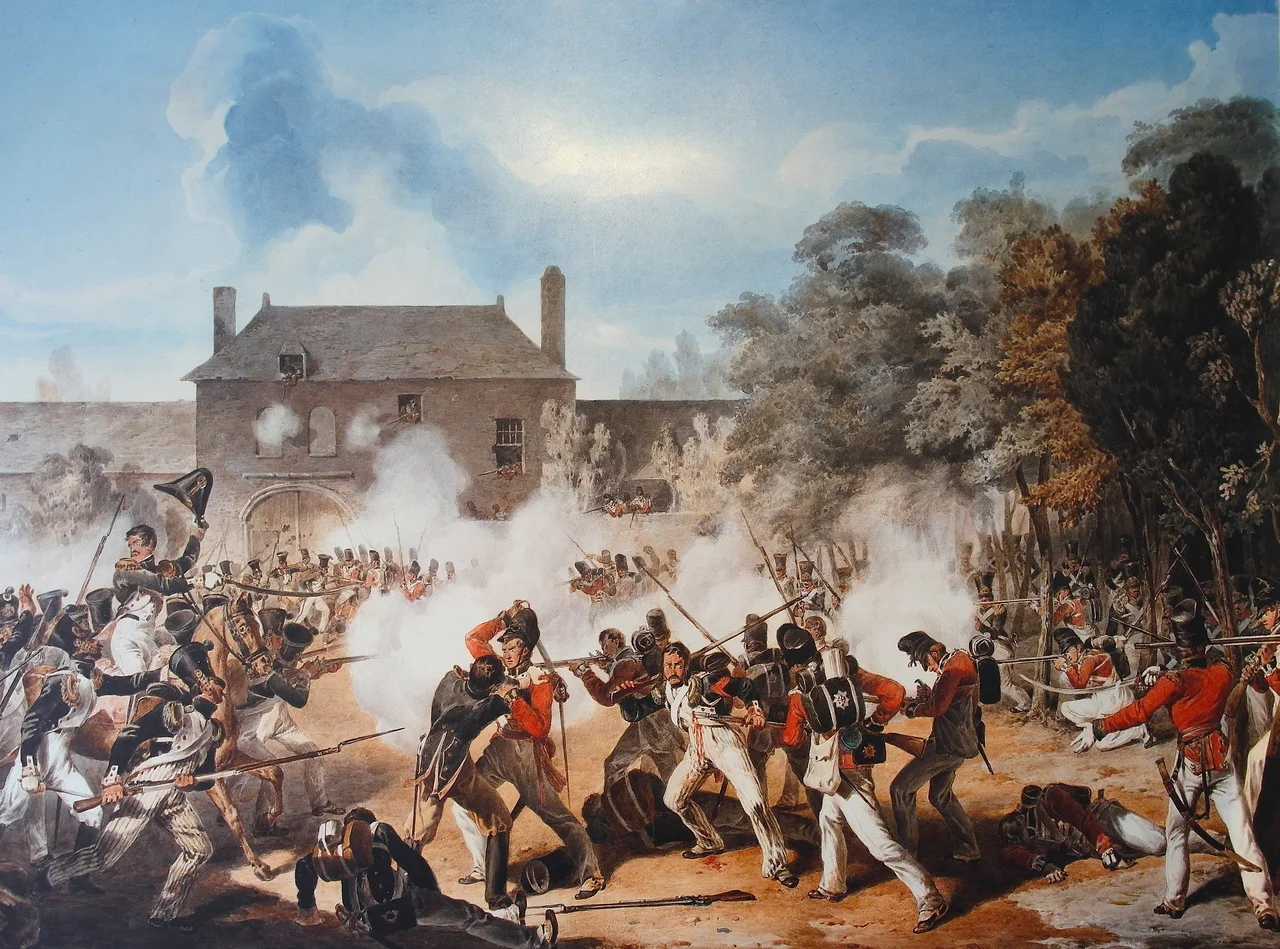
It was the corporal who got his shoulder against the gate. James Graham of the Coldstream Guards, helping a handful of officers shove against the iron-hinged north door of a farm in the Belgian countryside on the afternoon of 18 June 1815, while French soldiers of the 1st Légère pressed from the outside and a French sous-lieutenant named Legros, axe in hand, had already chopped his way in. Get the gate shut, and a small British garrison holds. Leave it open, and Napoleon punches through Wellington's right flank. The Château d'Hougoumont sits below an escarpment near Braine-l'Alleud, a walled compound of house, barns, chapel, and orchard, and for one long day it was the hinge on which the Battle of Waterloo turned. Wellington said so himself, afterward, in plain words: the success of the battle turned upon the closing of the gates at Hougoumont.
A Manor with a Mission
Before Waterloo, Hougoumont was just a working manor with a long memory. The name traces back to a 1356 mention of the "tenure and house of Gomont" in the seigneury of Braine-l'Alleud, and to a 1358 record in the allodial court of Brabant. By 1777, when Count Joseph de Ferraris drew his great map of the Austrian Netherlands, the place appeared as Château Hougoumont, a corruption of the older Goumont. High stone walls connected the main house to barns, stables, and a chapel. There was an orchard and a kitchen garden. None of it had been designed for battle, but stone walls and wooden gates have a way of becoming military architecture when armies arrive. On the evening of 17 June 1815, Wellington put men inside: the 1st Battalion of the 2nd Nassau Regiment, jägers and landwehr from Hanover, and the light companies of the Coldstream Guards and the Third Guards under Lieutenant-Colonel James Macdonell. The farm became a strongpoint on the allies' right.
Napoleon's Long Diversion
The plan was supposed to be simple. Napoleon would feint at Wellington's right, draw the British reserve toward Hougoumont, and then drive his weight through the centre near La Haye Sainte. Maréchal de Camp Pierre Bauduin led the first French brigade forward in late morning; the British guns answered, Bauduin was killed, and the wood around the farm filled with French infantry. A second brigade, under Baron Soye, managed a small breach on the south wall but could not exploit it. Then the north-side attack came, and the gate, and Legros with his axe. After Macdonell and Graham forced the gate closed, all the Frenchmen trapped inside were killed except one — a drummer boy, spared in the close, terrible fighting. Hougoumont was now a wound Napoleon could see from his own headquarters, and could not leave alone. He sent, in the end, roughly 14,000 men in 33 battalions of II Corps under Honoré Reille against a garrison that never amounted to more than a few thousand. Wellington answered by feeding 12,000 troops up the hollow way to keep the farm supplied, and shifted artillery from his strained centre. The feint had become the engagement that drained Napoleon's afternoon.
The Well, the Wood, and Victor Hugo
In Les Misérables, Victor Hugo describes 300 bodies thrown down a well at Hougoumont. It is one of the most famous images of Waterloo in literature, and it is almost certainly wrong. When Derick Saunders excavated the well in 1985, he found no human remains. What is harder to dismiss is the gentler horror of a contemporary account. A month after the battle, an English tourist was led around the field by the local guide Jean-Baptiste Decoster; in his diary the visitor describes another well — likely at Hougoumont — holding 73 dead, and an orchard whose trees were "peppered very much," and the ditch around the orchard used as a battery where "hundreds killed," and in a single acre, forty graves of English officers laid out like furrows. Whatever the truth of Hugo's well, the fields and walls around the farm had absorbed the bodies of thousands of men, French and British and German alike, each one someone's son.
The Gates, Two Centuries On
Hougoumont remained a working farm into the late 20th century, but by 2006 the walls that had once been a clean white had turned a dirty yellow, and the door post on the north gate — the gate — was visibly damaged. Project Hougoumont took up the rescue, backed by the then Duke of Wellington, the novelist Bernard Cornwell, and the late historian Richard Holmes. The Landmark Trust contributed in exchange for the right to let the Gamekeeper's Cottage to travellers. Restoration finished in June 2015 at a cost of about £3 million. The day before the bicentenary, Charles, Prince of Wales unveiled a memorial by Vivien Mallock beside the north gate: two life-size soldiers, captured in bronze at the exact moment they push the gate closed. On 18 June 2015, two centuries to the day, Hougoumont opened to the public as a place to remember what the buildings had been asked to do.
From the Air
Hougoumont sits at 50.6706 N, 4.3942 E, in the gently rolling farmland of Braine-l'Alleud about 15 km south of Brussels. The walled compound is small but distinctive from the air: a tight cluster of pale farm buildings just south of the Waterloo battlefield ridge, west of the modern N5 road and the famous Lion's Mound, which rises 40 m and is the easiest landmark for fixing the battlefield. Recommended viewing altitude 1,500-3,000 ft AGL in clear weather. Nearest airports: Brussels (EBBR) about 25 km north, Charleroi (EBCI) about 35 km south. Belgian airspace is tightly controlled; expect TMA constraints near EBBR.
Nearby Stories
- Basilica of Our Lady of Scherpenheuvel 4 km away
- Battle of Melle 4.9 km away
- Spanish Fury at Mechelen 6.7 km away
- Marcinelle Mining Disaster 8.4 km away
- Raffinerie Tirlemontoise 10 km away
- Egmont Castle 18 km away
- Courrieres Mine Disaster 69 km away
- Fort Jeanne d'Arc 169 km away