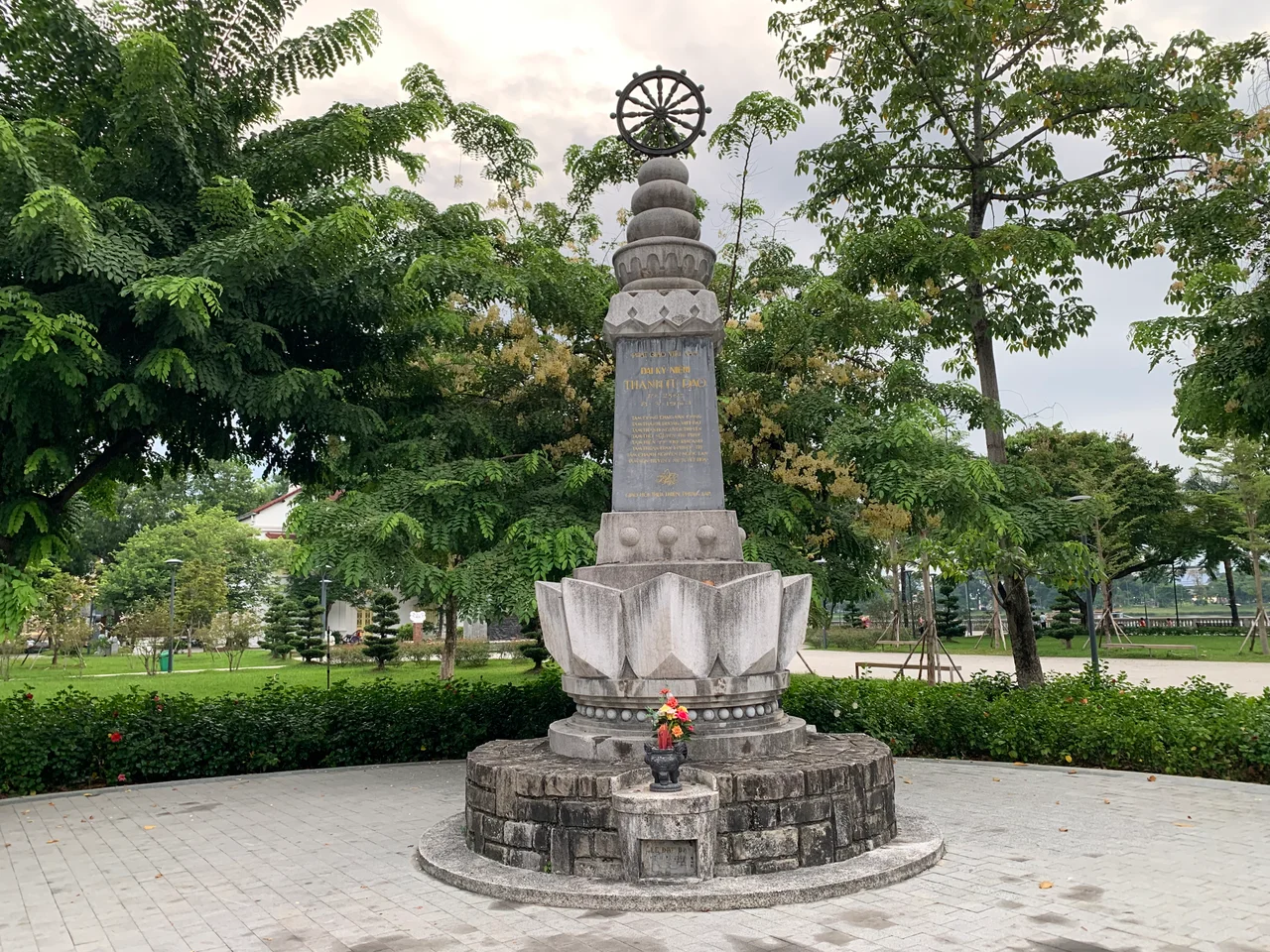

Huế Phật Đản Shootings
Phật Đản — the birthday of Gautama Buddha — was a day for flags and gathering. On 8 May 1963, thousands of Buddhists in Huế came together to celebrate it. They carried signs in both Vietnamese and English, the English intended for Western correspondents whose coverage they hoped would reach the world. What they met instead were armored personnel carriers, fire hoses, and grenades. Nine people died. Two of the dead were children, crushed beneath military vehicles. Some of the victims were mutilated. The government of President Ngô Đình Diệm said the Việt Cộng had caused the incident. Eyewitnesses said soldiers had opened fire on a crowd that was asking for the right to fly a flag.
The Flag and the Decree
The shootings did not come without warning. A week before Phật Đản, Catholic flags had flown openly across Huế to celebrate the 25th anniversary of Archbishop Ngô Đình Thục's appointment — Thục being the president's brother. Catholics had reportedly been required to pay a month's wages to fund the celebration. Then, on 7 May, a deputy province security commander named Major Đặng Sỹ invoked a rarely enforced 1958 law, Decree Number 10, to ban the display of religious flags. Thousands of Buddhist flags that had already been hung on homes and pagodas were torn down.
Buddhists understood the disparity immediately. The Vatican flags from the Catholic celebration remained on display. Only the Buddhist flags were removed. The following day, Phật Đản, more than five hundred people marched across the Perfume River to the Từ Đàm Pagoda, where a crowd of three thousand gathered in the city center as government forces surrounded them with armored personnel carriers.
What Happened Outside the Radio Station
The monk Thích Trí Quang had addressed the crowd during the day, calling for resistance to religious discrimination. That evening, he called on people to gather outside the government radio station to hear a speech he had prepared. The government's censor pulled the broadcast.
As the crowd grew restless at the censorship, two explosions shook the area. Major Sỹ reportedly fired his weapon into the air. His soldiers responded by launching grenades into the crowd while fire hoses swept demonstrators off their feet. The troops fired directly into the people. Nine civilians died — among them children. Four others were severely injured. The dead and the wounded were ordinary people who had come to hear a speech on a religious holiday, carrying signs asking for equal treatment.
Diệm ordered the bodies buried without autopsy. A local doctor who concluded that the fatal injuries had not been caused by plastic explosives — contradicting the official account — was subsequently jailed.
Denial and Its Consequences
The government's response to the killings compounded the harm. Diệm blamed the Việt Cộng for the explosion that allegedly started the stampede, a claim that eyewitnesses disputed and that physical evidence did not support. He refused to discipline the officials responsible and described the victims' demands for religious equality as the complaints of "damn fools" — language that appeared in an official government press release.
U.S. Ambassador Frederick Nolting, known for his policy of accommodating the Diệm regime, attempted to distribute blame among all parties. His deputy William Trueheart, left in charge while Nolting departed for vacation, eventually ended that policy. On 18 May, modest concessions were extracted: $7,000 in compensation for the nine families and a nominal agreement to dismiss the responsible officials. The dismissals were framed publicly as failures of order control, not acknowledgments of responsibility for the deaths.
The monk Thích Trí Quang rode through the streets of Huế the night of the shootings with a loudspeaker, accusing the government of having fired on the demonstrators. He was telling the truth.
The Reckoning That Came
The Phật Đản shootings did not end the crisis — they began it. What followed was six months of escalating civil disobedience, self-immolations by Buddhist monks that shocked the world, and growing American alarm about the Diệm regime's stability. The Buddhist crisis gave the U.S. government reason to tacitly support the military coup of 1 November 1963. Diệm was deposed and assassinated the following day.
After the coup, Major Đặng Sỹ stood trial. He reportedly later claimed that Archbishop Thục had personally ordered him to shoot the Buddhists, but refused to testify against Thục, who was living in exile in Rome. Sỹ was sentenced to life imprisonment. He was later released by a defense minister who claimed the trial had been politically rigged, and eventually emigrated to the United States.
The nine people who died outside the radio station in Huế on 8 May 1963 were not insurgents or agitators. They were worshippers, gathered on a holy day, asking their government to treat their faith the same way it treated another's. Their deaths mattered — to the movement that followed, to the historians who documented it, and to the city of Huế, which has carried this history in its streets ever since.
From the Air
The shootings took place in central Huế at coordinates 16.4672°N, 107.5903°E, near the Từ Đàm Pagoda and the government radio station on the south bank of the Perfume River. At 2,500 feet, the Perfume River (Hương Giang) is the city's dominant visual feature — a wide curve of water with the walled Citadel visible on its north bank. Nearest airport: Phú Bài International (VVPB), approximately 12 km south-southeast. Da Nang International (VVDN) lies roughly 90 km to the southeast.
Nearby Stories
- Battle of Fire Support Base Ripcord 4 km away
- Sơn Trà Mountain 5.8 km away
- Quảng Trị Citadel 7.3 km away
- Battle of Nam Dong 10 km away
- Hội An wreck 56 km away
- Battle of Cua Viet 65 km away
- Saravan 100 km away
- Hainan Island Incident 342 km away