
Illaunloughan
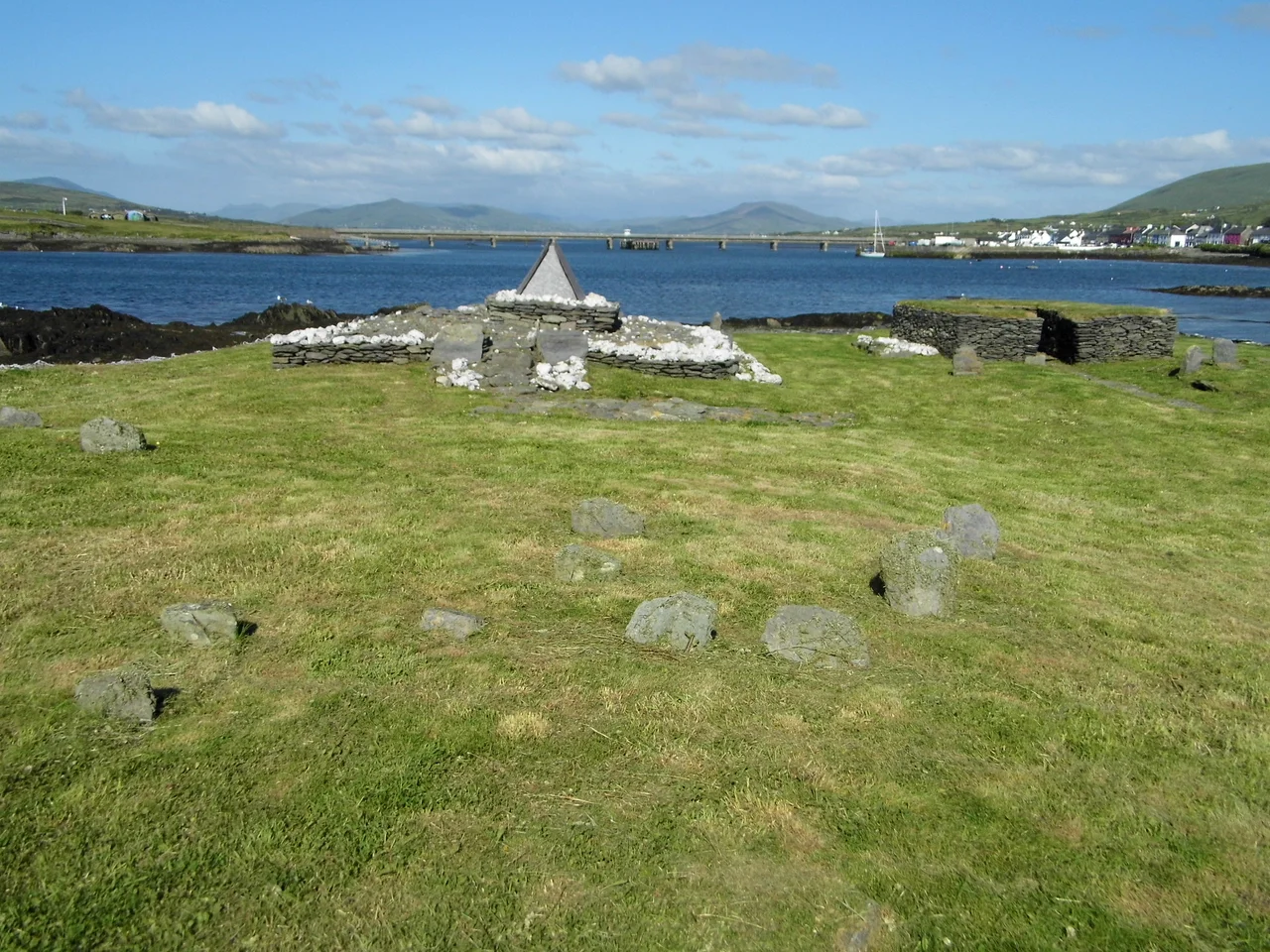
Three-tenths of an acre. That is the entire territory of Illaunloughan, a sliver of rock and grass in the Portmagee Channel between Valentia Island and the Iveragh mainland. You could walk around it in a few minutes. And yet someone in the late 7th century looked at this miniature island and saw a place to found a Christian monastery, with dry-stone oratories, altars, and a shrine where the relics of its saints would be set into quartz and scallop shells. The community here lived by fish and seabirds, by sheep brought in by boat, and by the rhythm of pilgrims passing south toward a much more famous rock on the horizon.
The Saint Whose Name Is Seaweed
The Martyrology of Tallaght, an early Irish list of saints compiled around AD 800, names two figures called Lochan. One of them may have been the founder of this monastery, though the connection cannot be proved. The matter is complicated by a quiet pun: in Irish, lochan can mean a small lake, but it can also refer to a kind of seaweed, exactly the sort of seaweed that would have draped the rocks of this very island at every low tide. The name Illaunloughan thus carries a doubled sense, half saintly and half coastal, that the early monks would have heard immediately.
On the Way to Skellig Michael
Look southwest from Illaunloughan and the silhouette is unmistakable, even at nine nautical miles. The twin peaks of Skellig Michael rise in stark profile from the Atlantic, the most famously austere monastic site in Ireland. Illaunloughan was likely a way-station for pilgrims travelling out to that wilder rock, a sheltered stop where the journey could be paused, prayers said, and provisions taken on. Archaeology backs this up. The site's middens contain not only fish and seabird bones, the expected food of a coastal community, but also oats and meat, suggesting more visitors than just the resident monks. Excavation also uncovered evidence of fine metalwork being cast on the island, a craft well above the level of bare subsistence.
Quartz, Shells, and the Camino Connection
The most striking thing the excavators found was a gable shrine built to hold the relics of the community's saints. The structure was decorated with quartz and scallop shells, two materials that travel together far beyond Kerry. The scallop, in particular, was the badge of pilgrims walking the Camino de Santiago across northern Spain, where it signified the road to the tomb of Saint James. Whether the monks of Illaunloughan made the connection consciously, or whether the shell simply carried an older meaning across the Christian west, the result is the same: a tiny Irish island sharing a visual language with a pilgrimage route hundreds of miles away.
The Saddest Use
The monastery had largely ceased to exist by the 9th century, but Illaunloughan was not abandoned. Up to the 20th century, the island was used as a cillin, a burial place for unbaptised infants, and as a general graveyard for local people. In Catholic Ireland, infants who died before baptism could not be buried in consecrated ground, so families took them by boat to places like this, set apart by water from the parish cemeteries. The pain in that history is real and recent; some of the families remembering a small grave on Illaunloughan are still alive. The dry-stone altars and the gable shrine still stand, weathered to the colour of the rock around them, and the island is now a quiet National Monument.
From the Air
Illaunloughan sits at 51.89 N, 10.37 W in the Portmagee Channel, between Valentia Island and the Iveragh Peninsula. Best viewed at 1,500-3,000 ft. The island is tiny, roughly 0.1 ha, and may appear as little more than a rocky outcrop in the channel. Skellig Michael is visible 17 km (9 nm) to the southwest in clear conditions. Nearest airport is Kerry (EIKY), 38 nm northeast. The channel is sheltered but the open Atlantic to the west is exposed; weather can change quickly.
Nearby Stories
- 1955 RAF Shackleton aircraft disappearance 3.8 km away
- Ballynavenooragh 5.4 km away
- French Expedition to Ireland (1796) 9.4 km away
- Tralee 12 km away
- Uragh Stone Circle 18 km away
- The Laki Eruption: The Volcano That Changed World History 1385 km away
- The Northern Lights: The Sky Show That Vikings Thought Was Bridge to the Gods 1487 km away
- Sao Miguel 1921 km away