
Inishnabro
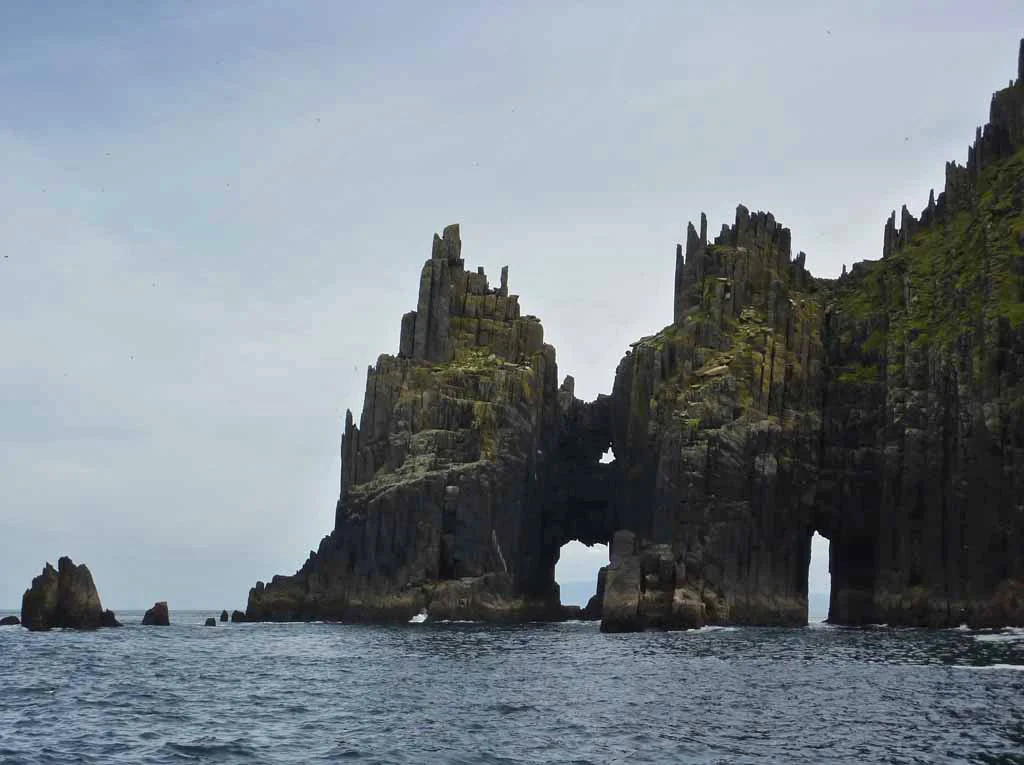
In January 1973, a young American engineer walked into the office of the Irish Consul General in Chicago and asked, with apparent seriousness, whether Ireland might be interested in hosting a commercial spaceport. He had a specific island in mind. Inishnabro - Inis na Bro, the island of the quern stone - is a 49-hectare lump of rock off the western edge of County Kerry, separated from its neighbour Inishvickillane by a sound so narrow you could throw a hat across it. The cliffs on its northern coast are known as the Cathedral Rocks because they rise in arched columns like the nave of a Gothic church. No one lives there. No one has lived there in living memory. And yet for a few weeks in 1973, a small file marked Inishnabro circulated through the Irish Department of Foreign Affairs containing the words space shuttle.
The Cathedral Rocks
Inishnabro rises to 229 metres at its highest point, a respectable Marilyn for an island you could walk across in under an hour. Approaching from the east, the green crown of grass and sea-pink ends abruptly at sheer northern cliffs that the early Irish-language tradition compared to a cathedral. Auks - puffins, razorbills, guillemots - cling to ledges in numbers that recall the noise and smell of medieval markets. The seas here can run uncannily quiet on still summer mornings and merciless on winter ones. A 200-metre sound divides the island from Inishvickillane, where one of the last serious attempts at habitation in the archipelago played out across the twentieth century. On Inishnabro itself, the last people were monks, perhaps, or hermits. Today the residents are entirely feathered.
A Visit to the Consul
The American who showed up in Chicago was Gary Hudson, a young aerospace engineer who would later become a respected figure in the commercial space industry. In 1973 he was selling an idea that, by his own framing, brought together some impressive names: the British astronomer Sir Fred Hoyle - the cosmologist who coined the term Big Bang as a joke - and an unnamed American astronaut said to have walked on the Moon. The pitch was that Inishnabro could become a launching site for a new generation of commercial reusable shuttles. The Irish Consul General, Sean Farrell, listened. In a memorandum he later sent to Dublin, Farrell wrote that his initial reaction was one bordering on disbelief, but that on reflection Hudson struck him as genuine enough. He passed the proposal up the chain.
The Reply
Back at the Department of Foreign Affairs, the file did not survive the cool air of an Irish civil service summer. Officials concluded that whatever Hudson's objective might be, the scheme he had propounded to Mr Farrell in Chicago belonged mainly to the realms of science fiction and could turn out to be a gigantic leg-pull. The file was shelved. No engineers ever surveyed the cliffs. No bulldozers ever crossed the sound. Hudson went on to a long career working on rocket designs and reusable launch concepts. Hoyle continued his cosmological work and his contrarian theories. The astronaut, if he ever existed in the room, was never named. The proposal vanished from public view for thirty-one years, until the Irish state papers from 1973 were released in 2004 under the thirty-year rule and a journalist for the Irish Examiner discovered them in a routine sweep.
An Island That Wasn't
It is hard to read the Inishnabro file today without imagining the parallel future the civil servants quietly declined. Picture the launch towers rising above the Cathedral Rocks. Picture the auks scattering. Picture the contrails arcing east from Kerry over the Atlantic. None of it happened. The cliff colonies grew. The grey seals continued to haul out on the rocks below. The sound between Inishnabro and Inishvickillane silted with the same kelp and Atlantic foam it has carried for centuries. Sometimes the most interesting thing about a place is what nearly happened to it. Inishnabro - one of the six principal Blaskets, one of the smaller and stonier among them - is now best known to walkers who reach it by RIB from the mainland and to the seabirds that have never heard of leg-pulls.
Reading the Map
From the air, Inishnabro looks like a comma between Inishvickillane and the open ocean. It sits within the special protected area that covers five of the Blaskets - the protected designation excludes only Great Blasket itself - and within the Natura 2000 special area of conservation surrounding the archipelago. The Cathedral Rocks face the wind from the north Atlantic with the same stoic verticality they have shown for millions of years. They were never going to be a launch pad. They were always going to be a colony, a cliff, a small island shaped like a quern. Which, of course, is exactly what its Irish name has always said.
From the Air
Located at 52.058 degrees north, 10.609 degrees west, between Inishvickillane and Tearaght in the southern half of the Blasket archipelago. The 200-metre sound between Inishnabro and Inishvickillane is one of the most navigable features when scanning the cluster from above. Kerry Airport (EIKY) is about 35 nautical miles east-northeast. Recommended observation altitude 2,500 to 4,000 feet AGL in clear weather. Look for the Cathedral Rocks on the northern coast - vertical, columnar, the most distinctive cliff feature in the archipelago. Winds in the area can be severe and shifting; treat all Blasket approaches with respect for Atlantic weather.
Nearby Stories
- Lispole 3.3 km away
- Butler Arms Hotel 3.5 km away
- Skellig Michael 16 km away
- Ballyheigue Castle 25 km away
- Kilkee 80 km away
- The Laki Eruption: The Volcano That Changed World History 1360 km away
- The Northern Lights: The Sky Show That Vikings Thought Was Bridge to the Gods 1460 km away
- Sao Miguel 1919 km away