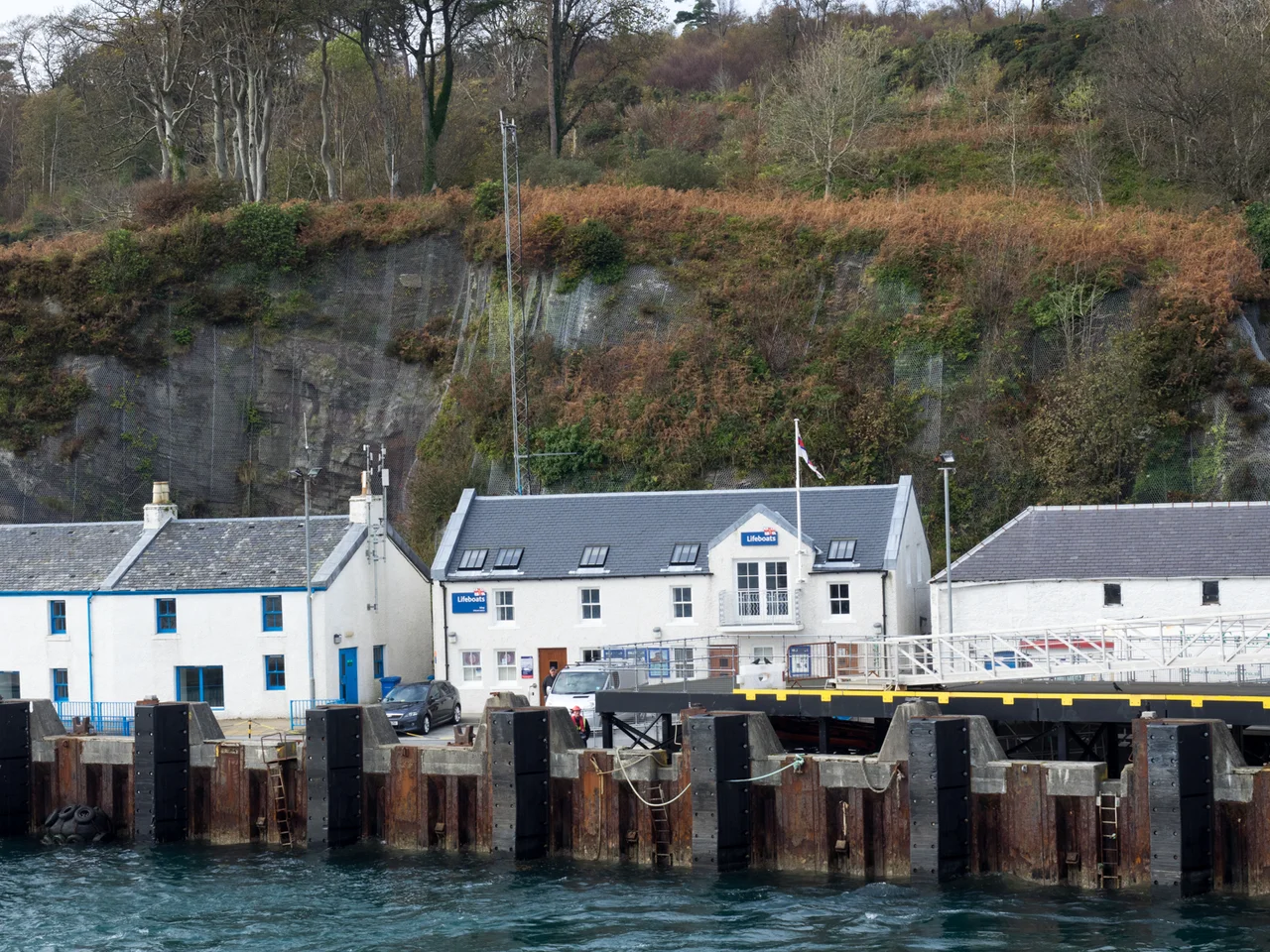

Islay Lifeboat Station
In March 1934, four Islay fishermen took a boat training trip they would never forget. None of them had been on a lifeboat before. The boat in question, the Frederick H. Pilley, was fourteen years old, 38 feet long, and had already saved a hundred and twenty lives at another station. Commander J. M. Upton of the RNLI's Irish District took the four men - Peter and Angus McPhee, Hugh Buie, and J. McDougall - down to Falmouth to collect her. The crossing back was 471 nautical miles, took ten days, and met full gale conditions in Angle and Rosslare. Upton later said it was the worst passage he had made on a lifeboat. When the new crew arrived at Port Askaig on 21 March 1934, they had a working knowledge of their boat earned the hard way.
Why Here
Port Askaig sits at the narrowest point of the Sound of Islay, the strait separating Islay from Jura, where tidal currents can reach four knots and the wind funnels between the islands. Sixty miles to the west, the open Atlantic produces ten-metre swells in winter. The shipping lanes that thread between Skerryvore, Dubh Artach, the Torran Rocks, and the Mull of Kintyre concentrate traffic into water that is hostile in any season and lethal in storm. Before 1934 the nearest all-weather lifeboat was at Campbeltown, thirty nautical miles southeast across the North Channel, or at Portrush in Northern Ireland. Boats in trouble off Jura or Colonsay could wait six or eight hours for help. The RNLI established the Port Askaig station to close that gap. In 1948 the station was renamed Islay Lifeboat Station, reflecting that it served the whole island and its outliers, not just one harbour.
31 January 1953
Some days the sea takes everything it can. On 31 January 1953 a hurricane-force storm tore through the North Channel and the Irish Sea. The car ferry MV Princess Victoria, one of the earliest roll-on/roll-off ferries, was overwhelmed crossing from Stranraer to Larne; she sank with the loss of 133 lives. On Islay the lifeboat launched at 17:45 in a full north-north-east gale to assist a vessel reported three miles south of Jura. Nothing was found in the dark and the rising sea. She returned to Port Askaig at 22:30. Soon afterwards came a second call - the fishing trawler Michael Griffiths was in trouble. The Islay crew launched again. On the passage out, Second Coxswain A. McNeill and Assistant Mechanic John MacTaggart went down to the engine-room to dry their soaked clothes. The room ventilation in heavy weather is never enough. Both men were overcome by exhaust fumes. Both died. At the inquest in Oban on 6 March, Sheriff R. Johnston Macdonald returned a verdict of death by carbon monoxide poisoning. The Michael Griffiths went down with all fifteen of her crew. The Princess Victoria, the Michael Griffiths, two men of the Islay lifeboat - one storm, one day, one stretch of water.
The Lone Dania
Just after midnight on Sunday 18 November 1979, a call came in from the Danish coaster Lone Dania, listing badly six miles northwest of Skerryvore Lighthouse. Her cargo had shifted in the kind of conditions that move cargo: gusts to 65 knots recorded at nearby airports, sustained wind at violent storm to hurricane force, twelve on the Beaufort scale. Two lifeboats launched - the Islay boat, Helmut Schroder of Dunlossit, and a second from another station. At 01:43 the Islay boat was capsized by a wave. Built as a Thames-class prototype, she self-righted as designed. The crew survived with minor injuries. But the radar was gone, the engine was misbehaving, the windscreen wipers had failed in conditions where you cannot see without them. The coxswain made the call to turn back. The Lone Dania was eventually escorted in by other vessels. The Islay boat had to be towed to Greenock for major repair. The Thames-class design was experimental; only two were built before the project was cancelled, and the Lone Dania incident illustrated both the survivability of the hull and the limits of what a self-righting boat can do in a Force 12 with damaged systems.
The Schroder Family
The current Islay lifeboat is the 17-08 Helmut Schroder of Dunlossit II, a Severn-class all-weather lifeboat on station since 1997. She is one of the largest boats in the RNLI fleet, capable of self-righting in any sea, and her name carries a curious thread of continuity. The Schroder family own the Dunlossit estate on Islay - their roots reach back to the German banking dynasty that founded what is now Schroders plc - and have funded successive Islay lifeboats through the Schroder Charity Trust since at least 1979. Helmut Schroder, the German-born banker after whom the boats are named, died in 1969. His son Bruno presented the 1979 boat at Port Askaig in front of a crowd of a thousand islanders and served as the station's president until his own death in 2019. His daughter Leonie took over as president in November 2022. Most Hebridean institutions have to scratch for funding. Islay's lifeboat has had the same Anglo-German family standing behind it for nearly fifty years, and the boat itself is now one of the more capable maritime rescue vessels in the United Kingdom. The Schroders have an Islay estate; the lifeboat has a future.
From the Air
Islay Lifeboat Station sits at 55.85°N, 6.10°W, at Port Askaig on the northeast coast of Islay overlooking the Sound of Islay. From the air the station appears as a small slipway and shed at the ferry harbour, with the Caol Ila distillery 1nm south and the Paps of Jura clearly visible 3nm east across the Sound. Islay Airport (EGPI) lies 8nm to the south-southwest; Oban (EGEO) is 35nm northeast. The waters covered by the station extend from Colonsay (15nm northwest) to Mull (30nm north), out past Skerryvore (35nm west), and across the North Channel toward Northern Ireland. Strong tidal flows in the Sound, frequent gales between October and March.
Nearby Stories
- Kintyre 5.8 km away
- HMS Vandal 21 km away
- Jura, Scotland 25 km away
- Rathlin Island 28 km away
- Battle of Lagganmore 29 km away
- Skerryvore 39 km away
- North West 200 39 km away
- German submarine U-218 55 km away