
Isle of Man Airport
The first time anyone tried to lengthen the runway at Ronaldsway, in 1936, the workers found a mass grave. The bones were thought to belong to soldiers killed at the Battle of Ronaldsway in 1275 — a struggle most modern travellers passing through the terminal have never heard of. A few years later, during another expansion, the diggers turned up the remains of a Neolithic settlement that was sufficiently distinctive to give its name to an entire archaeological period in Britain: the Ronaldsway culture. It is that kind of airport. You taxi between two-thousand-year-old farmland and a Second World War control tower, and the bus into Castletown rolls past Fairy Bridge.
From Field to Airfield
Ronaldsway was first used as an airfield in 1928, when aviation was still mostly a matter of grass strips and weather. Passenger services to the UK started in 1933, run by Blackpool and West Coast Air Services. Aer Lingus and Railway Air Services followed in 1934; from 1937 the Railway services were taken over by Isle of Man Air Services. The Isle of Man, sitting roughly equidistant from England, Scotland, Wales and Ireland, was an obvious pin on the early commercial map of the British Isles. The official identifier is EGNS, and the airport sits at the south-east end of the island, six nautical miles southwest of the capital, Douglas, and barely two miles north of Castletown.
HMS Urley
When the Second World War began, the airfield came under Royal Air Force control as RAF Ronaldsway. It was unusual: one of the few wartime airfields to keep operating civilian flights throughout. From 1943 it was handed to the Admiralty for redevelopment as a Fleet Air Arm training base. John Laing & Son built it out — by the summer of 1944 the grass-and-hangars airstrip had become a four-runway airfield with the infrastructure to house three squadrons of Fairey Barracuda torpedo bombers. On 21 June 1944 the Admiralty commissioned it as HMS Urley, the Manx word for eagle, and flying recommenced three weeks later. Its main job was working up torpedo crews for the closing campaigns of the war. The Royal Navy paid the base off on 14 January 1946. The torpedo training was over. The civilian flights, which had never quite stopped, simply expanded.
Runway and Terminal Today
The single terminal at Ronaldsway has five gates, all hardstands — passengers walk to and from the aircraft. A Menzies Aviation lounge, a duty-free, a bar and a Costa Coffee cover the airside requirements. The runway was resurfaced and extended in 2011, in a project that ran over budget partly because of Euro-denominated component costs and partly because the original feasibility study under-estimated the take-off length by 160 metres — a detail the Manx Treasury Minister was alluding to when, in his 2009 Budget speech, he warned that the island could no longer afford "Rolls-Royce" projects. Following the extension, the largest aircraft that can operate fully at Ronaldsway is the Boeing 757. The airport's own fire service operates as "station 9" in the island-wide series, with the seven Isle of Man Fire and Rescue stations numbered one through seven. Two Carmichael Cobra 2 major foam tenders and an Iturri Torro on order are the headline kit.
Getting In and Getting Out
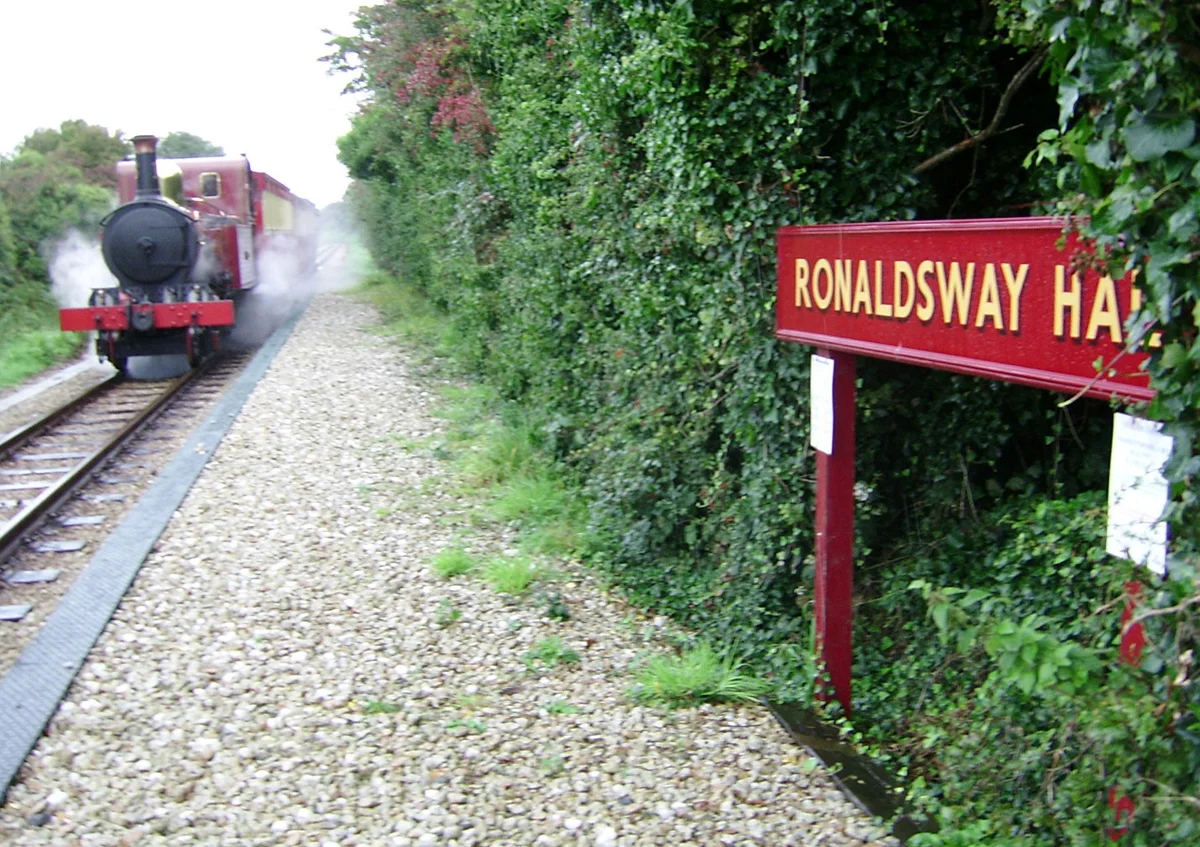
From outside the terminal, Bus Vannin runs services to Douglas, Castletown, Colby, Port Erin, Port St Mary, Peel, St John's and Foxdale — frequencies are reasonable through the day and the journey to Castletown is around ten minutes. Ronaldsway railway station, on the Isle of Man Steam Railway, sits about 600 metres' walk from the terminal and is sometimes used by air passengers timed lucky with the seasonal schedule (mid-March through October, four trains a day, more in peak season). For anyone with a few hours between flights, the Manx Military and Aviation Museum is next door to the airport, with exhibits and aircraft set against the same Ronaldsway sky where the Barracuda crews trained in 1944. Hango Hill, Derby Fort, the Castle Rushen keep, the small stone bridge at Fairy Bridge where bus passengers still greet the Mooinjer Veggey — all within a fifteen-minute drive. For a small civilian airport on a small island, Ronaldsway is unusually well-placed for the rest of its country.
From the Air
Isle of Man Airport — Ronaldsway, ICAO EGNS — sits at 54.083N, 4.624W on the south coast of the Isle of Man, two miles north of Castletown and six nautical miles southwest of Douglas. The main runway (08/26) handles aircraft up to the Boeing 757 after the 2011 extension. Notable landmarks on approach include Derby Fort on St Michael's Isle immediately east of the runway threshold, Hango Hill on the coast road to Castletown, and the long sweep of Derbyhaven Bay. Check the current AIP and ATIS for runway, traffic patterns and weather — the south coast of the Isle of Man can deliver Atlantic squalls and quick visibility changes.
Nearby Stories
- RAF Jurby Head 14 km away
- German submarine U-246 16 km away
- German submarine U-1051 17 km away
- Kilclief Castle 18 km away
- Ardglass 31 km away
- St Bees Lighthouse 44 km away
- Trwyn Du Lighthouse 54 km away
- Seascale Lifeboat Station 61 km away