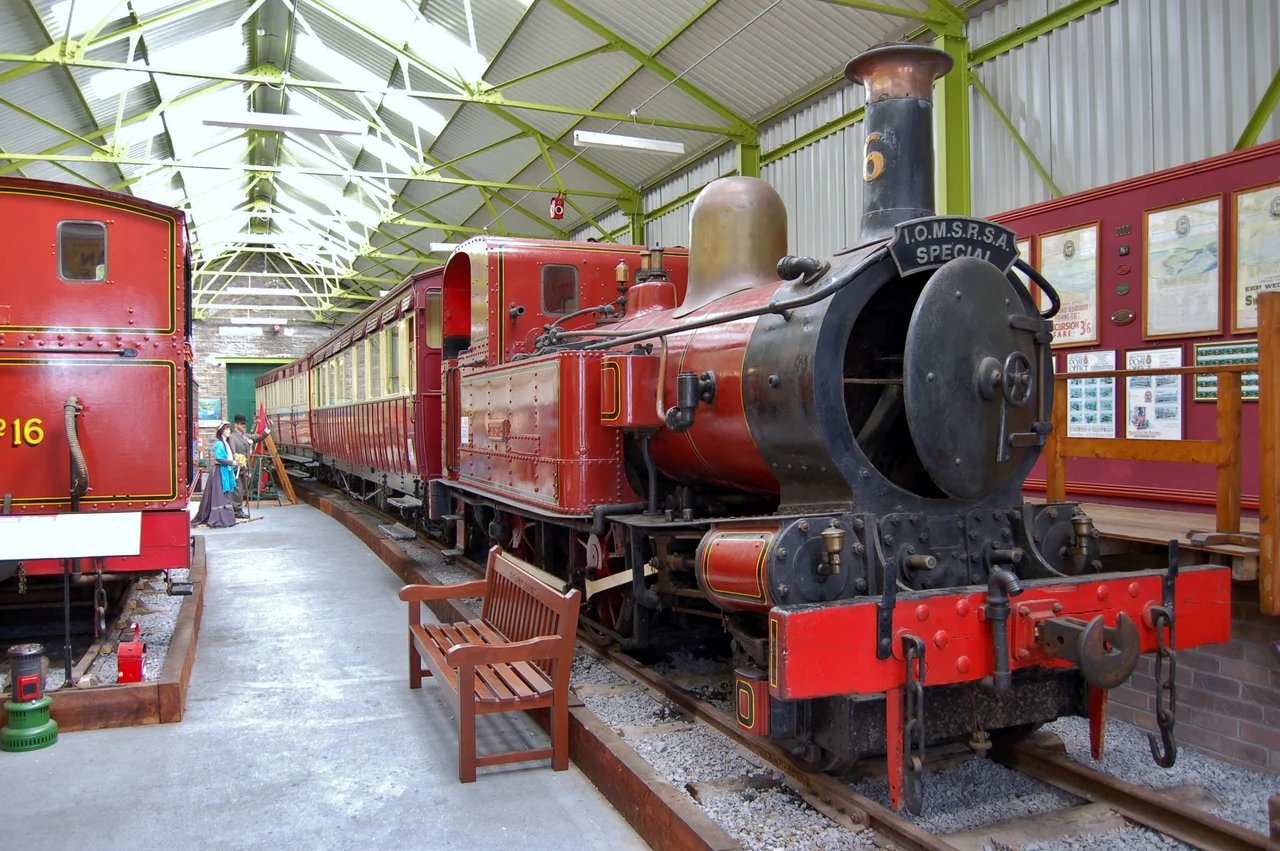

Isle of Man Railway Museum
Step off the steam train at Port Erin, walk twenty paces past the locomotive shed, and you are inside a small museum that holds the rolling-stock memory of an entire railway. The Isle of Man Railway Museum is, in some sense, a place that is mostly other places — a building of pieces from lines that no longer run, locomotives that retired before automation reached the island, saloons that carried two queens and a Queen Mother. It opened in 1975 in a converted Isle of Man Road Services bus garage during a particularly grim chapter when the railway itself was running on subsidy and rumour, kept alive by season-by-season experiments. Half a century later the line is steaming again and the museum is still here, a memorial to what was almost lost.
Born in a Bus Garage
The site is unusual in that it has never been a purpose-built museum. The Isle of Man Road Services, a subsidiary of the railway company, moved its garage operations to a new building at the foot of the Port Erin platform in 1975, and the old depot was repurposed as a museum almost immediately. The original locomotive shed sat right next to it, the goods shed nearby, and the whole assemblage became the museum. The first iteration of the building was a metal frame clad in asbestos. By 1998–1999 that had to go: the structure was rebuilt with replica stone gables where there had once been tall garage doors, the locomotive shed returned to maintenance use, and the goods shed converted into a shop. A 2017 "plaza" scheme reworked the approach from Station Road. Visitors today still get a glimpse, through a viewing window set into the old shed doors, of working locomotives stabled overnight.
The Locomotives and the Royal Saloon
Two engines anchor the collection. No.6 Peveril, built by Beyer, Peacock & Co. in 1875, was an early workhorse of the Isle of Man Railway and is one of the oldest extant Manx locomotives. No.16 Mannin, built in 1926 and the largest engine ever delivered to the island's narrow gauge, is the relative giant of the line — its frames are visibly heavier than the rest of the surviving fleet. Alongside them sit the Ducal Saloon F.75, built for the railway's opening year of 1873, and Royal Saloon F.36, which carried Queen Elizabeth the Queen Mother along the Peel Line in 1963 behind locomotive No.11 Maitland, and then Queen Elizabeth II, the Duke of Edinburgh and three of their children — Princess Anne, Prince Andrew and Prince Edward — into Douglas on 2 August 1972, with Lord Mountbatten in the party and No.13 Kissack at the head of the train. F.36 was removed in 2023 for restoration; in 2014, F.75 and van G.19 had already been put on an isolated plinth at the museum, joined in 2020 by No.1 Sutherland.
The Lines That Are Not There Any More
The Isle of Man Railway was founded in 1873 and once ran 46 miles of three-foot-gauge track across the island. The line to Peel, the Manx Northern Railway to Ramsey, the branch to Foxdale — all closed in the 1960s. What survives in active service is the 15-and-a-half-mile Douglas–Port Erin route, the south line, which celebrated its 150th anniversary in 2024. The museum holds, in effect, the family silver of everything else. There are display boards on the Knockaloe Internment Camp railway, on the long-gone Glen Wyllin Pleasure Ground, the kind of small spurs and resorts that built the Manx tourist trade in its Victorian heyday. There is an original 1873 carriage door. There is a snow plough from the line. There is a wood-turning lathe from the workshops. None of it dramatic on its own. All of it, taken together, a working railway's sediment.
A Visit
Port Erin is the southern terminus of the line, and the museum sits adjacent to the platform — you can step off the morning train from Douglas and be inside within a minute. The line itself runs March through November, with around four trains a day in standard season and intensified services on event weekends. A short walk up the hill brings you to the seafront and the curve of Port Erin Bay; a longer one takes you on to Cregneash. For anyone who cares about the small engineering history of an island that built and lost most of a railway network in a hundred years, the half-hour spent here changes how the rest of the south of the Isle of Man reads. The steam in the shed window is not a heritage demonstration. It is the actual continuation of the thing the museum is about.
From the Air
The Isle of Man Railway Museum sits at 54.085N, 4.758W in Port Erin, on the south-western coast of the Isle of Man. Best viewed at 1,500 to 2,500 feet over Port Erin Bay — the museum is at the very bottom of Station Road, immediately adjacent to the Port Erin railway station and its locomotive shed. Nearest airfield is Ronaldsway (EGNS), 7 NM east-northeast. The wide arc of Port Erin Bay, with Bradda Head to the north and the Mull Hills to the south running down toward Cregneash and the Calf of Man, is the unmistakable landmark.
Nearby Stories
- RAF Jurby Head 14 km away
- German submarine U-246 16 km away
- German submarine U-1051 17 km away
- Kilclief Castle 18 km away
- Ardglass 31 km away
- St Bees Lighthouse 44 km away
- Trwyn Du Lighthouse 54 km away
- Seascale Lifeboat Station 61 km away