
Itatiaia
A group of Finnish natural scientists arrived in the Brazilian highlands in 1929 with a plan that sounded strange then and sounds stranger now: they would build a tropical vegetarian community at the foot of the Serra da Mantiqueira. They called it Penedo. The utopian project did not quite survive its own ambitions, but the town did - it still shows Finnish architecture in its houses and shops, still honors Finnish traditions in its festivals, still marks itself as the main Finnish colony of Brazil. Penedo is a neighborhood of the municipality of Itatiaia, and Itatiaia itself is a mountain town of about 32,000 people on the edge of Brazil's first national park.
Pointed Stone
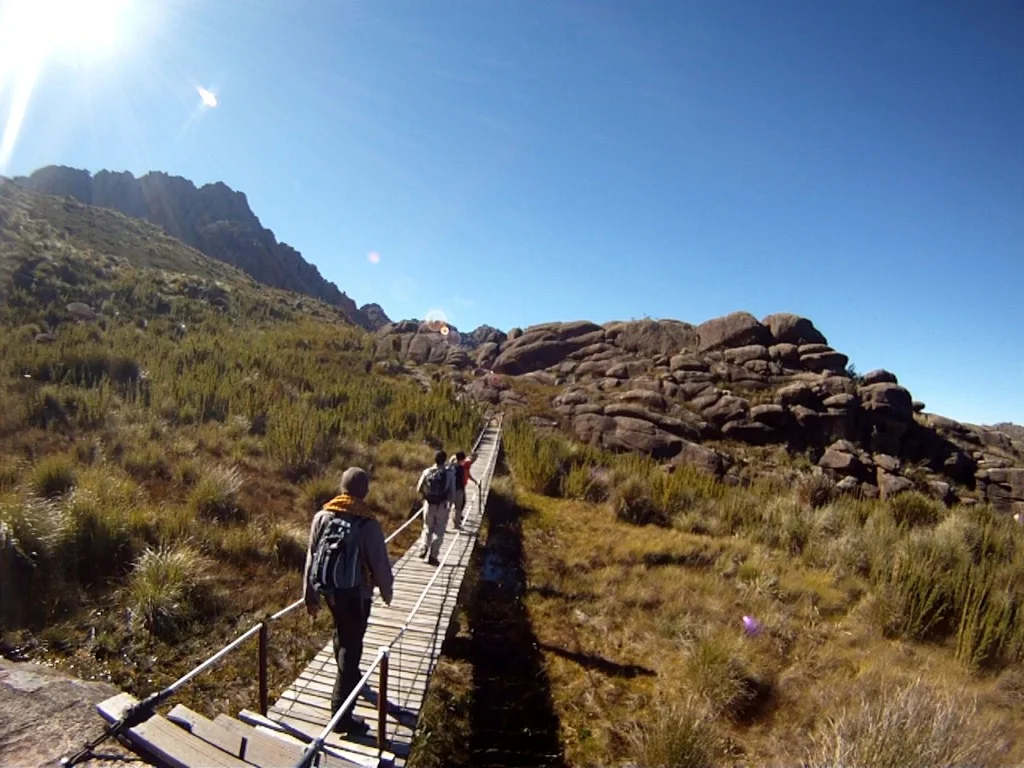
The name is Guaraní, though the specific word - *itatiaia* - combines *itá* (stone) and *atîaîa* (pointed). *Pointed stone.* It describes the peaks that define the municipality's geography: Pico das Agulhas Negras, the Prateleiras formation, and the ridgelines of the Mantiqueira mountain range rising to the west and north of town. Itatiaia sits in the state of Rio de Janeiro at the border with Minas Gerais, in a region that was originally inhabited by the Tupi, Purí, and Coroado indigenous peoples. The European arrival came in the 17th century, when *bandeirantes* - armed expeditions from São Paulo searching for gold and indigenous slaves - pushed up over the Mantiqueira range. The gold routes that developed later, carrying ore from Minas Gerais to the ports of Angra dos Reis and Paraty, passed through what are now the municipalities of Mauá and Itatiaia. The roads came first. The town came later.
The First National Park
Parque Nacional do Itatiaia - Brazil's first national park - sits partially within the municipality, and its presence defines much of Itatiaia's identity and economy. The park was created in 1937 under President Getúlio Vargas, making it the oldest in Brazil. Visitors come for rock climbing, hiking, and bird watching (the park holds approximately 250 species), and the small hotels and services of Itatiaia exist largely to accommodate them. The Agulhas Negras peak - Black Needles Peak - is the highest point in Rio de Janeiro state and the fifth-highest mountain in Brazil. Despite sitting in a tropical zone, the peak typically records negative temperatures in winter and occasionally receives snow in especially humid years. The municipality also contains part of the Pedra Selada State Park, established in 2012 - a newer protected area that extends the conservation footprint. Forests in parts of the region were preserved specifically because earlier landowners like Irineu Evangelista de Sousa - the Barão de Mauá, one of Brazil's most influential 19th-century industrialists - avoided coffee monoculture on their properties.
Penedo
Finnish immigration to Brazil was never large-scale; it happened on a small, deliberate basis, often driven by specific communities with specific goals. The group that founded Penedo in 1929 was led by members associated with the Pentti Group - scientists and intellectuals drawn to the ideas of Finnish agrarian mysticism who wanted to build a cooperative settlement in a tropical climate. They chose the foot of Itatiaia National Park, 3 kilometers north of the town center and 170 kilometers northwest of Rio de Janeiro. The colony operated at 600 meters elevation, a height that moderated the tropical heat without sacrificing the warmth that had drawn the founders south. Today Penedo is better known for tourism than for agriculture: 52 hotels and 39 restaurants, snack bars, and cafes serve visitors to the park. The Finnish character remains visible in architecture - timber-frame houses, sauna traditions carried over from the homeland - and in cultural events that keep the original colony's identity alive. It is one of the more unusual ethnic enclaves in Brazilian history, and it survives because it turned toward tourism when its original purpose faded.
Maromba, Maringá, and Mauá
Beyond Penedo, Itatiaia's tourist geography extends into the Visconde de Mauá region - a mountain resort area that spans three municipalities and draws visitors for its waterfalls, trout, and cool highland climate. The villages of Maromba and Maringá are within that region. Rock climbing, trekking, camping, rappelling - what Brazilian Portuguese calls *turismo de aventura*, adventure tourism - cluster around these villages, fed by the population of Rio de Janeiro and São Paulo looking for weekend escapes into the mountains. The 2021 population estimate for Itatiaia was 32,312, making it the 1,097th-most populous municipality in Brazil - small by national standards, but not tiny. Public education includes twenty municipal schools, one state school, and five private schools. The municipality was formally established in 1849, though the area had been settled for more than a century before that.
Winter in the Tropics
Most of Brazil does not experience cold. Itatiaia does. The Agulhas Negras peak drops to negative temperatures every winter, and in especially humid years it receives snow - a phenomenon that makes local news and draws day-trip tourists from the coastal cities hoping to photograph their children throwing snowballs. The dry winter months, roughly May through August, are the peak tourist season: clear skies, cool days, cold nights, and the chance of frost on the high meadows. Wintertime pousadas fill with visitors escaping the heat of Rio and São Paulo. Summer brings rain and green returning to the slopes. The rhythm is seasonal in a way that most of Brazil's coastal geography is not. Rio de Janeiro sits in permanent heat 170 kilometers to the southeast. Itatiaia, in the mountains, has seasons you can feel - which may be why the Finnish settlers chose this particular corner of the country when they came looking for a place that reminded them, if not of home, then at least of a climate they could live with.
From the Air
Located at 22.49°S, 44.56°W in the Mantiqueira mountain range, at the border between Rio de Janeiro and Minas Gerais states. The town sits at approximately 400-500 m elevation, with the Agulhas Negras peak rising to 2,792 m to the northwest. Nearest airport: Resende Airport (SDRS) about 15 km south. Best flown in dry winter months (May-September) when visibility is clearest. Recommended viewing altitude: 8,000-12,000 ft to see the town, Penedo colony, and the peaks of Itatiaia National Park rising to the north.
Nearby Stories
- Basilica of Our Lady of Aparecida 31 km away
- Cambuquira 44 km away
- Itajuba 47 km away
- Ibitipoca State Park 48 km away
- Miguel Pereira 49 km away
- Christ the Redeemer: The Statue Built from Soapstone Carried Up a Mountain 81 km away
- Três Corações 95 km away
- Campos do Jordao 115 km away