
Miguel Pereira
Locals will tell you - with a smile that acknowledges the claim is not strictly confirmed - that Miguel Pereira has the third-best climate in the world. The first two slots, they will admit, are up for debate. What is not up for debate is that this town of about 25,000 people, tucked into the mountains two hours from Rio's Novo Rio bus terminal, is where people go when they can no longer bear the summer heat of the coast. Pedal boats cross Lake Javary. The fog hangs until ten. The air is thin enough at 620 meters to feel different on the first breath. And if you know where to eat, the Adega do Abel will feed you comida mineira so good you will consider cancelling your return ticket.
Getting There
From downtown Rio the drive takes about 110 minutes in moderate traffic - roughly 150 kilometers of winding road through the Serra do Mar foothills. You take the Linha Vermelha out of the city, merge onto the Rodovia Presidente Dutra toward Sao Paulo, and exit at 205, a kilometer before the first toll and five hundred meters past the first SOS call station. From there RJ-125 carries you through Japeri, past Conrado, up past the Highway Police post, through Arcadia, and finally into the nine-kilometer mountain climb that takes about fifteen minutes to ascend. Governador Portela appears. Then Barao de Javary. Then the lake, and Miguel Pereira itself. Intercity buses from Util run the same route for around R$40 and depart from Novo Rio at Av. Francisco Bicalho 01 in Santo Cristo.
The Lake and the Pedal Boats
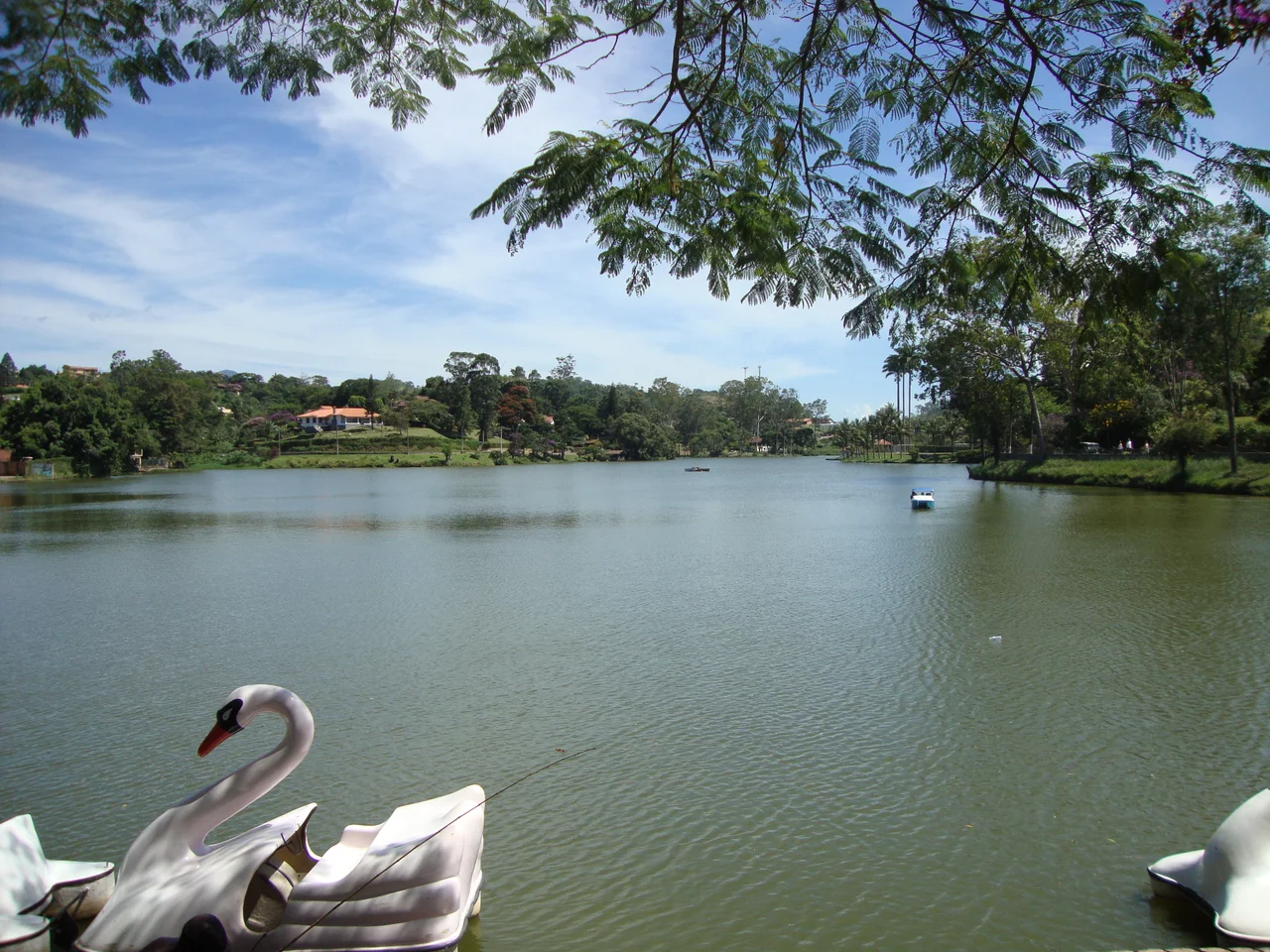
Lake Javary is the town's postcard image and the first thing most visitors point a camera at. It formed when the Corrego do Saco was dammed in the village of Barao de Javary, and it sits between Miguel Pereira's first and second districts with RJ-125 running along one bank. A rustic wooden bridge spans the narrow middle. On weekend afternoons the pedal boats fan out across the surface, families share pao de queijo on the grassy edges, and the Hotel Fazenda Javary - directly on the lakeshore - does brisk business. The water reflects the blue-green of the surrounding mountains. On quiet weekday mornings, especially with fog lifting off the surface, the lake is one of those places that reminds you why the doctor whose name the town carries bothered to write papers about it.
Where to Eat Like a Mineiro in Rio
Miguel Pereira sits on the Rio side of the border, but its cooking leans heavily into the neighboring Minas Gerais tradition. Adega do Abel is widely considered the best table in town. Casserole, Gourmet and Goumant, New Idylius, and Recanto da Serra each have their devotees. Sitio Solidao does the country-kitchen version of the same idea - feijao tropeiro, frango com quiabo, pao de queijo still warm. Pizzeria Fino Trato da Massa handles the late-night crowd. Up in the district of Governador Portela, Bar do Boquina is a local institution, and Point17 turns out pizza and crepes to skiers - metaphorical skiers; there is no snow - who have driven in from Rio for the weekend.
Where to Sleep
Options range from modest pousadas in the town center to larger fazenda-style hotels on the outskirts. Hotel Fazenda Javary is the obvious choice for lake-frontage; Hotel Fazenda Miguel Pereira and the Mountain Hotel both cater to groups wanting horseback riding and hiking. For smaller and more intimate, Pousada Casa nas Pedras on Rua Bruno Lucci in the neighborhood called Vila Switzerland - yes, Vila Switzerland - leans into the alpine branding. Pousada La Maison in the center is walkable to dinner. Pousada Paraiso Tia Regina over in Barao de Javary is the kind of place where you wake up to mist in the trees and a rooster somewhere you cannot quite locate. Rates stay reasonable; Miguel Pereira has never priced itself as a luxury destination.
The Feeling of the Place
What Miguel Pereira sells is not a sight or an activity. It is an absence. The absence of heat. The absence of crowds. The absence of the noise that makes Rio exhausting even on a beautiful day. You come here to walk slowly, eat heavily, sleep under a blanket in summer, and leave with your phone at a lower battery level than when you arrived. The Tingua Biological Reserve shelters the town from one side; the hills fold away from it on the others. Waterfalls thread the Atlantic Forest remnants, streams run clean enough to drink from in some places, and the pedal boats on Lake Javary move at exactly the pace the town wants to you travel. It is a rare thing in the Rio metropolitan sphere - an escape that is actually, palpably, an escape.
From the Air
Coordinates: 22.45S, 43.47W, in mountainous interior Rio de Janeiro state. Elevation 618 meters. Nearest major airport: Rio de Janeiro-Galeao (SBGL) approximately 80 km southeast. Tom Jobim general aviation access from Santos Dumont (SBRJ) or Jacarepagua. Afternoon orographic buildup common over the Serra do Mar throughout summer; morning fog routinely covers the Lake Javary basin until 10:00 local.
Nearby Stories
- Serra dos Órgãos 15 km away
- Rio de Janeiro 36 km away
- Juiz de Fora 45 km away
- Military Academy of Agulhas Negras 53 km away
- Leopoldina, Minas Gerais 73 km away
- Church of Saint Francis of Assisi (Sao Joao del-Rei) 117 km away
- Basilica of Our Lady of Aparecida 134 km away
- Grytviken 3555 km away