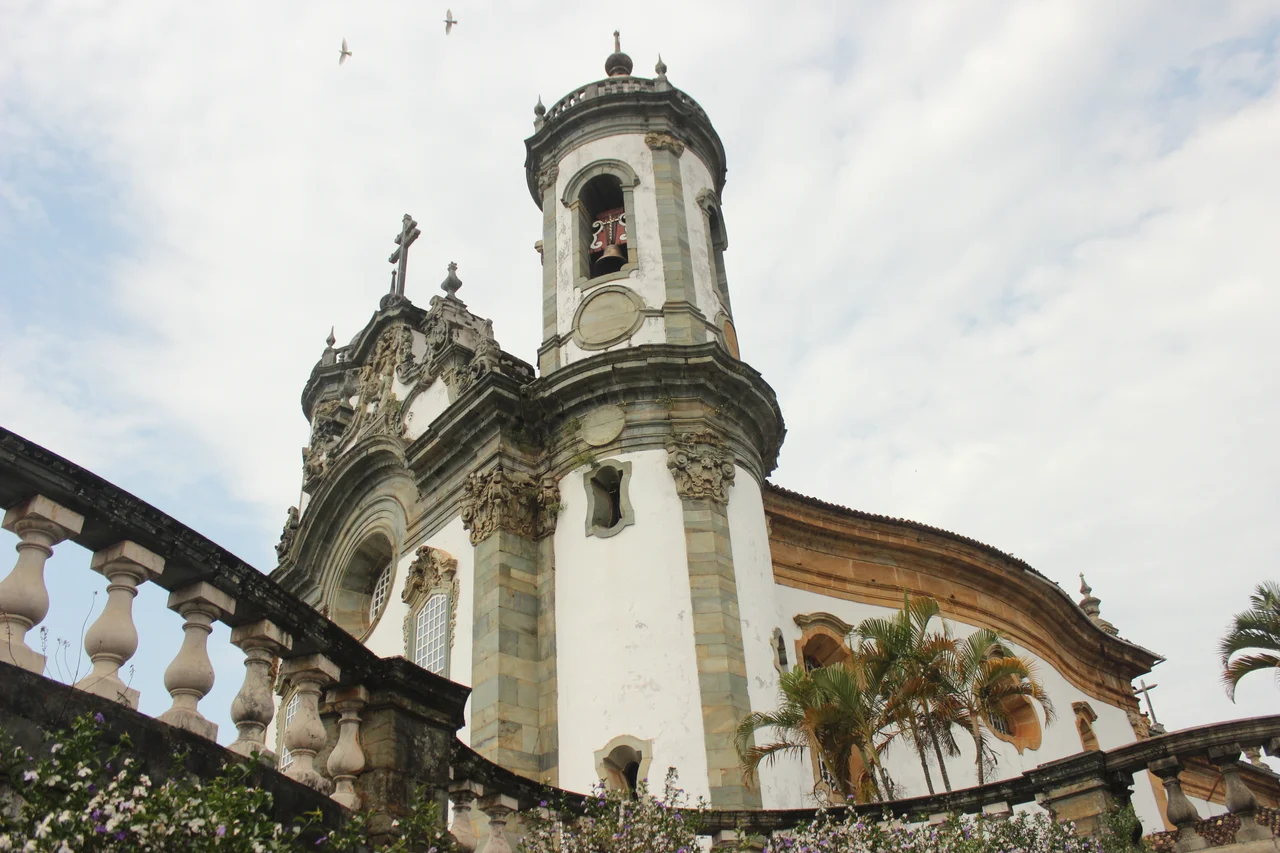

Church of Saint Francis of Assisi (Sao Joao del-Rei)
Sir Richard Burton - the 19th-century English explorer who translated the Arabian Nights and tried to find the source of the Nile - pronounced the facade of this church 'the most spectacular in Sao Joao del-Rei, if not in all Minas Gerais.' He did not give praise easily. The building was a collaboration that Aleijadinho drew, another architect built, and a third finished. An incomplete autograph elevation survives in the Inconfidencia Museum in Ouro Preto, signed by Aleijadinho's own hand, which is how we know the design was his. What he drew and what was built are not quite the same thing, and the gap between them is where the story lives.
The Secular Order That Needed a Bigger Church
The Secular Franciscan Order of Sao Joao del-Rei - a lay brotherhood of white devotees - was canonically erected on March 8, 1749 by Friar Manoel da Cruz, the Bishop of Mariana. They used an earlier chapel for a generation. By 1772 that building had deteriorated, and the brotherhood decided to build something larger and finer. Aleijadinho had just completed the designs for Saint Francis of Assisi in Ouro Preto, the town where he lived, sixty kilometers away. He was hired for Sao Joao as well. His drawing arrived. Then construction began, and the building started to drift from the drawing.
Cerqueira Makes It His Own
In 1774 Francisco de Lima Cerqueira was commissioned to do the masonry work. Cerqueira was a Portuguese-trained mestre-de-obras who had worked at the Carmo church in Ouro Preto, and he had ideas of his own. He changed the towers. He changed the pilasters of the crossing. He changed the glass arrangement in the nave and the layout of the sacristy. Whether these were improvements or liberties was already controversial in his own time and has stayed controversial ever since. John Bury, the British art historian who wrote the definitive studies of colonial Brazilian architecture, argued that Cerqueira's modifications actually increased the church's originality - particularly his solution for the towers. The building finished at Sao Joao is distinctively itself, neither pure Aleijadinho nor standard colonial practice.
A Building Finished Over Generations
Colonial churches in Minas Gerais were almost never built by one generation. By 1804 the nave and the body of the church were done. In 1809 Aniceto de Souza Lopes completed the towers and the choir, and according to IPHAN also executed the reliefs on the pediment and the frontispiece of the main door. From start to substantial completion took about thirty-five years, spanning the end of Portuguese colonial rule and the first decade of independent Brazil. The plan itself is conventional - a single nave with side altars, a choir above the entrance, a deep apse separated from the nave by a monumental arch, and an attached sacristy. What is not conventional is the doorway, which IPHAN describes as having 'the rich composition of the doorway, with emphasis on the magnificent carvings that are organized in an elegant design.' This is the facade Burton praised.
Where the Bells Speak
Sao Joao del-Rei calls itself the city 'where the bells speak,' and at the Church of Saint Francis they are not exaggerating. A colonial-era tradition called the combate dos sinos - the battle of bells - still plays out every Lent. The city's churches compete to ring their bells more vigorously and for longer than their rivals, and Saint Francis fields a serious team. The bells have their own vocabulary: specific ringing patterns announce funerals, saints' days, specific mysteries of the liturgical year. When a bellringer dies in service, there is a tradition of temporarily removing the bell clapper and chaining it - a ritual that has generated local legends, including an implausible one about a bellringer arrested for a statue that miraculously appeared on the altar. The statue story has no historical basis. The clapper tradition does.
Music Old as the Walls
The church has been a musical institution from its beginning. An 18th-century musical group performed for its festivities, which later split and reorganized in the 19th century as the Lira Sanjoanense and the Orquestra Ribeiro Bastos. Both are among the oldest continuously active musical associations in Brazil. They still perform for the church's festivities: the patron saint's celebration around October 4 with a nine-day novena, and the Quinquenas of St. Francis between September 12 and 17 that mark his reception of the stigmata. Holy Week is the big season - Saint Francis receives the image of Our Lord of the Steps from the Cathedral in a torchlit Procession of the Deposits, then joins the Procession of the Meeting at the Largo da Camara, where it encounters the image of Our Lady of Sorrows coming out of the Carmo church. The pageantry has been happening this way for over two hundred years. The same orchestras play music composed specifically for this church, for this ceremony, in this town, continuing a practice older than the independence of Brazil.
From the Air
Located at 21.14 degrees S, 44.26 degrees W in Sao Joao del-Rei, Minas Gerais. Best viewed from 2,500 to 3,500 feet AGL - the twin towers and ornate facade read clearly against the whitewashed walls of surrounding colonial buildings. The town sits at about 900 meters elevation in gentler terrain than nearby Ouro Preto (60 km north). Nearest airport is Sao Joao del-Rei (SNJR), essentially adjacent; Belo Horizonte/Confins (SBCF) lies 100 nm northwest. The church faces a large praca - the square is a regular venue for cultural events and is where the Holy Week processions converge.
Nearby Stories
- Santos Dumont, Minas Gerais 4.5 km away
- Our Lady of the Rosary Church, Lavras 37 km away
- Ibitipoca State Park 38 km away
- Inconfidência Mineira 58 km away
- Crucilandia 64 km away
- Ubá 68 km away
- Três Corações 69 km away
- São Gonçalo do Pará 106 km away