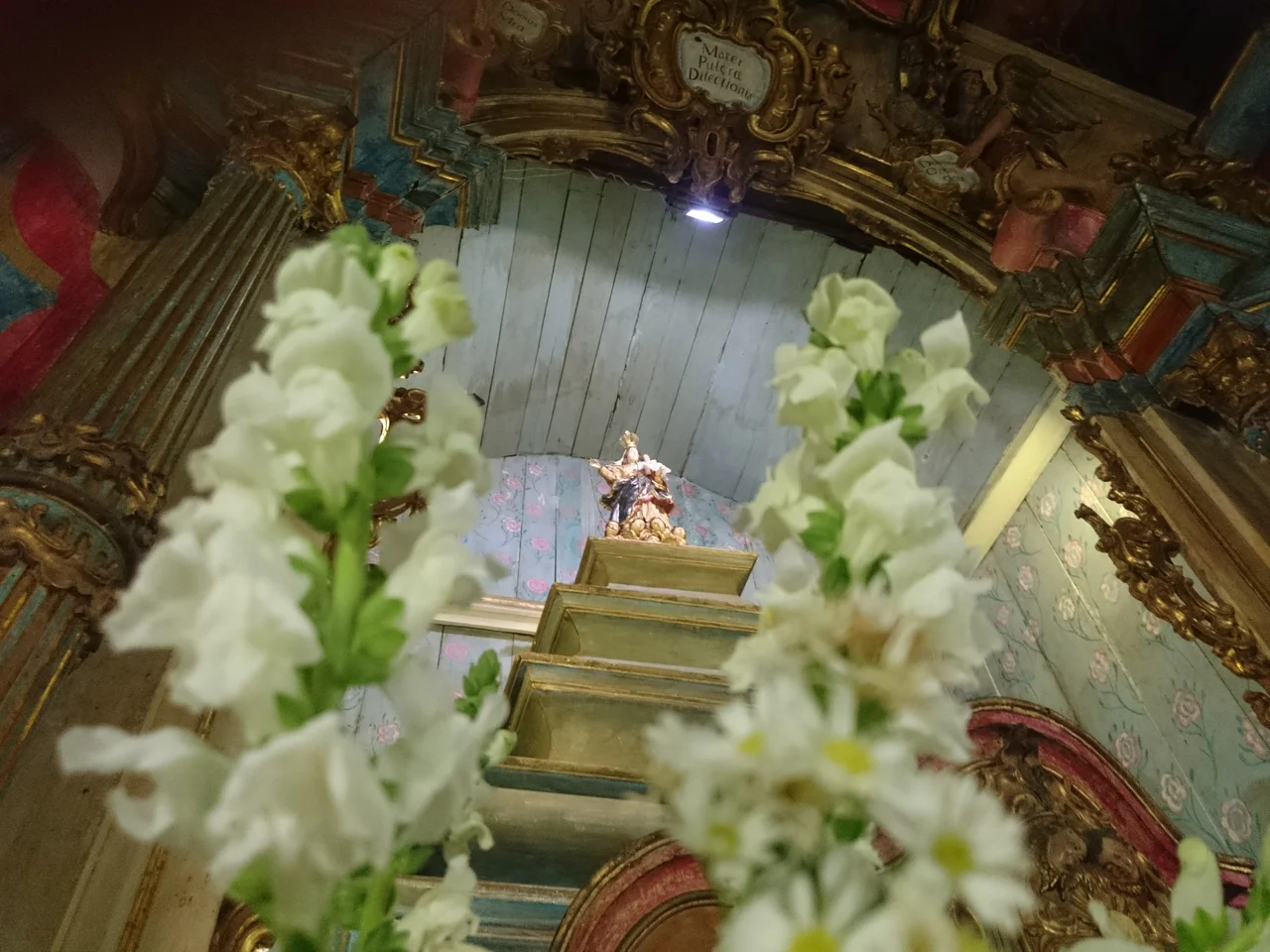

Our Lady of the Rosary Church, Lavras
In 1940, someone proposed tearing it down to build a social club. The oldest building in Lavras - a weathered colonial church where generations had come to pray, where a 19th-century priest had run an informal school teaching Latin and arithmetic to local children, where the Society of Saint Vincent de Paul had met since 1908 - was slated for demolition. A local teacher named José Luiz de Mesquita refused to let that happen. He wrote letters. He alerted Brazil's federal heritage agency. He recruited the bishop. When partial collapses rocked the structure in 1944, he turned those tremors into a preservation campaign. Four years later, the church he saved was designated a National Historic Heritage site. Today the Our Lady of the Rosary Church still stands in the hills of southern Minas Gerais, a survivor of gold-rush ambition, midcentury indifference, and the quiet stubbornness of a schoolteacher who thought it mattered.
Built by Gold, Haunted by It
Construction began in 1751 on land donated by Captain Luiz Gomes de Morais Salgado, and was completed around 1765 - a humble chapel originally dedicated to Saint Anne. This was the era when Minas Gerais gold was flooding through the backcountry, when every small settlement with ambition built a church to mark its permanence. The chapel caught that wave. By 1760 it had been elevated to parish status, the religious seat transferred from nearby Carrancas. For two centuries it served as the main church of a town that grew up around it. A cemetery surrounded the building until 1853, when bodies were moved to the new Saint Michael Cemetery on Lavras's southern edge. In 1875, lottery money paid for a major restoration - one of many the building would need. Gold built these churches, but gold also left them, and what remained was the long, quiet work of keeping stone and timber upright in a tropical climate that does not forgive.
A Priest, a Classroom, and Two Bells
Around the time Lavras gained town rights in 1831, Father Francisco d'Assis Braziel opened a school inside the church. One of its rooms became a classroom where local children learned Latin, French, geography, drawing, arithmetic, and music. Before public education, this was education - a priest with enough learning to share, and a sanctuary willing to double as an academy. Nearly a century later, in 1928, Father Fernando Baumhoff installed two new bronze bells cast in Divinopolis. Local teacher Mesquita - the same man who would later save the building - recorded their names. The smaller was called Francelino. The larger was Jeronimo II. They still ring. If you stand in the churchyard when they sound, you are hearing something that Father Baumhoff heard in 1928, that Father Braziel's students would have recognized, that has been part of the air above Lavras for nearly a hundred years.
The Saved Building
By the 1930s, the church had fallen into disuse. It was only opened during Holy Week. When the demolition plan emerged in 1940, Mesquita alerted Rodrigo Melo Franco de Andrade at the federal heritage agency - the precursor to IPHAN - and persuaded Bishop Dom Inocencio Engelke to back the cause. Press coverage followed. The demolition was stopped. But the building kept trying to fall down on its own. Partial collapses came in 1944, and then more serious failures in 1965 and 1969. The church was closed from 1964 until 1982. When municipal funds finally enabled real repairs under Mayor Mauricio Padua Souza, the doors reopened on 8 May 1982. In 2002 the building was also inscribed as municipal heritage. In 2023, a community campaign paid for 48 new wooden pews. The saving was not a single act. It was decades of small refusals to let go.
The Veronica Comes Home
Inside are life-size polychrome wooden statues that lead Holy Week processions through the streets of Lavras: the Lord of Triumph, the Lord of the Steps, Our Lady of Sorrows, Good Jesus of the Green Cane, and the Dead Christ. Art historians debate their attribution - Portuguese sculptor Jose Maria da Silva, or local masters from the Rio das Mortes region like Luis Pinheiro de Souza. Ceiling paintings in the chancel, around 1805, are attributed to Joaquim Jose da Natividade, a mulatto artist from Sao Joao del-Rei who worked in Minas Gerais during the late colonial period. One of his paintings, a Veronica depicting the Holy Face of Jesus, had disappeared from Lavras for 62 years - ending up in the collection of the Sao Paulo Museum of Art. In 2020, after rescue efforts led by William Daghlian and restoration work completed in 2017, it came home. In 2021, during the Fourth Lavras Cultural Heritage Forum, the painting was exhibited in the church for the first time since its return. Statues of Saint Benedict, Saint Michael, and Saint Ephigenia have been lost over the years. As of 2026, the altarpieces still await restoration, with an estimated cost of R$500,000.
From the Air
Located at 21.25 degrees south, 45.00 degrees west in southern Minas Gerais, at roughly 3,000 feet elevation. The town of Lavras sits in hilly cattle country between Sao Joao del-Rei and Tres Coracoes. Nearest major airport is Belo Horizonte (Confins, SBCF), about 220 km north. Small regional airport at Lavras (SNLV) serves local traffic. Cruise altitudes of 8,000 to 10,000 feet offer good views of the Mantiqueira foothills.
Nearby Stories
- Church of Saint Francis of Assisi (Sao Joao del-Rei) 6.1 km away
- Varginha 14 km away
- Boa Esperança, Minas Gerais 24 km away
- Ibitipoca State Park 51 km away
- Três Corações 53 km away
- Crucilandia 78 km away
- Capitólio 80 km away
- Inhotim 89 km away