.jpg)
Inhotim
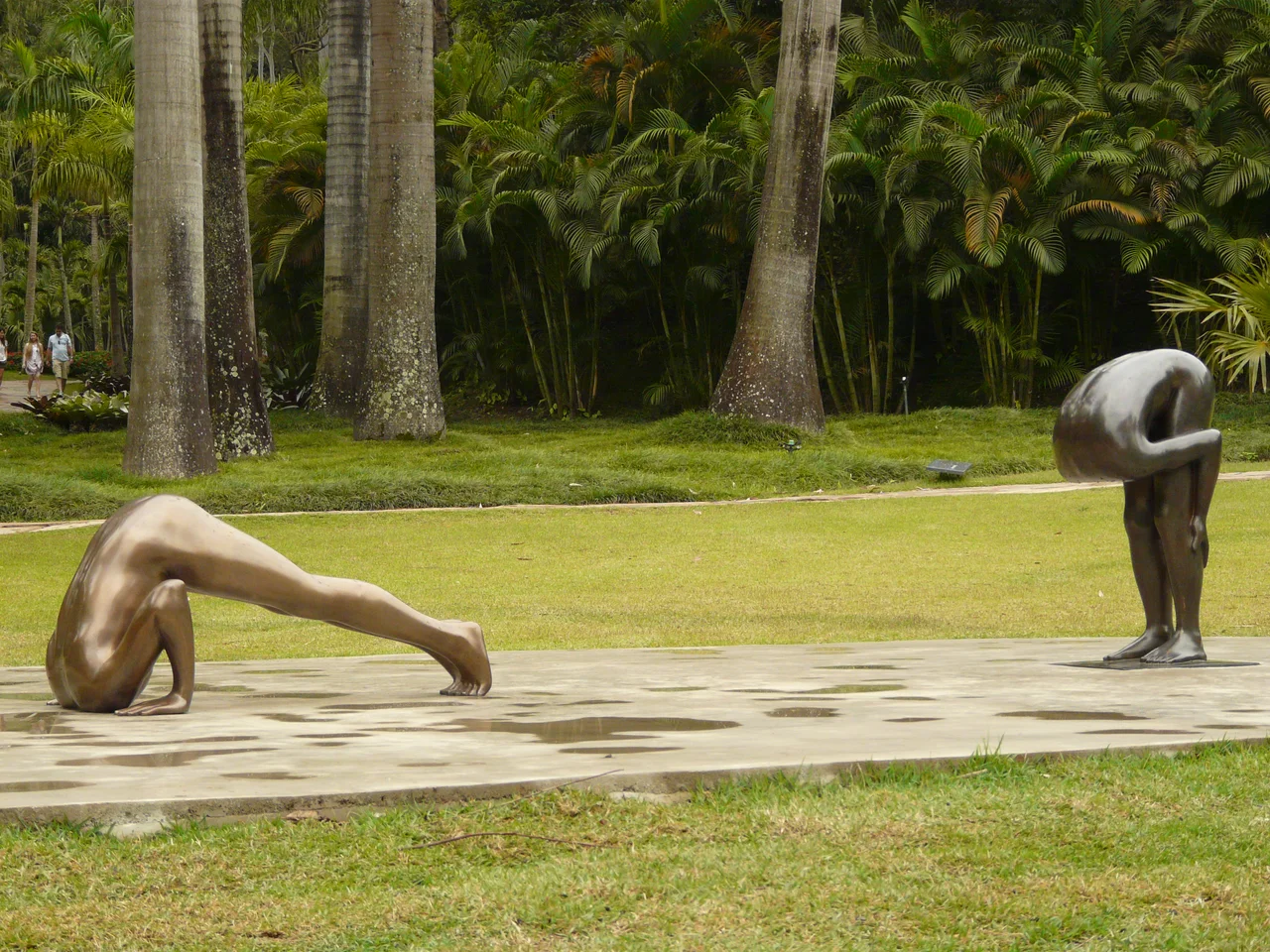
Chris Burden's *Beam Drop* looks like an industrial accident that finished itself: seventy-two steel beams dropped forty-five meters from cranes into wet concrete, left wherever they landed, now a permanent sculpture. Doug Aitken's *Sonic Pavilion* is a circle of frosted glass that plays the sound of the earth itself, piped up from microphones lowered hundreds of meters into boreholes. A corpse flower blooms here every few years, smelling precisely as bad as its name suggests. This is Inhotim - an open-air museum and botanical garden in the hills of Minas Gerais, built by a former mining magnate who wanted his art to live outdoors among the Atlantic Forest.
The Englishman's Farm
The name came first. Before the art, before the gardens, there was a modest farmhouse in the municipality of Brumadinho, about 60 kilometers southwest of Belo Horizonte. A former owner - an English engineer named Tim - lived there long enough that locals began calling the place after him. In the Mineiro dialect, *Senhor Tim* slid into *Nhô Tim*, and the name stuck to the land. Bernardo Paz bought the farmhouse in the 1980s, and when developers began threatening the surrounding landscape, he started buying the adjacent tracts to protect them. The 3,000-acre ranch would eventually become a 5,000-acre botanical garden, designed by the Brazilian landscape architect Roberto Burle Marx - the same artist who laid out Rio de Janeiro's Copacabana promenade. Burle Marx was a friend. He would not live to see what Inhotim became.
Art Outdoors
Paz made his fortune in mining, and he spent it on art. He began collecting in the 1980s, commissioning and acquiring work from some of the most significant contemporary artists working anywhere - Anish Kapoor, Thomas Hirschhorn, Dominique Gonzalez-Foerster, Steve McQueen, Cildo Meireles, Vik Muniz, Yayoi Kusama, Matthew Barney, Hélio Oiticica, Adriana Varejão. Some of the works he bought. Others he commissioned directly, paying artists to build permanent pieces into the landscape itself. The institute opened to the public in 2006, and by 2014 TripAdvisor ranked it among the top 25 museums in the world. What separates Inhotim from a conventional museum is its geography: the galleries are scattered across a botanical garden, linked by walking paths, so visiting the art means walking through the forest, passing between pavilions that hold single artists or single works. There is no single route. You wander.
The Forest and the Flower
Inhotim is a museum with official botanical garden status. Of its 1,942 acres, more than a thousand are marked as preservation areas, including 359 acres registered as a Private Reserve of Natural Patrimony - a category of conservation land protected under Brazilian law. The collection spans more than 28 percent of known botanical families, which is an extraordinary claim to make about any single institution. The star specimen is *Amorphophallus titanum*, the titan arum - the largest unbranched inflorescence in the plant kingdom. Inhotim was the first place in Latin America to cultivate one. It bloomed on 15 December 2010 and again on 27 December 2012. When it blooms, it releases a smell engineered by evolution to attract carrion beetles, hence its common name: corpse flower. The plant lives in the Equatorial Greenhouse, and the public is invited to come smell it when it opens.
The Collapse
Bernardo Paz built Inhotim with the money from his mining companies, and when the mining business failed, the museum nearly failed with it. Paz was convicted of money laundering in 2017 in a case involving donations to the institute, sentenced, then acquitted on appeal in 2020. In the years between, the Minas Gerais state government signed an agreement in which 20 works from his collection were transferred to government ownership to cover his debts - but with a condition that none could be sold or removed from Inhotim. The institution would keep what it housed. Between 2021 and 2022, Paz - who had been funding 70 percent of the museum's operating budget - donated the grounds, galleries, pavilions, and 330 artworks to the institute itself. The place he had built became, formally, its own. In 2008 Inhotim had already been converted from a private museum to a public institute with a board of directors; the legal structure was ready for the transition.
Walking the Museum
A visit takes hours or days, depending on how thoroughly you want to see it. The pavilions are spread out across hills and gardens - Yayoi Kusama's dedicated gallery, opened in 2023, requires a walk to reach; the Cildo Meireles gallery is a building-sized immersive installation; Doug Aitken's *Sonic Pavilion* sits at its own elevation, invisible until you arrive. There are no uniform opening times for the works; visitors rent electric carts or walk miles between pieces. The contemporary art world contains very few places that feel like Inhotim. It is closer to a national park with sculpture than a museum with grounds - the landscape dominates, and the art has to earn its place in it. Bernardo Paz once said he wanted to build "the Disney of the future." What he actually built was stranger and better: a hilly Brazilian garden where you can walk from a Kusama mirror room to a corpse flower to a field of dropped steel beams, hearing the earth hum through frosted glass along the way.
From the Air
Located at 20.12°S, 44.22°W in Brumadinho municipality, about 60 km southwest of Belo Horizonte. The institute sits in the hills of the Atlantic Forest biome at approximately 700-900 m elevation. Nearest airport: Belo Horizonte Confins (SBCF) about 70 km northeast. Best flown in dry winter months (May-August) when forest haze is reduced. Recommended viewing altitude: 5,000-8,000 ft to see the forested hills and the scatter of pavilions, lakes, and gardens across the grounds.
Nearby Stories
- Inconfidência Mineira 9.8 km away
- Kubitschek Residence Museum 15 km away
- Iron Quadrangle 17 km away
- São Gonçalo do Pará 27 km away
- Morro Velho 32 km away
- Bom Despacho, Minas Gerais 65 km away
- Tiradentes 80 km away
- Our Lady of the Rosary Church, Lavras 102 km away