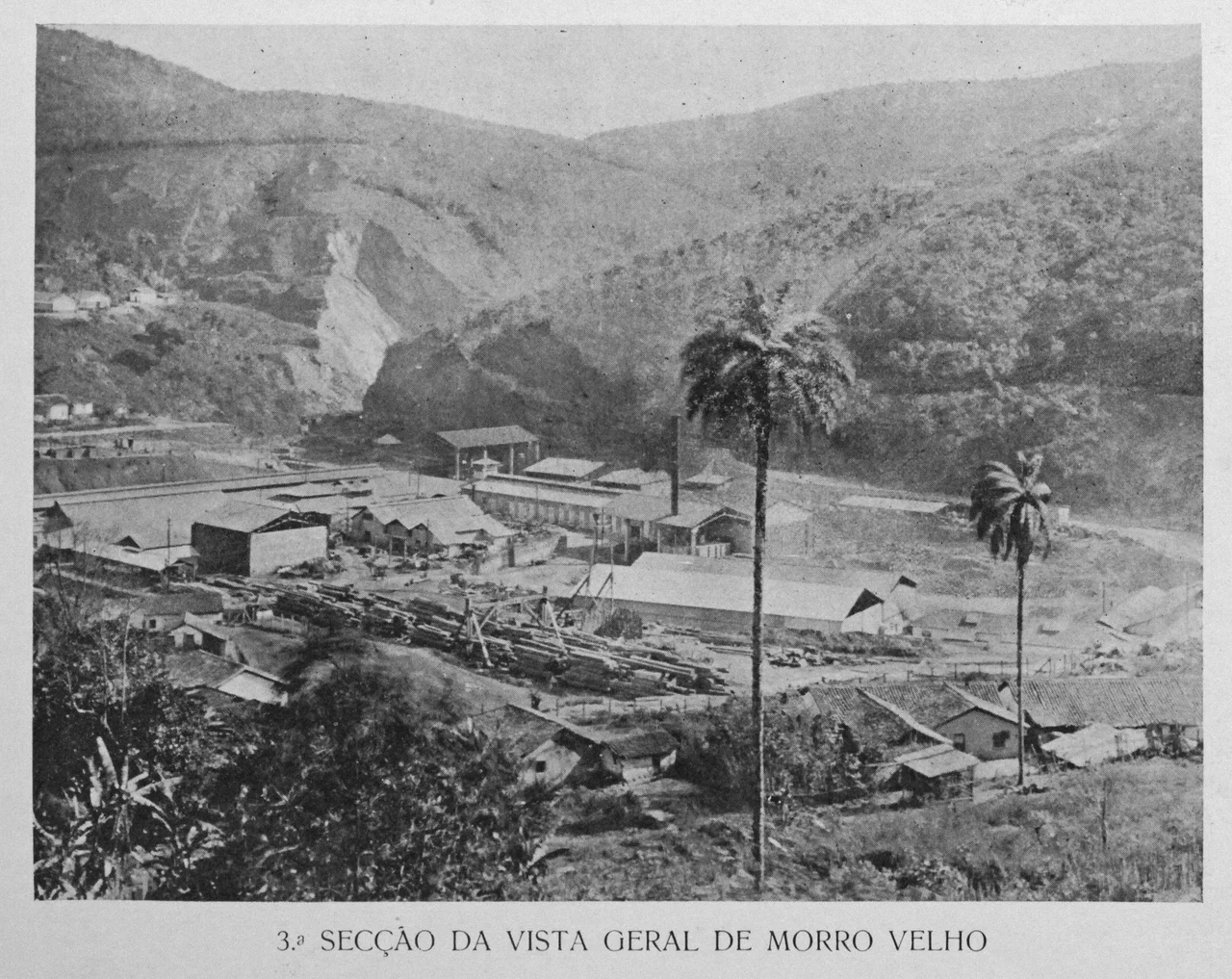

Morro Velho
Old Hill. That is what the name means - Morro Velho - and when the Saint John Del Rey Mining Company bought the property in 1834, the hill had already been producing gold for 109 years. Nobody in London that year could have guessed they were acquiring what would become the world's deepest mine. Nobody could have guessed it would still be running nearly two centuries later. The shaft now reaches more than three kilometers below the surface. Near the city of Nova Lima in Minas Gerais, Morro Velho keeps doing what it has done since 1725: pulling gold from the rock.
The British Century
The Saint John Del Rey Mining Company arrived with capital, steam engines, and expectations of empire. What they built around their pit was essentially a company town - a hydroelectric power plant, a state-of-the-art hospital for the era, a ten-kilometer tramway between Nova Lima and Raposos that ranks as one of the first in South America. They even founded a football club, Villa Nova AC, which would later win five Minas Gerais state championships between the 1930s and 1950s. The miners who made this English prosperity possible were first enslaved Africans and their descendants, forced down into the galleries, and then, after abolition in 1888, Brazilian free labor on the company's terms. The aqueduct the British built to wash the gold still stands, the Bicame, a stone artery running through Nova Lima's old quarter. The 150 British families who settled around the works gave the neighborhood its name: Bairro dos Ingleses, the Quarter of the English. Their chapel became the Anglican Church in town.
Deepest in the World
In 1915, the vertical shaft reached 5,824 feet. That made Morro Velho the deepest mine on Earth. The title was not a trophy the miners particularly celebrated - it meant longer rides to work, higher temperatures at the face, more complicated ventilation, more dangerous gases. But the Brazilian diggers kept going deeper because the gold kept leading them deeper. By 1929 the mine had reached 7,126 feet. The record had already passed the year before, in 1928, when South Africa's Village Deep mine pushed beyond Morro Velho's depth. The South Africans took the title, but the Minas Gerais operation kept descending. Today, some of the galleries here stretch more than 3,000 meters below the surface - a vertical distance equal to three Empire State Buildings stacked end to end in darkness.
Change of Hands
The Saint John Del Rey company eventually sold to the Carvalhaes family, a transition that brought Brazilian ownership to the shaft after more than a century of British control. Then in 1975, Anglo American Corporation - the South African mining giant that was a precursor to today's AngloGold Ashanti - took over the operations. The owners changed; the gold kept coming. Between 2003 and 2004, the old Minha Velha and Engenho D'Água pits closed, but the main complex actually increased production. In 2004 alone Morro Velho yielded 240,000 ounces of gold at an average ore grade of 7.62 grams per metric ton. By 2009, annual production had climbed to 329,000 ounces, and the mine employed close to 3,000 people, most of them permanent staff.
What Comes Out of the Dark
Gold is not the only thing this hill surrenders. The ore carries silver, arsenic, and other minerals that get separated in the processing stages. The arsenic is part of the legacy - for generations, the chemistry of extracting gold here produced contamination that lingered in soil and water long after the men who mined it had gone home. Modern operations run under tighter controls, but the ground around old mining districts in Nova Lima still carries its inheritance. Cash costs of production rose from 133 dollars per ounce in 2003 to 339 dollars by 2009, tracking the broader economics of a gold industry that has become more technical and more expensive to maintain.
Oldest Working Mine on the Planet
No mine on Earth has been in continuous operation longer than Morro Velho. Three hundred years of shifts, three hundred years of timbering and hoisting, three hundred years of headlamps moving into the dark and back out again. The Centro de Memória Morro Velho, an archive maintained by AngloGold Ashanti, keeps the records: photographs of 1868 miners in rough cotton and leather boots, 1907 images of the steam-powered hoists, early twentieth-century football teams from the company town. The mine survived the end of slavery, the fall of the empire, the rise and fall of the Estado Novo, the military dictatorship, the return of democracy. Empires came and went above the surface. Below it, the drills kept working.
From the Air
19.59°S, 43.51°W. The mining complex lies about 20 km south of Belo Horizonte in the Iron Quadrangle of Minas Gerais. Recommended viewing altitude 3,500-5,000 m AGL to see the scarred hillsides and tailings dams of Nova Lima against the rolling cerrado. Nearest airports: SBCF (Belo Horizonte/Confins) 40 km north, SBBH (Pampulha) 25 km north. Air quality sometimes reduced by dust from active mining operations; prefer early morning for best visibility.
Nearby Stories
- Mineirão 2.7 km away
- Sumidouro State Park 5.7 km away
- Santa Bárbara, Minas Gerais 11 km away
- Santo Antônio do Rio Abaixo 21 km away
- Serra dos Cocais 27 km away
- Paraopeba 49 km away
- Robert Quayle (1814 ship) 74 km away
- Vila Império 109 km away