.jpg)
Mineirão
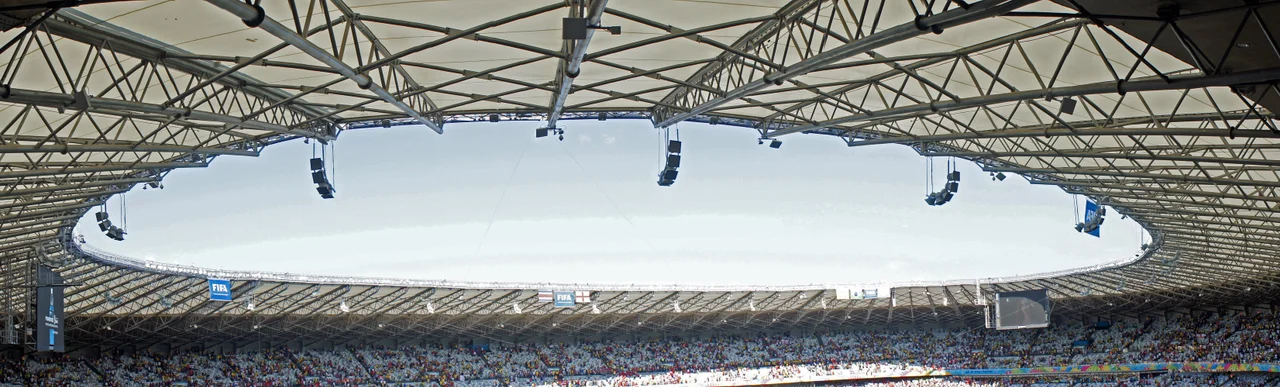
Brazilians call it the night the country cried. On 8 July 2014, in the semifinal of a World Cup Brazil was hosting on home soil, Germany scored seven goals. They scored the first in the eleventh minute. They scored the fifth in the twenty-ninth. The stadium - 58,000 people - went silent and then, at a certain point, began to applaud German passes out of stunned respect. The venue for that unprecedented collapse was Mineirao, Belo Horizonte's 66,658-seat false-ellipse concrete colossus, which Brazilians call the Pampulha Giant. It is the home of Cruzeiro Esporte Clube. It has also hosted Paul McCartney, Beyonce, Kiss, Pearl Jam, Metallica, and a gospel singer named Ana Paula Valadao whose concert in 2001 drew more than 210,000 people - the biggest audience ever recorded at the stadium. But for a large share of Brazilians, it will always be the stadium where that happened.
A Stadium Built in Eight Months
The law creating it was signed in 1959, but serious construction did not really begin until 1963. When it did, it moved at a pace that engineers still describe with disbelief. Cesar Gil, the construction manager, ran three shifts of three thousand workers each - around the clock, twenty-four hours a day. From buildings in downtown Belo Horizonte, people reported seeing a strange flash of light coming from the Pampulha district all night long. It was the welding. The steel industry could not produce rebar in the lengths the design required, so workers soldered and extended bars on-site as the structure rose. A smaller sector was built first as an experimental model - the mini-Mineirao - where concrete pours, roof bleachers, and structural joints were all tested before being scaled up. Between August 1964 and July 1965, the work jumped from that single experimental sector to a finished stadium ready for its public. Eight months of round-the-clock shifts. Only one worker died during the entire construction.
The False Ellipse
The mathematical shape is what engineers kept talking about. A false ellipse, with a major axis of 275 meters and a minor axis of 217 meters, built with conventional equipment in a country whose steel industry had never handled a project of that scale. Eduardo Mendes Guimaraes Junior and Gaspar Garreto designed it. Arthur Eugenio Jermann engineered the structural work. The goal had been a 100,000-seat stadium, upgraded from an existing 30,000-seat University Stadium site, and they nearly got there - the stadium originally held well over 100,000, though FIFA later forced reductions for safety. The final cost was about 10 million US dollars, and company bidders had offered to do the job for fifteen million cruzeiros, which engineers calculated would have been enough money to build Mineirao one-and-a-half times over. The whole thing was, literally, a bargain.
The 132,834
The record attendance was set on an afternoon in 1997. Cruzeiro played Villa Nova in the Campeonato Mineiro final. The paying attendance was 74,857. The remaining 56,618 spectators were women and children who entered for free - and one of the largest crowds ever assembled for a football match anywhere on Earth filled the bowl to the roof. People sat in the aisles. They stood on the concrete ramps. They watched from concourses that were never designed for spectators at all. That same arena has hosted the first international match by Brazil - a 3-0 victory over Uruguay in 1965 - and the first Classico Mineiro between Cruzeiro and Atletico Mineiro the same year. Cruzeiro has hoisted four Copa do Brasil trophies here. Atletico won the 2013 Copa Libertadores on this pitch. Reinaldo of Atletico scored 144 goals at Mineirao between 1973 and 1984; Tostao of Cruzeiro scored 143 between 1965 and 1972, with a better yearly average.
The Seven
On 8 July 2014, Germany met Brazil in the World Cup semifinal at Mineirao. Thomas Muller scored in the eleventh minute. Then Miroslav Klose, in the twenty-third, scored his sixteenth career World Cup goal - breaking Ronaldo's all-time record. Toni Kroos scored in the twenty-fourth. Kroos again in the twenty-sixth. Sami Khedira in the twenty-ninth. By halftime it was 5-0, a scoreline without modern precedent for a host nation in a World Cup knockout match. Andre Schurrle added two in the second half to make it 7-0 before Oscar pulled one back in stoppage time. A particular silence settled over Mineirao that evening that Brazilian commentators have still not quite found language for. Klose's record-breaking goal and Germany's 2000th-ever national-team goal - scored by Muller - both happened at Mineirao on the same night. It was a historic stadium. It became a more historic one for reasons no one wanted.
The Venue That Plays Everything
Football is not all Mineirao does. The stadium has hosted music since it opened. Kiss played here on the Creatures of the Night tour in 1983. Menudo came in 1985. Paul McCartney chose Mineirao to kick off his Out There tour in May 2013 - the first show of a world tour, played in Belo Horizonte because the scale of the place and the intensity of Brazilian fan culture made it the right place to begin. Beyonce brought the Mrs. Carter Show in September 2013, with Jay-Z in the audience. Pearl Jam played in 2015. Roger Waters has played here twice, first with Us + Them in 2018 and again with This Is Not a Drill in 2023. The outer patio, after the 2014 renovations, became its own concert venue - Black Sabbath played there, Foo Fighters, Iron Maiden, Ed Sheeran. Mineirao is the Pampulha Giant, and giants draw giants.
From the Air
Coordinates: 19.87S, 43.97W, in the Pampulha neighborhood of Belo Horizonte, Minas Gerais. Elevation approximately 800 meters. Nearest airport: Belo Horizonte-Pampulha (SBBH) immediately adjacent; larger commercial operations at Belo Horizonte-Confins (SBCF) approximately 40 km north. The stadium's false-ellipse roof (275 m by 217 m) is one of the most distinctive urban landmarks visible from altitude around Belo Horizonte, sitting alongside the modernist Pampulha reservoir and Oscar Niemeyer's Church of Sao Francisco de Assis. Afternoon convective buildup common in summer.
Nearby Stories
- Iron Quadrangle 11 km away
- Morro Velho 14 km away
- Santa Bárbara, Minas Gerais 19 km away
- São Gonçalo do Pará 22 km away
- Sumidouro State Park 24 km away
- Crucilandia 29 km away
- Our Lady of the Rosary Church, Lavras 120 km away
- Paranaíba River 168 km away