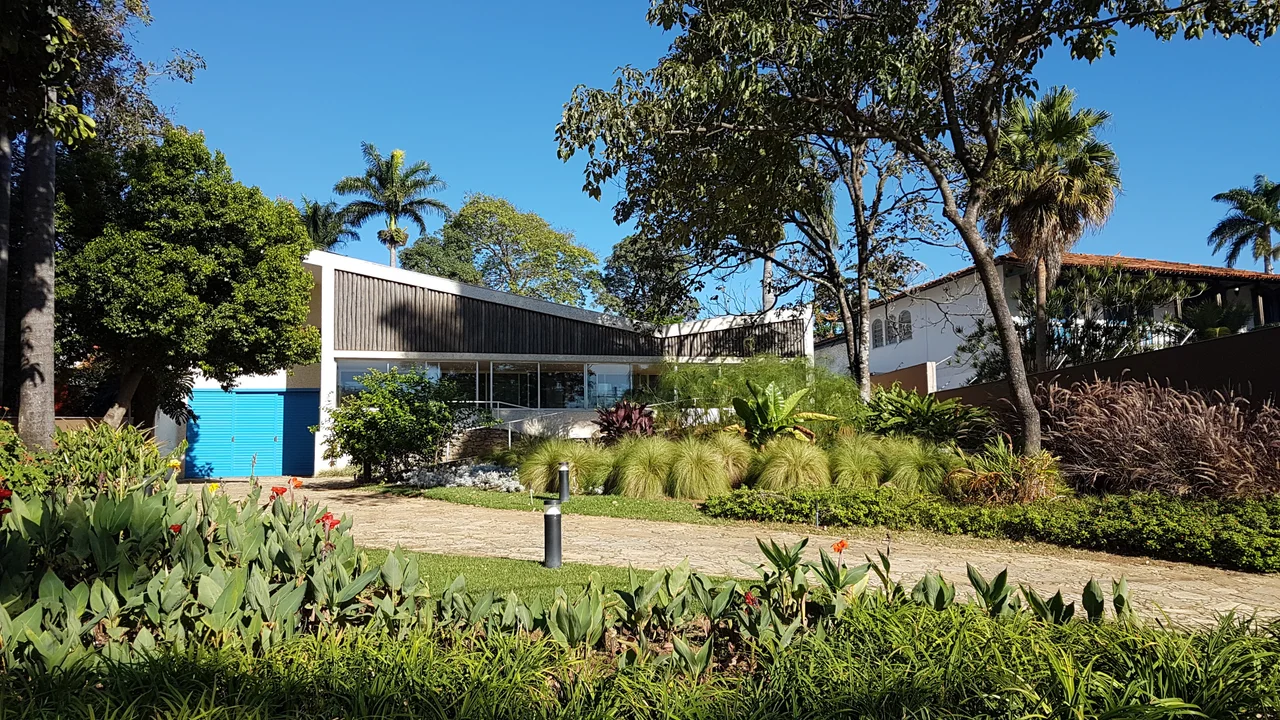

Kubitschek Residence Museum
Before Juscelino Kubitschek built Brasília, he built a house. It went up between 1940 and 1943 on the shore of Lake Pampulha in Belo Horizonte, a weekend retreat for a man who was then only prefect of the city - a local politician with a restless friendship with a young architect named Oscar Niemeyer. The roof folds down the center like a butterfly resting, two inclined planes meeting at a spine. Inside, the walls carry paintings by Alfredo Volpi and murals by Paulo Werneck. Outside, a garden by Roberto Burle Marx frames the entrance. The house is the quiet prelude to everything that came next - the governorship, the presidency, the new capital on the red dirt of the central plateau.
A Butterfly on Pampulha
The residence occupies 680 square meters on a lot of 2,800. Niemeyer placed the structure at the farthest edge of the plot from the street, a choice the Kubitschek family asked for and the architect delivered with characteristic intelligence. The butterfly roof, two planes pitched toward a central valley, is the house's signature gesture. Inside, the spaces are partitioned in a way that preserves intimacy without sacrificing the openness that defines Brazilian modernism. Social rooms - living, dining, games - sit on one side of the plan. Service spaces - kitchen, servants' quarters, a secondary bath - occupy another. Three bedrooms form the private core. A bathroom connects the master bedroom directly to the pool, a detail Kubitschek's political enemies later pointed to as a possible emergency exit from his alleged affairs.
The Office by the Pool
Behind the main house, near the swimming pool, Niemeyer designed a smaller second structure. Three bedrooms, two living rooms, one bathroom - technically a guesthouse, but Kubitschek turned it into his office. It was one of his favorite places in the world. He worked there, took phone calls there, sunbathed by the pool there. The photographs of this period show a man comfortable in his own house, in a way later photographs of him in the presidential palace would rarely capture. The small office is where the idea of building a capital from nothing, on an empty plateau 900 kilometers away, was first batted around and not immediately dismissed.
The Family Who Stayed
The Kubitschek family lived in the house only until 1945, when Juscelino moved to Rio de Janeiro to take his seat as a federal deputy. The residence sat empty for eleven years. In 1956 - the same year Kubitschek was inaugurated as president of Brazil - his best man and lifelong friend Joubert Guerra bought the property, bringing the Guerra family into the butterfly house. The arrangement was warm. Kubitschek kept the house available to himself whenever he visited Belo Horizonte, and the Guerras kept the furniture and art exactly where the Kubitscheks had left them. A refrigerator, a master bed, a French billiard table, and some ninety other items passed from one household to the next without leaving the rooms.
Fifty Years of Preservation
Joubert Guerra died in 1977. His wife, Juracy Brasilience Guerra, remained in the house until her death in 2004. For sixty years, through a transition that could have scattered everything, the house and its contents had been looked after almost as a memorial. When Juracy died, the Prefecture of Belo Horizonte saw the opportunity to turn private memory into public heritage. In 2005, the Guerra heirs signed an expropriation agreement ceding the property to the city. Reconstruction work began in 2008, guided by the Municipal Culture Foundation's patrimony directorate. The intent was to restore the house to its Kubitschek-era condition while opening it to the public.
Joining the Modern Ensemble
On September 10, 2013, the Kubitschek Residence Museum opened to visitors. It took its place in the Pampulha Modern Ensemble, Niemeyer's larger masterpiece around the lake - the curving Church of Saint Francis of Assisi, with Cândido Portinari's tilework; the Pampulha Museum of Art, formerly the casino; and the Casa do Baile, the ballroom on its own tiny island. Together these buildings represented something new in Brazilian architecture when they went up in the 1940s, and something enduring after. The residence fits alongside them now as a quieter, more personal piece of the same experiment. You can stand where Kubitschek stood by the pool, look across the water at the church he commissioned the next year, and trace the path from one young prefect's ambitions to a movement that would reshape Brazil.
From the Air
Located at 19.85°S, 43.98°W on the southern shore of Lake Pampulha in Belo Horizonte, Minas Gerais, Brazil. Best viewed from 2,000-3,500 ft AGL; Lake Pampulha is a distinctive kidney-shaped artificial lake in the northern part of Belo Horizonte. The Pampulha Modern Ensemble - a UNESCO World Heritage Site since 2016 - includes this house, the Church of Saint Francis of Assisi (with its Niemeyer curves and Portinari tiles), the Pampulha Museum of Art, and Casa do Baile, distributed around the lake. Nearest airport is Pampulha Airport (SBBH), just west of the lake, or Tancredo Neves International Airport (SBCF) about 40 km north.
Nearby Stories
- Serra do Rola-Moça State Park 12 km away
- Morro Velho 22 km away
- Iron Quadrangle 25 km away
- São Gonçalo do Pará 32 km away
- Paraopeba 40 km away
- Santo Antônio do Rio Abaixo 48 km away
- Our Lady of the Rosary Church, Lavras 139 km away
- Três Marias 158 km away