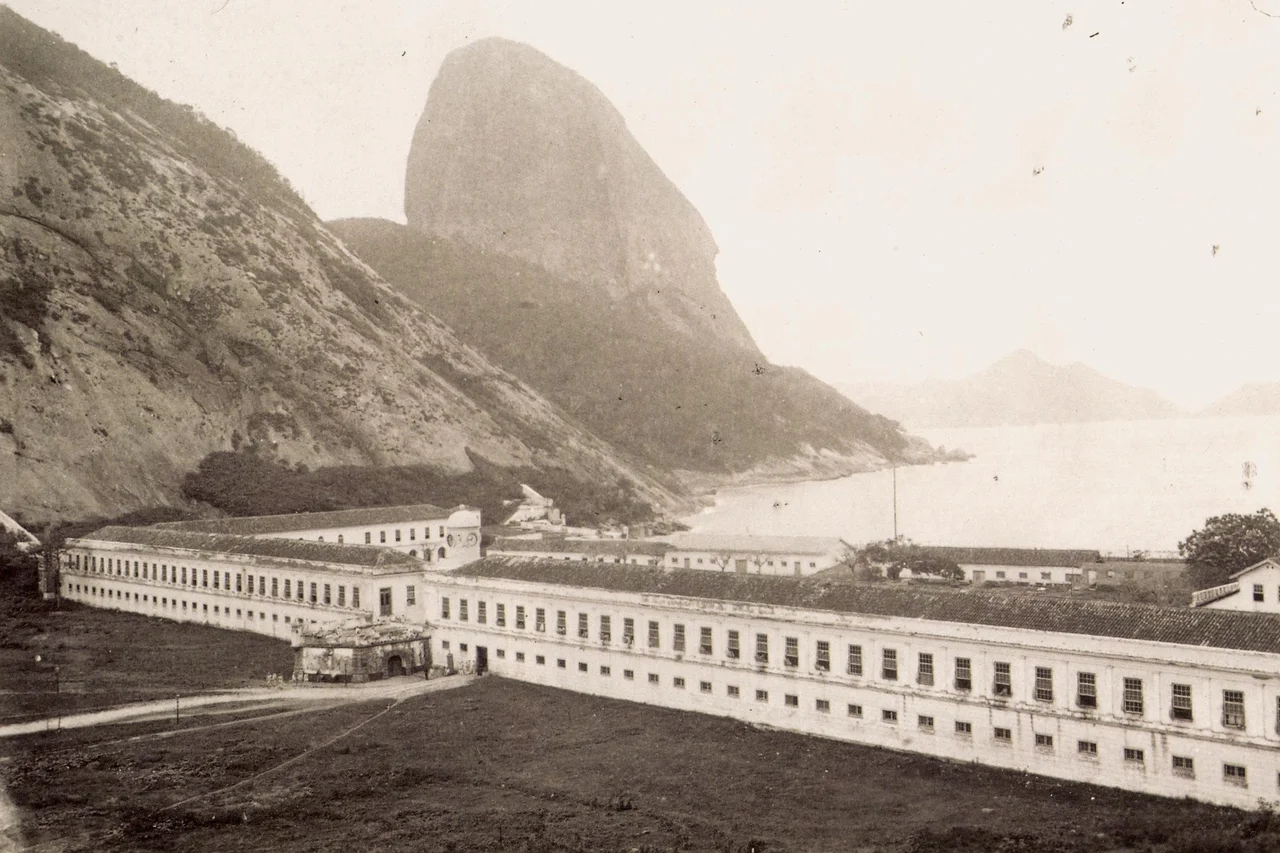

Military Academy of Agulhas Negras
Queen Mary I of Portugal signed the decree in 1792, and with that signature she accidentally founded the oldest military academy in the Americas - older than West Point, older than any Spanish-American institution, the first of its kind on two continents. The Real Academia de Artilharia, Fortificacao e Desenho began in Rio de Janeiro in a building called the Casa do Trem, training young men to build forts against English, Dutch, and French corsairs. Two hundred and thirty years later, that same institution lives on as AMAN, the Academia Militar das Agulhas Negras, occupying 67 square kilometers in the town of Resende at the foot of the Serra da Mantiqueira. It has trained nearly every president Brazil produced during its twenty-one years of military rule.
A Queen's Signature
Portuguese Brazil in 1792 was a colony worried about pirates. English, Dutch, and French corsairs had been raiding the coast for two centuries, and the Crown needed officers who could design and build coastal fortifications. Queen Mary I - remembered in Portuguese history as Maria the Mad, though the label is contested - issued the founding decree that year. The Royal Academy of Artillery, Fortification and Drawing was modeled on its Lisbon counterpart and offered three tracks: a three-year course for infantry and cavalry officers, a five-year course for artillery, and a six-year course for engineers. That last track specialized in construction materials, hydraulics, bridges, canals, and floodgates - a thoroughly practical education that produced men who, more than any other colonial officers, could build things that stayed built. This is considered the pioneering institution of both military and engineering education in the Americas.
The Royal Court Arrives
Everything changed in 1808. Napoleon invaded Portugal. The entire Portuguese royal court - King Dom Joao VI, the queen, the nobility, the state archives - fled across the Atlantic and relocated to Rio de Janeiro, making a colonial capital the seat of empire overnight. Three years later, on 23 April 1811, the King inaugurated the Real Academia Militar, absorbing the existing Royal Academy of Artillery. Its first home was the old Artillery academy building, now occupied by Brazil's National Historical Museum. In 1812 it moved to Sao Francisco square for better parade ground. Independence in 1822 renamed it the Imperial Academia Militar. Each political transformation left the institution standing. It simply kept training officers, and the buildings kept changing signs.
The Move to Resende
The Brazilian Army needed room. By the 1940s the old urban campus in Rio had become inadequate for modern training - no space for tank maneuvers, no space for artillery ranges, no space for the scale of exercises that a 20th-century army required. On 1 January 1944, the Military School of Resende was inaugurated at a 67-square-kilometer site tucked against the Mantiqueira mountains. Marshal Jose Pessoa, nephew of President Epitacio Pessoa, oversaw the construction. In 1951 it took its final name, Academia Militar das Agulhas Negras - Black Needles Military Academy - after the mountain peak that dominates the western horizon from campus. Pico das Agulhas Negras, at 2,792 meters, is one of the highest points in Brazil, and its dark granite spires cut into cadet skies every morning during physical training.
The Saber of Caxias
Every AMAN cadet takes an oath that begins with a specific line: I receive the saber of Caxias as the symbol of military honor itself. The reference is to Luis Alves de Lima e Silva, Duke of Caxias, the official patron of the Brazilian Army and twice Prime Minister of Brazil. In August of their first year, cadets attend a ceremony where they receive ceremonial daggers modeled on the saber Caxias carried. The daggers, called espadins, are paired with the blue dress uniform of the Corps. The ritual is unchanged for decades. Cadets are informally ranked in their own slang - first-years called bichos, the animals; second-years called calouros, the freshmen; third-years called afim; and fourth-years addressed as aspirante, officer candidate. These terms are almost never used by officers. They are used among cadets themselves, constantly.
The Alumni Roll
The list of notable alumni tells a particular 20th-century Brazilian story. The generals who ruled Brazil from 1964 to 1985 under military dictatorship nearly all passed through AMAN or its predecessor: Humberto Castelo Branco, Artur da Costa e Silva, Emilio Garrastazu Medici, Ernesto Geisel, Joao Figueiredo. Eurico Gaspar Dutra graduated earlier and served as Minister of War during World War II before becoming president. Golbery do Couto e Silva founded the National Intelligence Service. More recently, Hamilton Mourao served as Vice President; Jair Bolsonaro, president from 2019 to 2023, entered AMAN's gates as a cadet in 1974, photographed in uniform with his parents. In 2017, the first female cadets walked through the academy's doors - a change that came roughly 225 years after Queen Mary's signature. The campus today houses the largest battalion in the Brazilian Army, and the same morning ritual plays out: reveille, formation, physical training under peaks named for the blackness of their rock.
From the Air
Coordinates: 22.44S, 44.46W, near Resende in the Paraiba do Sul valley of Rio de Janeiro state. Elevation approximately 430 meters. Nearest airport: Resende Airport (SDRS) adjacent to town; larger options at Sao Jose dos Campos (SBSJ) to the east. The campus sits at the foot of the Serra da Mantiqueira; Pico das Agulhas Negras rises to 2,792 meters approximately 25 km to the north-northwest, and Itatiaia National Park dominates the skyline. Orographic activity in the mountains is a routine consideration for approaches from the north.
Nearby Stories
- Basilica of Our Lady of Aparecida 31 km away
- Cambuquira 44 km away
- Itajuba 47 km away
- Ibitipoca State Park 48 km away
- Miguel Pereira 49 km away
- Christ the Redeemer: The Statue Built from Soapstone Carried Up a Mountain 81 km away
- Três Corações 95 km away
- Campos do Jordao 115 km away