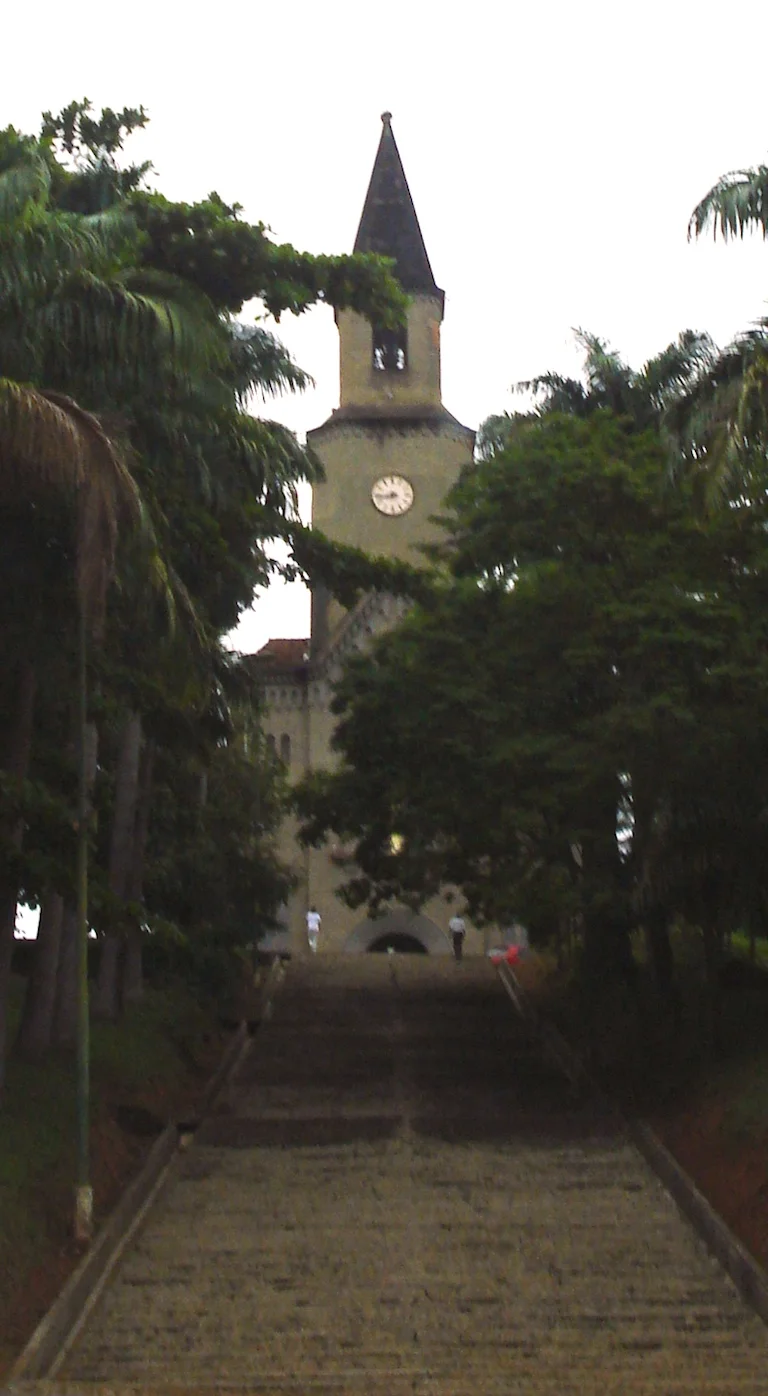

Leopoldina, Minas Gerais
The name belongs to a princess. When the small frontier settlement along the Feijão Cru Stream was ready to break away from its parent municipality in 1854, the provincial lawmakers chose to honor Princess Leopoldina de Bragança e Bourbon, the second daughter of Emperor Dom Pedro II. Before that, the place had been called São Sebastião do Feijão Cru - Saint Sebastian of the Raw Bean, the saint and the stream together. The name changed, but the town kept growing. A century and a half later, Leopoldina is a municipality of about 51,000 people in the Zona da Mata, the Forest Zone of southeastern Minas Gerais, a town that has lived through gold decline, coffee boom, coffee crash, and a slow reinvention around milk and rice.
Before the Farmers Came
The Zona da Mata was once called the Sertões do Leste, the Eastern Backlands - a strip of Atlantic forest stretching from the Paraibuna River and the old Royal Road down to the Doce River. The Portuguese colonial government forbade settlement here, trying to protect the gold mines deeper inland from smuggled supply routes. The Puri indigenous people lived in this forest. When the first Portuguese settlers began arriving at the end of the 18th century, looking for land after the gold ran out, the Puri were pushed into contact with them. The settlers paid Puri workers in cachaça - sugarcane liquor - to clear the forest and harvest ipecacuanha root, a medicinal plant. Measles and other introduced diseases killed a great many. The rest were driven east toward Espírito Santo. By 1865, the Puri were effectively gone from the area.
A Chapel by the Raw-Bean Stream
The earliest settler records in the municipality date to 1824. Families camped along the Feijão Cru Stream, where a muleteers' stop began to form. In 1831, two farmers - Francisco Pinheiro de Lacerda and Joaquim Ferreira Brito - built a small chapel of wattle and daub and dedicated it to Saint Sebastian. That same year the district of São Sebastião do Feijão Cru was formally created as part of São Manuel do Pomba. In 1851 it was transferred to Mar de Espanha. Three years later, provincial law No. 666 of April 27, 1854, made it a municipality in its own right - Vila Leopoldina. The village grew around Rosário Square, from which three streets ran out. They still exist today, though under different names: Tiradentes, Gabriel Magalhães, and Joaquim Ferreira Brito - the farmer who had helped build the first chapel.
The Coffee Cycle
Coffee turned Leopoldina into a real city. From the province of Rio de Janeiro, coffee crossed the Paraíba do Sul river and spread up into the Zona da Mata through the valleys of the Paraibuna, Pirapetinga, and Pomba rivers. The town was elevated from village to city in 1861. Latin and French were taught in local schools. Wealth accumulated fast. In 1906, engineers laid the cornerstone of the Mauricio Hydroelectric Power Plant at Cachoeira da Fumaça on the Novo River - the first hydroelectric plant in the region. By July 1908, electric power arrived in the city. The Banco Ribeiro Junqueira opened in 1911. The Leopoldinense Gymnasium, founded in 1906, added an agricultural school and even a school of pharmacy and dentistry. Leopoldina was, briefly, one of the most important cities in Minas Gerais.
Crash and Reinvention
Coffee did not last. Early-20th-century crises and the 1929 crash collapsed the coffee economy of the Zona da Mata. Leopoldina turned to dairy farming and rice cultivation, the quieter industries that would carry the town from then on. Politics, however, stayed active. From the First Republic through the 1964 military coup, Leopoldina produced senators, governors, and even a president: Senator Ribeiro Junqueira, Governor Clóvis Salgado, and President Carlos Luz all came from here. The Rio-Bahia Highway, inaugurated in 1963, kept the town connected to the national economy. Today 80 percent of the municipality is undulating or hilly terrain, with only 20 percent classified as plain; the town sits at 225 meters, with Alto de Santa Úrsula reaching 712 meters.
A Catholic Diocese and a Viola Festival
Leopoldina has been the seat of a Catholic diocese since 1942, with the Cathedral of St. Sebastian as its episcopal see. Seven parishes fan out across the municipality. About 71 percent of residents identify as Catholic, 17 percent as evangelical. The year fills with festivals. The Agricultural and Industrial Exhibition in July. The Feira da Paz in September, a handicraft and cultural fair staged at the central circle of the Exhibition Park. The Viola and Gastronomy Festival in the district of Piacatuba, held each mid-July and August, draws wide crowds for the viola caipira - the ten-string country guitar that is the instrument of rural Minas Gerais. Piacatuba is also home to the Electricity Museum, installed beside the old Mauricio Power Plant, where you can see the turbines that first lit the region more than a hundred years ago.
From the Air
Located at 21.53°S, 42.64°W in the Zona da Mata of southeastern Minas Gerais, Brazil, 322 km southeast of Belo Horizonte. Town center sits at 225 m elevation; highest point in the municipality is Alto de Santa Úrsula at 712 m. Best viewed from 3,500-5,500 ft AGL to pick out the rolling hill country and the pattern of dairy pastures intermixed with fragmented Atlantic forest. Nearest commercial airport is Presidente Itamar Franco Airport (SBZM) near Juiz de Fora, about 100 km southwest. Climate is tropical Aw (dry winter, wet summer) with mean annual temperature near 21°C.
Nearby Stories
- Juiz de Fora 27 km away
- Ubá 29 km away
- Desengano State Park 31 km away
- Paraiba do Sul, Rio de Janeiro 41 km away
- Hospital Colônia de Barbacena 57 km away
- Nova Friburgo 57 km away
- Itaboraí Formation 88 km away
- Pedra Azul State Park 154 km away