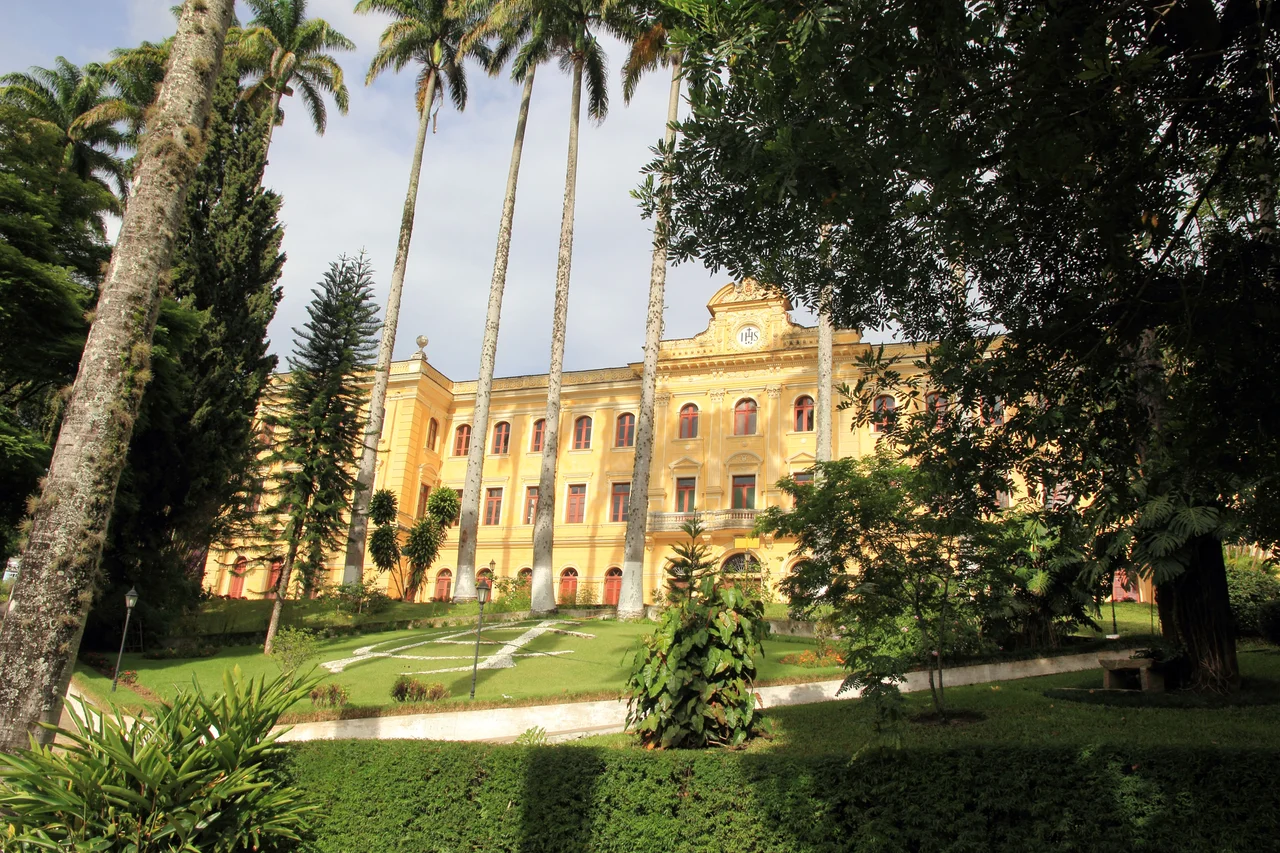

Nova Friburgo
In May 1818, King John VI of Portugal signed a royal decree inviting the Canton of Fribourg in Switzerland to send one hundred families to Brazil. The king was looking for allies against Napoleon's lingering influence. He was also looking for European settlers to populate the mountains above Rio de Janeiro. The Swiss obliged. Between 1819 and 1820, 265 families boarded ships and crossed an ocean - 1,458 immigrants in all, far more than the original decree had called for. They chose a mountainside 136 kilometers from the capital, 846 meters above sea level, and they named it after home. Today, Nova Friburgo is a city of 189,939 people with the second-largest hotel network in the state, a Swiss house museum, a cheesemaking school, and a memory of cold winters that most Brazilian cities cannot share.
Before the Swiss
The land that became Nova Friburgo was not empty when the settlers arrived. The Coroado Puri people lived in these mountains, a subgroup of the Puri with their own customs and language, moving through the forests and fishing the high-altitude streams. The royal decree that brought the Swiss made no meaningful provision for them. As happened across colonial Brazil, the indigenous residents were pushed to the margins, displaced by the clearing of land for European farms, and eventually absorbed into the broader diaspora of dispossessed peoples who became part of Brazil's complex racial history. The Alpine-style buildings of present-day Nova Friburgo sit on ground that was Puri country for centuries before any Swiss farmer sowed his first potato here.
The Hundred Families Who Became Thousands
The Morro Queimado farm in Cantagalo district was chosen because its climate and terrain resembled the Swiss home country - cool, mountainous, fit for European crops and European nerves. In 1822, Brazil declared independence from Portugal. The imperial government of Pedro I continued the colonization policy. In May 1824, eighty German families originally assigned to Bahia arrived unexpectedly in Nova Friburgo for unknown reasons, thickening the Germanic character of the town. Italians, Portuguese, and a small Syrian community followed. By 1890, the settlement had grown large enough to be elevated to city status. The Baron of Nova Friburgo brought the Leopoldina Railroad through in 1872, connecting the mountains to Rio de Janeiro and allowing Cantagalo coffee to reach global markets. Agriculture anchored the economy until industrialists arrived around 1910 and pivoted the town toward manufacturing.
The Underwear Capital
Today Nova Friburgo is known nationally as the capital of the undergarment industry. The origin story is mid-twentieth century: Swiss and German textile traditions grafted onto Brazilian manufacturing yielded a cluster of lingerie factories that now produce enormous variety and volume, with local brands moving into export markets. Textile mills and metallurgical operations fill out the industrial base. Agriculture continues alongside industry, with the municipality ranking as Brazil's second-largest flower producer, surpassed only by Holambra in São Paulo state. Vegetable farming and goat raising persist in the countryside. The district of Lumiar, an hour outside the city, has become one of Rio state's most important ecotourism centers, drawing rafters and canoers to the rivers Macaé and Bonito.
January 2011
On 11 January 2011, the rains that had been falling for days collapsed the hillsides. Mudslides tore through neighborhoods. The 2011 floods in the mountain region of Rio de Janeiro killed at least 916 people across several municipalities, including at least 424 in Nova Friburgo alone - the hardest-hit municipality. National news reports confirmed the toll as the biggest natural disaster in Brazilian history, with over 900 dead and over 200 missing across the region. Whole houses disappeared. The survivors were left for days without water, electricity, food, or cooking gas. The city rebuilt - houses, roads, retaining walls - but the slopes above Nova Friburgo carry scars still visible from altitude, and families here mark anniversaries no tourist brochure mentions.
Chairlifts and Cold Mornings
The tourist reason to visit Nova Friburgo is the climate. Annual average temperature sits at 19 degrees Celsius, with humid mild summers and dry cool winters under the Köppen Cwb subtropical highland classification. The coldest temperature ever recorded here was -1.4 degrees Celsius, on 8 August 2014 - properly cold by Brazilian standards. Suspiro Square holds the country's largest chairlift. The Pedra Riscada, the Sitting Dog Stone at Furnas do Catete, and the Vale dos Frades in Três Picos State Park draw climbers and day-hikers. Casa Suíça preserves architectural memory of the original settlers. FRIALP trains cheesemakers. Bräun and Bräun still serves Alpine dishes. A 1940 photograph of Alberto Braune Avenue looks like a Swiss mountain town with tropical trees in the background - which is, essentially, what Nova Friburgo has always been.
From the Air
22.28°S, 42.53°W. Nova Friburgo sits at 846 meters in the Serra do Mar mountain system, about 140 km northeast of Rio de Janeiro city. Recommended viewing altitude 4,500-6,500 m AGL to appreciate the dramatic ridges, including Pico Maior at 2,316 meters and the Três Picos formation. Nearest airports: SBGL (Rio de Janeiro/Galeão) 130 km southwest, SBJR (Jacarepaguá) 120 km southwest. Mountain weather is volatile; fog and low cloud common in winter mornings, with afternoon thunderstorms in summer.
Nearby Stories
- Macaé 16 km away
- Montanhas de Teresópolis Municipal Nature Park 17 km away
- Desengano State Park 49 km away
- Juiz de Fora 54 km away
- Rio de Janeiro 54 km away
- Paraiba do Sul 94 km away
- Christ the Redeemer: The Statue Built from Soapstone Carried Up a Mountain 100 km away
- Grytviken 3562 km away