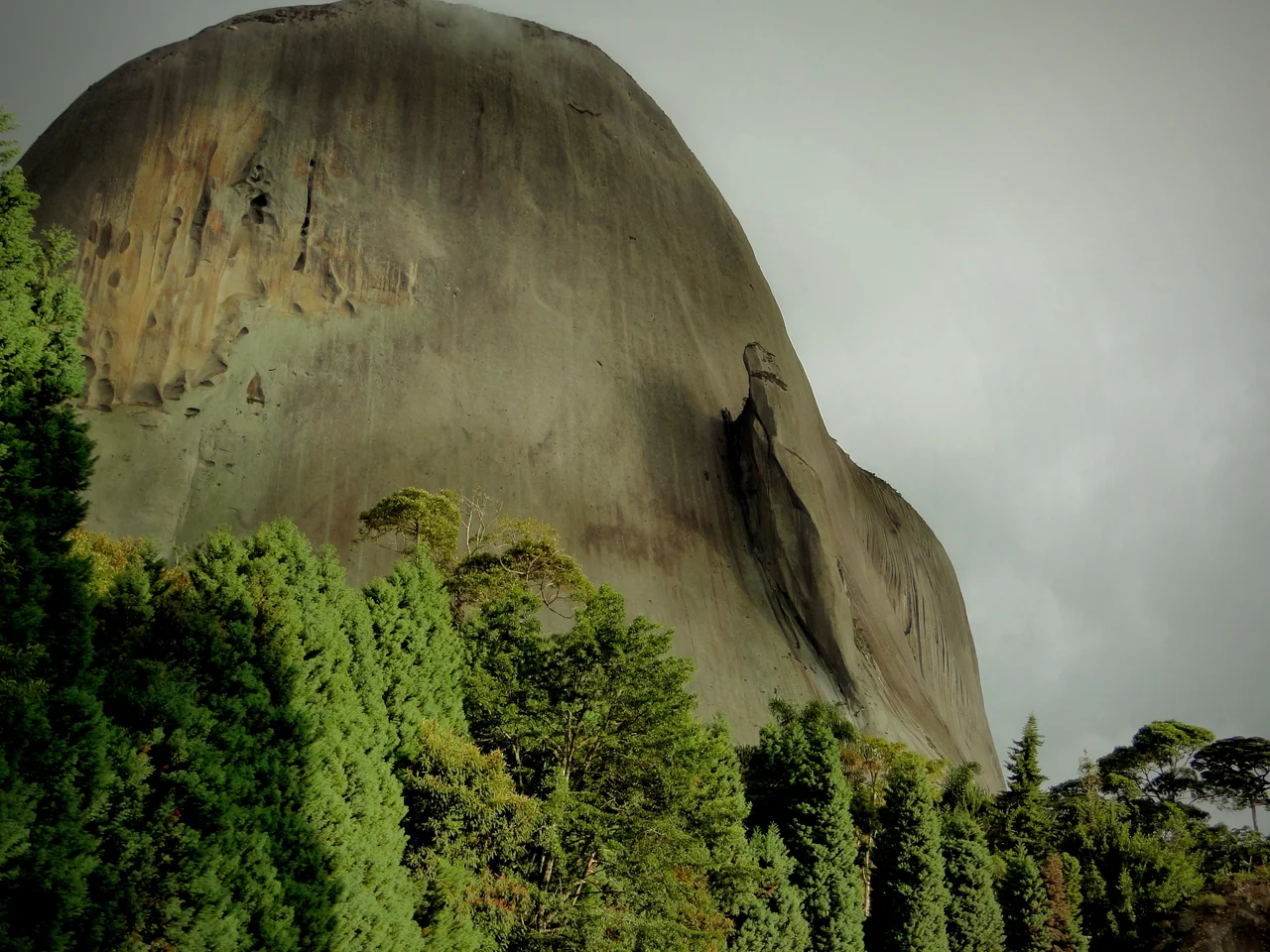

Pedra Azul State Park
The rock turns blue. Not at every hour, not from every angle - but at specific times of day, when the sun hits the granite just right, Pedra Azul reflects back a blue tonality that gave it its name and made it impossible to mistake for any other peak in Espirito Santo. The summit reaches 1,909 meters. The flank holds a natural sculpture so distinctive it has its own name: Pedra do Lagarto, the Lizard Rock - a gneissic formation that from certain angles resembles an enormous reptile climbing the slope. Seen from the valley floor it looks prehistoric. Seen from the trails that wind through the 12-square-kilometer park, it looks like the landscape is alive and moving, which given the tropical forest's constant sound of monkeys, birds, and wind through the bromeliads is not entirely wrong. Pedra Azul State Park is off the beaten path. That is part of what makes it worth finding.
The Rock That Changes Color
The main attraction is the mountain itself - a massive granite-gneiss formation rising from the interior highlands of Espirito Santo state, visible from the BR-262 highway long before you reach it. The Lizard Rock formation on the right slope climbs to 1,882 meters and catches light in ways that make the granite flash silver, pink, blue, and gold across the day. For travelers who can handle a climb, there is a trail to the upper levels of Pedra Azul where the rock holds natural pools carved by water action over geological time. The hike takes at least an hour and requires reasonable fitness. At the top, the pools hold water cold enough to shock you and clear enough to swim in. The view stretches across the mountainous interior of Espirito Santo, down toward Domingos Martins and the coast. On a clear day the municipality of Caparaó in Minas Gerais is visible to the west, along with the rugged profile of Forno Grande State Park.
What Lives Here
The park protects a slice of the Atlantic Forest biome at elevation, with vegetation and wildlife that shift as you climb. Around the rocky formations grows rupestral vegetation - plants that root in cracks and thin soils beneath stones. Above 1,500 meters the ombrophilous anti-mountainous forest takes over, a cloud-fed woodland that captures the heavy rains falling across this elevation. Orchids cling to trees. Bromeliads catch their own water. Cedars, cassias, ipes - the last a family of showy-flowered trees with names like Tabebuia and Tecoma - stand alongside canjeranas and several laurels. The fauna is a catalog of everything a visitor to the Atlantic Forest hopes to see. Brown Capuchin Monkeys in the canopy. Ocelots hunting at dawn. Toucans calling across valleys. Bellbirds with their metallic notes carrying for kilometers. Gray Brocket Deer in the clearings. Crab-eating Raccoons in the streams. Buffy-Headed Marmosets - one of the more endangered primates - persist in protected patches. Jaguars have been recorded, though they are rarely seen. The Barbado, a freshwater fish in the catfish family, holds on in the park's streams.
Climate and Trails
The weather here runs cooler than the Espirito Santo coast. Annual average temperature sits around 18 degrees Celsius, with summer highs averaging 28 and winter lows dropping to 8 - temperatures that in Brazilian coastal terms counts as cold. The result is that local pousadas install fireplaces and offer fondue on the winter menu, transforming this corner of a tropical state into something that feels briefly alpine. Four trails serve public visitation. The Do Lagarto - Trail of the Lizard - runs 480 meters and gives the best view of the rock formation that gave it its name, with sightlines across to Minas Gerais and Forno Grande. The Das Piscinas - Pools Trail - covers 1,200 meters and passes nine natural swimming pools carved by moving water. The Da Pedra Azul - Blue Rock Trail - covers 945 meters alongside a 500-meter-tall granite face. The Pedra das Flores climbing route ends at more pools set in rock gardens of wildflowers. Access to all of them is controlled by the IDAF - Instituto de Defesa Agropecuaria e Florestal - the state agricultural and forest defense institute. Independent hiking is not allowed. Group visits go out every morning around 8 AM and finish by noon.
Getting There and Staying
Domingos Martins is the access town, 46 kilometers from the park center. The municipality has been part of this territory since German-Swiss immigrants settled here in the 19th century, and that European heritage still shapes the local food and architecture. Tourism around Pedra Azul has grown quickly. Hotels and pousadas have multiplied in recent decades, many of them equipped with saunas, swimming pools, and occasional tennis courts. Rooms typically come with fireplaces - a direct response to winter temperatures that elsewhere in Espirito Santo would be unthinkable. The area phone code is 27. Visitors typically combine Pedra Azul with a night or two in one of the pousadas of the surrounding hills, watching the rock turn colors through the course of a day, hiking into the natural pools, and returning to warm rooms when the cloud forest starts to chill in the evening. The park was established in the 1990s to protect what generations had already come here to see.
From the Air
Located at 20.41 degrees south, 41.02 degrees west in interior Espirito Santo state, Brazil. The summit of Pedra Azul stands at 6,260 feet (1,909 meters) and the Lizard Rock reaches 6,175 feet (1,882 meters) - both dramatic granite landmarks visible from altitude. Nearest airport: Vitoria (SBVT), about 90 km east on the coast. Cruise altitudes of 10,000 to 14,000 feet give excellent views of the Atlantic Forest-clad highlands, the distinctive granite exposures of Pedra Azul and Forno Grande, and the transition from coastal plain to the mountainous border with Minas Gerais. The BR-262 highway runs southeast-northwest past the park.
Nearby Stories
- Serra, Espírito Santo 16 km away
- Moscoso Park 20 km away
- Feliciano Miguel Abdala Private Natural Heritage Reserve 65 km away
- Mutum, Minas Gerais 68 km away
- Paraiba do Sul 97 km away
- Muriaé 101 km away
- Robert Quayle (1814 ship) 132 km away
- Petrobras 36 173 km away