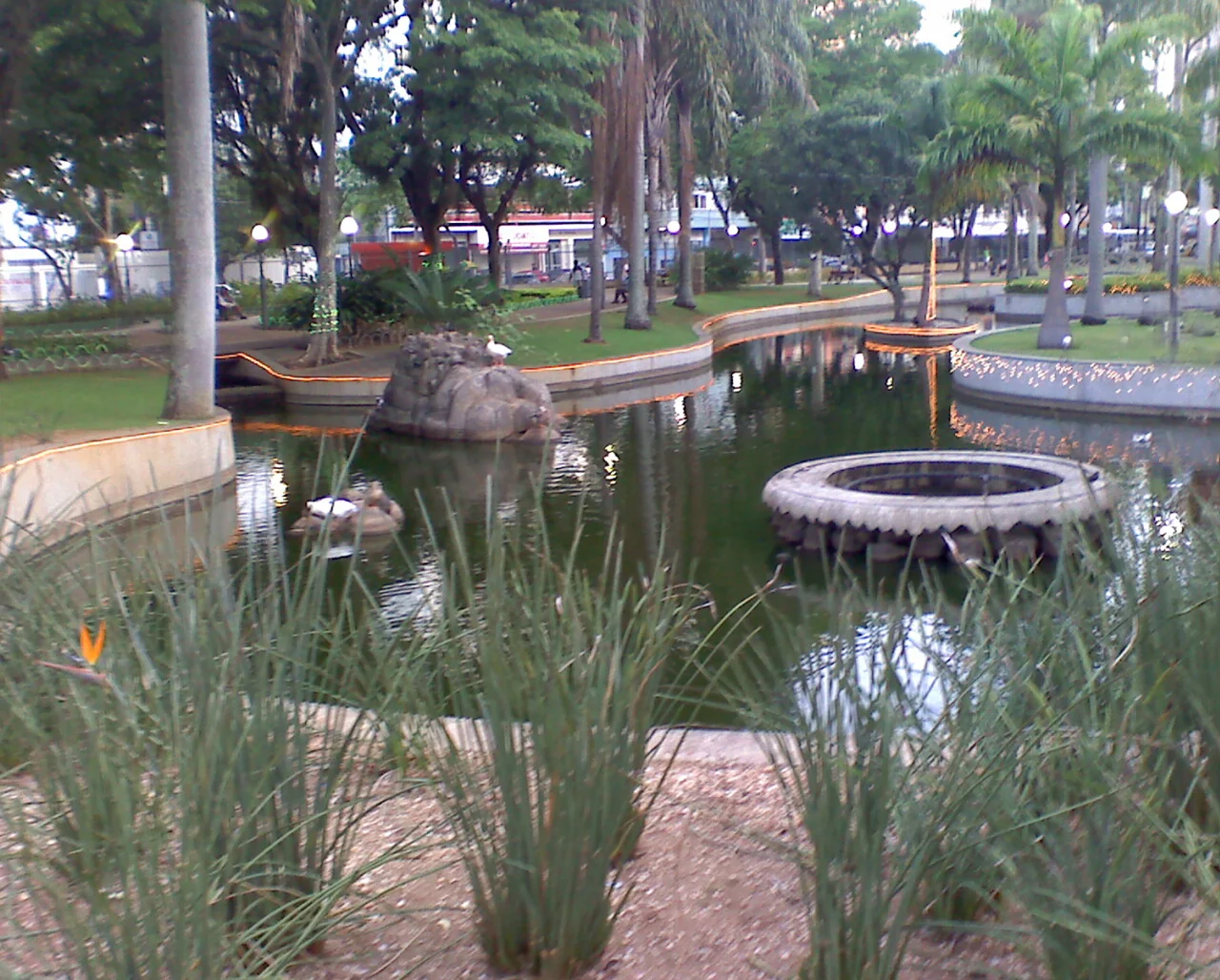

Moscoso Park
In 1910, this was a tidal swamp. The lower part of Vitória Island flooded twice a day with the bay's waters, a muddy area the locals called Campinho, not fit for building, not yet fit for much of anything. Then the governor Jerônimo Monteiro decided it should become a park, and the landscape artist Paulo Motta Teixeira started dragging in earth. Two years later the park opened. It had artificial islands, a fish lake, footbridges, benches, and the confident nineteenth-century conviction that gardens could make a city civilized. More than a century on, Moscoso Park is still Vitória's oldest public green space - 24,000 square meters of Atlantic Forest canopy and European-inflected landscape design, pressed on every side by a city that grew up around it.
Born from the Tides
Governor Jerônimo Monteiro received the land as a federal donation during his 1908 to 1912 term, with one condition - that it be turned into a public park. The name honors Henrique Moscoso, a president of the province whose legacy the governor wanted to preserve in greenery rather than bronze. Motta Teixeira dragged in fill, drained what could be drained, sculpted the rest. He designed the place in the nineteenth-century garden idiom - symmetric paths, formal plantings, a sense of strolling theater - and then watched the park pick up eclectic and Art Nouveau accents as it aged. By the 1920s it featured fountains, lagoons, small artificial islands, and the then-fashionable plaster ruins of imagined Greco-Latin temples. Tourists in search of arcadian Brazil found it here.
The Elite Hour
In the 1930s the neighborhood around Moscoso Park became one of Vitória's most desirable addresses. The capixaba elite - the term for people born in Espírito Santo - built mansions within walking distance of the greenery. The park filled with Sunday promenaders, young couples under the mango trees, children chasing parrots between the lagoons. A tennis court appeared. Birdsong mixed with the clink of glasses from shaded terraces. For a couple of decades, this was the social heart of a small state capital that still thought of itself as a port town with aspirations. People dressed up to walk here.
The Modernist Wound
Then came the 1952 renovations. The architect Francisco Bolonha, working in the clean lines of mid-century modernism, designed an Acoustic Shell and a kindergarten in the middle of a park that had been conceived as a Victorian reverie. To make room, the old boulevards were diverted and narrowed. An Ecumenical Chapel arrived. Children's toys. Walls and railings and an admission gate. Suddenly the park cost money to enter, which contradicted the entire civic logic of why a park existed. The nineteenth century made way for the twentieth, not always gracefully. The Acoustic Shell itself was an architectural gift - it still hosts concerts and has been listed as cultural heritage by the State Council of Culture - but the project as a whole enclosed what had been open, and the community felt it.
Restoration by Subtraction
In 2001 the city returned to the park with a different goal - not to modernize it, but to give it back the features it had lost. The admission walls came down, replaced by railings that kept the park visible from the street. The paths were re-routed to their original courses. The fountains returned to the locations Motta Teixeira had mapped a century earlier. The exercise was not a reconstruction so much as a conversation with the past - taking the park seriously as a historical artifact that deserved consideration. Then in May 2012, on the centennial, another restoration: the Acoustic Shell was renovated, the electrical systems overhauled, benches and walls and sidewalks repaired, the main lake renewed. The park was given another hundred years of working life.
The Breathing Room
Moscoso Park today is what the city editors of Globo have called calmaria no meio da agitação - calm in the middle of the bustle. The fish still move in the lake. The two small islands, each threaded by its own bridge, still catch the late light. The Atlantic Forest trees overhead - some of them approaching their own century - hold heat at bay. The Acoustic Shell still hosts concerts. School groups still visit. Tourists walking from the historic colonial center of Vitória find themselves suddenly under canopy, the sound of the city muffled by leaves, and understand why a governor once thought a tidal swamp might be worth rescuing.
From the Air
20.32°S, 40.34°W. The park occupies a small square in the historic center of Vitória, the capital of Espírito Santo state, on the island of Vitória. Recommended viewing altitude 1,500-3,000 m AGL to see the green patch of the park against the dense urban grid, with the Bay of Vitória to the south. Nearest airport: SBVT (Eurico de Aguiar Salles) 10 km north. Expect afternoon sea-breeze activity; morning flights offer clearer views of the harbor and historic buildings.
Nearby Stories
- Pedra Azul State Park 28 km away
- Guarapari 29 km away
- Mutum, Minas Gerais 74 km away
- Linhares 74 km away
- Paraiba do Sul 119 km away
- Petrobras 36 167 km away
- Itaúnas 180 km away
- Caraíva 393 km away