.jpg)
Feliciano Miguel Abdala Private Natural Heritage Reserve
In 1944, a man named Feliciano Miguel Abdalla, the son of a Lebanese immigrant, bought a farm in eastern Minas Gerais on one strict condition: he had to preserve the forest that stood on it. At the time, conservation was an alien concept in rural Minas. Settlers were clearing the Atlantic forest as fast as they could swing axes, and the man Abdalla had to face down for decades were not strangers from far away but his neighbors, hunters, and palm-heart harvesters who considered the old forest wasted. He kept his promise anyway, sometimes at risk to his own life. The small patch of forest he protected became one of the last refuges for a species of monkey that once numbered a million.
Fazenda Montes Claros
The property was called Fazenda Montes Claros, and when Abdalla took it on it covered coffee plantations, pasture for cattle, and a substantial stand of mature Atlantic forest. He ran the farm as a working enterprise. Over 20 families lived on the property in houses he provided. But he refused to log or clear the forest, even when the financial logic of the surrounding region pushed in exactly that direction. Hunters came for game. Palm-heart harvesters came for the juçara palms whose central stems had to be cut down to yield their edible hearts. Timber merchants came for hardwoods. Abdalla turned them all away, sometimes at physical risk. For decades he was the forest's sole defender.
The Scientists Arrive
By the late 1960s, Abdalla's stubborn preservation had started to attract the attention of outsiders who understood what he had been protecting. Professors Alvaro Aguirre and then Celio Valle introduced the woods to the Brazilian scientific community. In 1977 professor Akira Nishimura began the first systematic study of the northern muriquis (Brachyteles hypoxanthus), a large and endangered woolly spider monkey that was mostly absent from the rest of the Atlantic forest. Russell Mittermeier and Karen B. Strier followed with their own long-term studies, Strier's decades-long research on the Caratinga muriquis eventually becoming one of the foundational primatology studies of the 20th century. Abdalla, in his 70s by the time all this began, housed the researchers in his farmhouse before renovating a small vacant building on the edge of the forest. In May 1983 that building became the Estacao Biologica de Caratinga.
Muriquis
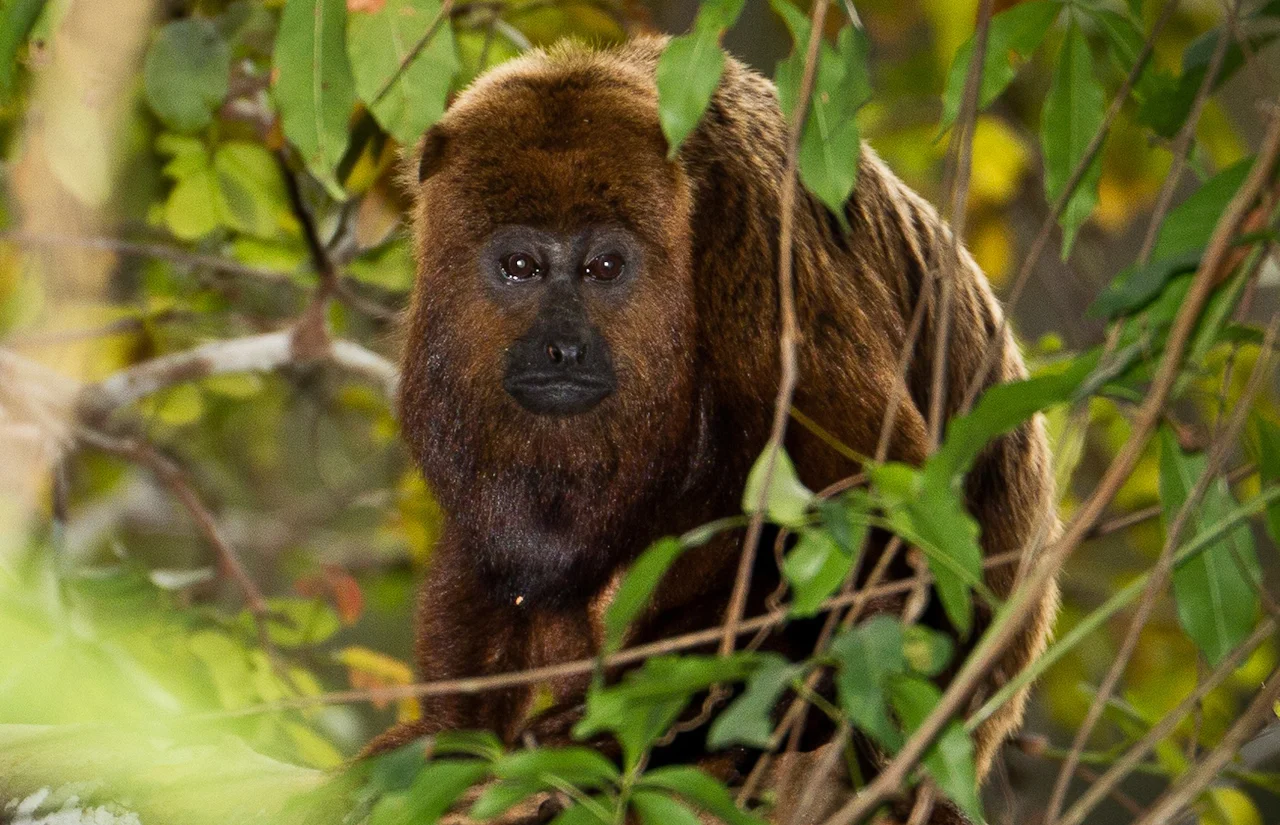
When Europeans arrived in Brazil in the 16th century, scientists estimate there were roughly a million northern muriquis ranging through the Atlantic forest. The species is large, loud, and slow to reproduce, and by the end of the 20th century it had been pushed onto the list of the 25 most endangered primates in the world. Fewer than 1,000 individuals remained in the wild by 2006. Of those, 226 lived at the Caratinga reserve. Thanks to the protected habitat and the ongoing research presence, the Caratinga population grew. By 2011 it had reached 320 muriquis, the largest concentration in the world. Alongside them the reserve supports buffy-headed marmosets, brown howlers, tufted capuchins, and hundreds of other vertebrate species, including the bushmaster pit viper Lachesis muta and Natterer's longwing butterfly.
From Private Promise to Public Reserve
Abdalla died in June 2000 at the age of 92. His family, determined to continue his work, founded a private non-profit called the Sociedade para a Preservacao do Muriqui, Preserve-Muriqui, which still manages the reserve. On September 3, 2001, the Brazilian government formally designated the 957.57-hectare property as the Feliciano Miguel Abdala Private Natural Heritage Reserve, recognizing it as an IUCN category IV protected area for habitat and species management. The designation marked the transition from one man's personal commitment to an institutional conservation project, with technical and financial support from Conservation International Brazil and the Fundacao Biodiversitas. The Federal University of Minas Gerais, the World Wildlife Fund, and the Brazilian Foundation for the Conservation of Nature all contributed to the biological station's ongoing work.
A Forest Among Neighbors
The reserve sits on the left bank of the Manhuacu River in the Doce River basin, within the municipality of Caratinga. Its rugged terrain climbs from 318 meters at its lowest points to substantially higher ridges. About 80 percent of the reserve is well-preserved semi-deciduous Atlantic forest, with the best-preserved stretches along the Jao and Matao streams where the canopy runs continuous at 25 meters with emergent trees reaching 35. The remaining 20 percent is abandoned pasture and secondary growth. What Preserve-Muriqui has done, deliberately and patiently, is work with the neighbors. Local people are employed at competitive rates to open trails, follow muriquis, and help with reforestation. The organization has taught intensive farming techniques that allow more production on less land, freeing hilltops for replanting. As the reserve manager put it, the neighboring farmers have become the guardians of the forest. The reserve has supported 22 research projects and ten PhD theses, all springing from a forest one man refused to cut down.
From the Air
The Feliciano Miguel Abdala Reserve sits at 19.73 degrees S, 41.82 degrees W in eastern Minas Gerais, within the Caratinga municipality. The nearest airports are Governador Valadares (SBGV) roughly 85 kilometers northeast and Ipatinga Usiminas (SBIP) roughly 90 kilometers to the north. The reserve occupies 957.57 hectares on rugged terrain along the Manhuacu River, a Doce tributary. From altitude, it appears as a dark green forested patch among pasture and coffee cultivation in the surrounding hills, with the Caratinga urban area visible a short distance to the southwest. The broader Doce basin stretches east toward the Atlantic.
Nearby Stories
- Piracicaba River (Minas Gerais) 34 km away
- Rio Doce State Park 39 km away
- Pedra Azul State Park 43 km away
- Vila Império 77 km away
- Robert Quayle (1814 ship) 79 km away
- Serra, Espírito Santo 95 km away
- Linhares 113 km away
- Guarapari 138 km away