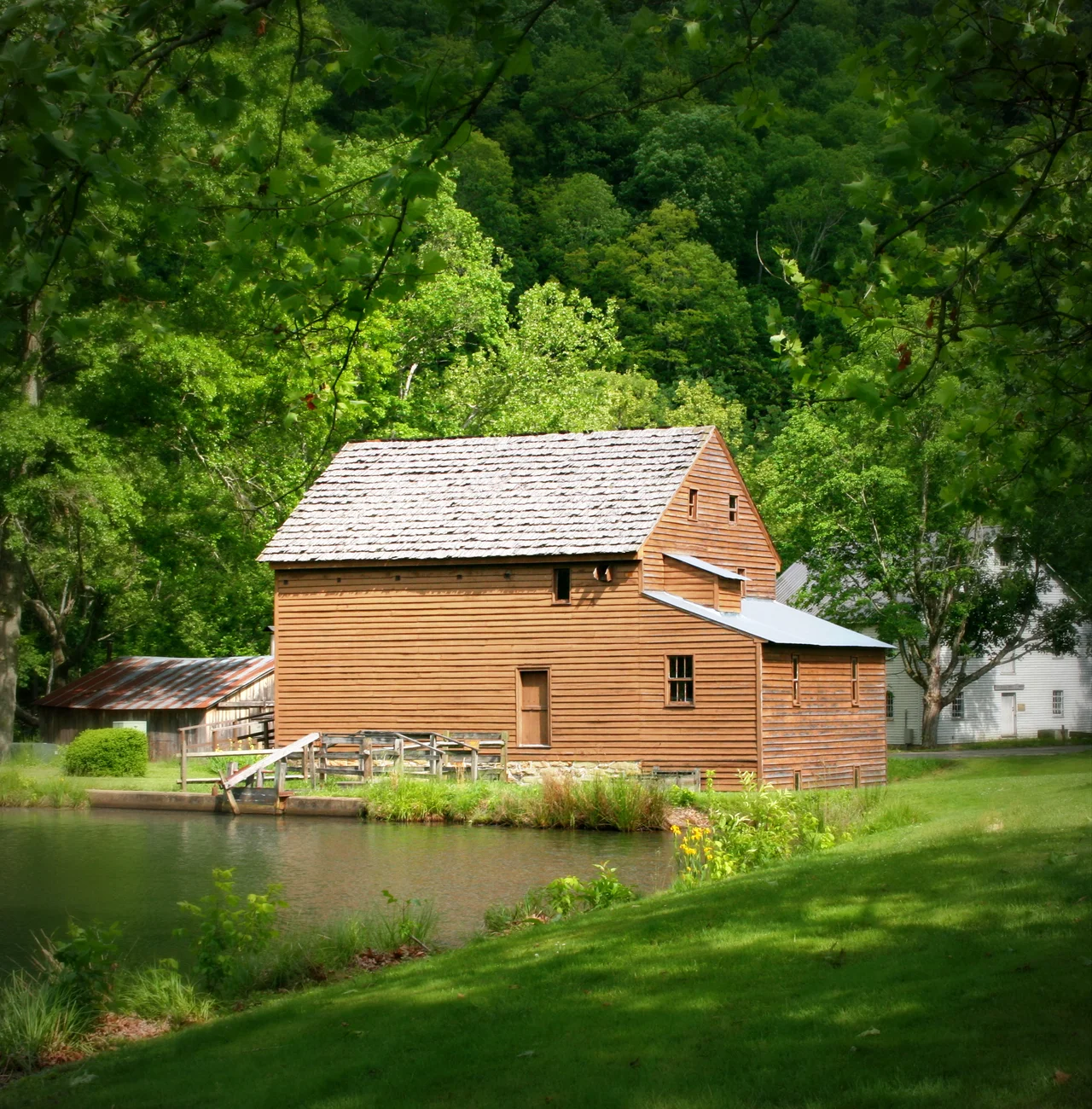

Jackson's Mill State 4-H Camp Historic District
Stonewall Jackson grew up on this farm. From around 1830, when he was six, until 1842, when he left for West Point, he lived at his uncle's mill on the West Fork River in Lewis County, working the land and growing into the young man who would later become one of the most consequential generals of the American Civil War. The mill, the farmhouse, and a 1793 log cabin from a neighboring property survive on the site, but the bulk of what stands here now is something else entirely: thirty-three contributing buildings, sites, and structures of the country's first statewide 4-H camp, established in 1921 on the same land where Jackson had spent his boyhood. Generations of West Virginia rural youth have come to Jackson's Mill in the summers since to learn farming, cooking, public speaking, and the cooperative habits that 4-H was created to foster.
The First State 4-H Camp
The 4-H movement grew out of late nineteenth-century efforts to bring scientific agriculture and home economics education to rural American youth through hands-on programs. By the 1910s, county-level camps had become a fixture of the movement, but no state had organized a single, central camp where 4-H members from across its borders could gather for week-long sessions of instruction, competition, and community-building. West Virginia became the first in 1921, choosing the Jackson farm at the confluence of the West Fork River and Freeman's Creek as the location. The site had everything a camp needed: open ground for tents and rapid construction, river frontage for swimming, woods for hiking, and a usable historical anchor in the Jackson Mill itself, then nearing a century of age. The camp opened in tents that first summer. Permanent buildings began going up almost immediately.
Two Decades of Building
Most of the camp's surviving architecture dates from the 1920s and 1930s. Council Circle and Camp Green went in in 1922; Assembly Hall in 1923; Vesper Rock - a natural rock outcrop arranged as an outdoor chapel - in 1925; the Mount Vernon Dining Hall, modeled in part on the dining hall at George Washington's Virginia estate, in 1926. The West Virginia Building, a substantial Colonial Revival structure that served as the camp's administrative anchor, went up in 1934. Through the late 1930s and into the 1940s, more buildings followed: the Amphitheatre in 1940, the Dominion Trail in 1942, the Camp Gates in 1942. The camp's buildings were designed in a regional vernacular that mixed Craftsman, Bungalow, and Colonial Revival elements, all using local materials and rough-cut beams. The intent was to create a coherent, picturesque rural environment that 4-H delegates from across the state would recognize as both distinctive and welcoming.
McWhorter Cabin and the Older Layer
Among the camp's older buildings is one truly old structure: the McWhorter Cabin, originally built in 1793 a few miles away and moved to Jackson's Mill in 1927 as part of the camp's effort to interpret the pioneer settlement of the area. The cabin is a single-room log structure of the type pioneer families lived in for years before they could afford anything larger. Jackson Spring, which the original Jackson family used, was incorporated into the camp landscape in 1922; a Jackson Homestead Marker had been placed on the site in 1915 by patriotic societies interested in preserving the connection to the Confederate general. The camp's interpretive program has always woven the Jackson family history and the older settlement story into the modern 4-H mission - a slightly unusual mixture that reflects how complicated the legacy of the Civil War remains in the upper South.
Camp Life Then and Now
For a century, the rhythm of summer at Jackson's Mill has been broadly the same. Delegates arrive on Sunday afternoons by the hundreds, sign in at the Registration Office, and are assigned to cottages organized by county. Days are structured around classes in animal husbandry, gardening, leadership, public speaking, cooking, sewing, woodworking, and the many other practical skills 4-H exists to teach. Mornings are pledge-of-allegiance and flag-raising; evenings are campfire and vespers at Vesper Rock; meals are taken family-style at Mount Vernon Dining Hall. Mountaineer Boys State - the American Legion's annual leadership program for high school students - has met here for decades. So has Mountaineer Girls State. The camp's modern facilities, including the 2021 Annette S. Boggs STEAM Education Center, indicate where 4-H's mission is heading: agriculture and homemaking remain, but engineering, robotics, and computer science have been added alongside them.
On the National Register
The Jackson's Mill State 4-H Camp Historic District was added to the National Register of Historic Places in 2005, recognizing both its significance as the first statewide 4-H camp in the United States and the architectural coherence of its early twentieth-century buildings. The Register listing covers 23 contributing buildings, 4 sites, 4 structures, and 2 objects across the camp's grounds. The district overlaps with but is distinct from the separately listed Jackson's Mill itself - the gristmill complex on the West Fork River that gave the place its name and that pre-dates the camp by more than a century. Together, the two listings cover a working historic landscape with three overlapping layers: the late-eighteenth-century mill and pioneer settlement, the mid-nineteenth-century Jackson family farm, and the twentieth-century 4-H camp that has been the property's principal use for the past hundred years.
From the Air
Jackson's Mill is at 39.10 N, 80.47 W in Lewis County, central West Virginia, on the West Fork River. Best viewed at 2,500-4,500 feet AGL; the cluster of camp buildings and the river bend create a recognizable pattern. Nearest airports: Mid-Ohio Valley Regional (KPKB) about 50 nm northwest at Parkersburg, and North Central West Virginia (KCKB) about 25 nm north at Clarksburg. The West Fork River traces a clear north-south line through the area; US-19 passes through Weston a few miles east. Stonewall Jackson Lake reservoir lies a few miles south.
Nearby Stories
- Appalachia 13 km away
- State of Kanawha 17 km away
- Weston and Gauley Bridge Turnpike 18 km away
- Tucker County, West Virginia 20 km away
- Sinks of Gandy 20 km away
- Garrett County, Maryland 46 km away
- The Ohio River Museum 51 km away
- West Virginia Penitentiary 70 km away