
Ještěd Tower
In the spring of 1969 the International Union of Architects awarded the Auguste Perret Prize to Karel Hubáček for a building that was still a construction site. Scaffolding stood on the summit of Mount Ještěd above Liberec, in what was then Czechoslovakia, and the concrete cone rising there was four years from opening. It remains the most significant award a Czech architect has ever won. What the jury could already read in the drawings is the idea the whole design turns on: from any distance, the tower does not sit on the mountain. It finishes it. The hill tapers upward, the concrete picks up the same curve, and the eye finds no seam between the two.
A Lodge Burns Down
The commission came out of a fire. Two wooden lodges had stood near the summit, one from the middle of the nineteenth century and one added in the early twentieth, and both burned to the ground in the 1960s. When the second went up in January 1963, Restaurace Liberec, the company that had run them, and the Prague Radio Communications Administration decided to combine their problems into one building: a mountain hotel and restaurant that would also carry a television transmitter. A competition was announced the following month at the Stavoprojekt offices in Liberec. Eleven architects and teams entered, among them Otakar Binar, Jiří Svoboda, Pavel Švancer and Svatopluk Technik. Only Hubáček's design satisfied both halves of the brief at once, which is to say only Hubáček had found a shape that could be a hotel and an antenna mast without one apologising for the other.
The Shape of the Hill, Continued
The form is a hyperboloid in reinforced concrete, and it was chosen for two reasons that happen to agree with each other. It extends the silhouette of Ještěd, which climbs to 1,012 metres and is the dominant landmark of the whole North Bohemian skyline. It also sheds the summit's weather, which is severe: rime ice, wind loading and freeze-thaw cycles that punish anything with flat faces or exposed corners. A curved surface that narrows as it rises gives the wind nothing to catch. The foundation sits at 1,004.75 metres above sea level and the tower rises 94 metres from there. The result is a building that looks inevitable rather than imposed, which is a rare thing for a broadcast structure and rarer still for one built in the 1960s.
Two Cylinders and a Hanging Floor
Underneath the curve, the engineering is straightforward and unusual at once. Two concentric reinforced concrete cylinders carry the load, with inner diameters of 4.4 and 12.5 metres and walls thirty centimetres thick; the narrow one stands 42.4 metres, the wider outer one 22.5 metres. From the second floor upward the floors do not rest on anything below them. They hang from those cylinders on steel structures, which is how the interior gets its open, unsupported feel. Getting it built took help from the Czechoslovak Academy of Sciences, the Czech Technical University in Prague and the engineering institute in Liberec, and the methods developed along the way were covered by Czechoslovak patents. Zdeněk Patrman handled the statics. The design phase ran three years, from 1963 to 1966; construction took seven more, finishing in 1973. The transmitter did not wait for the builders and went on air on 1 May 1971.
Sleeping Inside a Transmitter
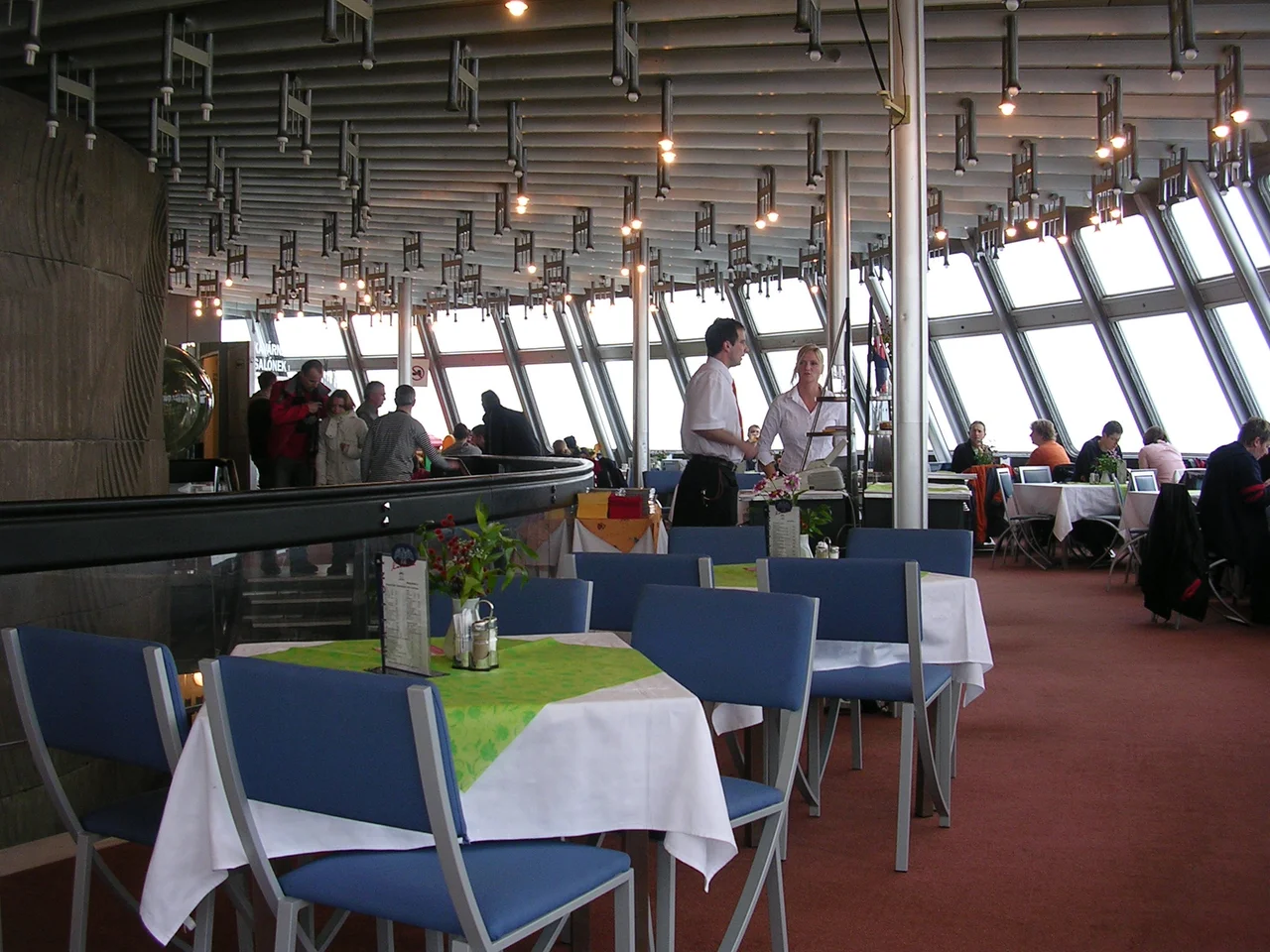
Otakar Binar designed the interiors, and the arrangement is genuinely strange when you think about what is stacked above your head. Engine rooms and stores fill the basement. The first floor is shared between administrative offices, the restaurant kitchen and the television transmission hall, which connects to the antenna systems on the ninth floor by a lift and an emergency staircase running up inside the central tube. Guests arrive on the second floor, into an entrance hall with the reception desk, a buffet and an observation terrace, and from there a suspended staircase climbs to the restaurant on the third. Eat by the window in clear weather and the view runs out across the Bohemian lowlands into Poland and Germany.
The Silhouette on Everything
Liberec has taken the shape as its own. The tower's outline appears on the region's flag and coat of arms, on the local university's logo, and on the badge of the football club FC Slovan Liberec; it turns up in the Czech film Grandhotel, adapted from Jaroslav Rudiš's novel. The Ministry of Culture registered the building as a cultural monument on 26 March 1998, declared it a national cultural monument in January 2006, and in May 2007 placed it on the Czech Republic's tentative list for UNESCO World Heritage inscription. When readers of iDNES.cz voted on the seven wonders of the country in September 2005, Ještěd came second, beaten by the Dlouhé stráně hydro power plant. Getting up there is harder than it was. On 31 October 2021 a cabin of the Ještěd cable car fell, killing an operator; an official report published in 2024 found that a haul rope had broken and that an automatic brake had previously been removed without authorisation. The cable car has not run since, and the summit is reached on foot or by road.
From the Air
Ještěd Tower stands at 50.73 N, 14.98 E, on a summit ridge 1,012 metres above sea level roughly 3 nm southwest of Liberec city centre and about 45 nm north-northeast of Prague. The tower itself adds 94 metres above a foundation at 1,004.75 metres, so plan on a terrain-plus-obstacle top near 3,600 feet MSL and give the ridge generous clearance. Best appreciated between 4,000 and 6,000 feet, approaching from the southwest along the Ještěd-Kozákov ridge: the cone is unmistakable, a smooth white taper on an otherwise wooded summit, and on a clear day the view from its restaurant reaches into Poland and Germany. The Jizera Mountains rise to the northeast and the Elbe sandstone country lies northwest. Nearest airports are Liberec (LKLB) about 3 nm northeast, Mladá Boleslav (LKMB) about 20 nm south, and Prague (LKPR) about 45 nm southwest. The summit generates its own weather; rime ice, low cloud and strong ridge-crossing winds are common outside high summer.
Nearby Stories
- JAT Flight 367 12 km away
- Herrnhut 15 km away
- Pillnitz Castle 38 km away
- The Defenestration of Prague: The Thrown Men Who Started a Thirty Years' War 40 km away
- Krzeszow Abbey 42 km away
- Lubiaz Abbey 77 km away
- The Battle of Vienna: The Cavalry Charge That Saved a Continent 254 km away
- 2020 Vienna Attack 270 km away