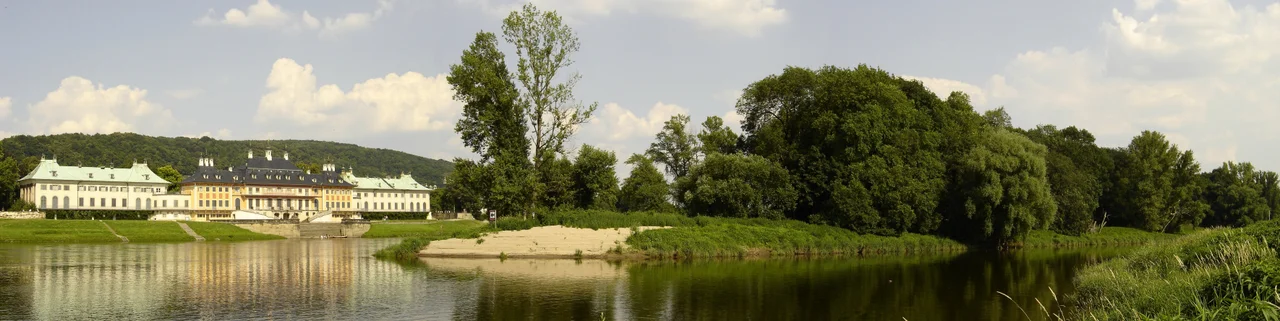

Pillnitz Castle
On 27 August 1791, Emperor Leopold II of Austria and King Frederick William II of Prussia met on the riverbank at Pillnitz, a Saxon summer palace twenty kilometres upriver from Dresden, and issued a joint declaration. They condemned the treatment of King Louis XVI of France by the Revolutionary government, and they invited the other monarchs of Europe to consider, jointly with them, what could be done. The Declaration of Pillnitz was carefully hedged — both sovereigns added that they would only act if all the great powers agreed, which they knew was unlikely — but the French revolutionaries read it as a threat. Within a year France had declared war on Austria, and within four years the Wars of the French Revolution had pulled in every major European power. Pillnitz Castle, a delicate baroque ornament wrapped in painted chinoiserie roofs, became briefly the most consequential building on the Elbe.
A Mistress's Palace
The palace's earlier history is mostly bedrooms. A medieval residential fortress had stood on the site since the fourteenth century. The Wettin dynasty acquired it in 1694 when Elector John George IV of Saxony bought it as a gift for his mistress Magdalena Sibylla of Neidschutz. Both died young soon after. In 1706 John George's brother Augustus II the Strong gave the property to one of his many mistresses, the Countess Anna Constantia of Brockdorff, only to rescind the gift after she fled to Berlin in 1715. Augustus then turned the property into something more useful for himself: a riverside summer palace for festivals and theatricals, redesigned starting in 1720 by his court architect Matthaus Daniel Poppelmann — the same man who built the Zwinger in Dresden. Poppelmann's Wasserpalais, the Riverside Palace, went up in 1720-21 with a broad terrace and water stairs running down to a gondola dock on the Elbe. The matching Bergpalais, the Hillside Palace, followed in 1723-24.
The Roofs Look Wrong on Purpose
Look at the rooflines and you will notice they curl. The eaves are bent up at the corners, the moldings have a slight ogee, the ornaments include little pagoda caps. This is chinoiserie — a Western imitation of what eighteenth-century European architects believed Chinese architecture looked like. Augustus II was obsessed with Asian luxury goods; he founded the Meissen porcelain factory in 1710 because he could not tolerate the trade imbalance with China. At Pillnitz the chinoiserie is mostly in the roofs and the painted decoration on the facades, which is an aesthetic that aged unevenly. Some of the painted brickwork on the facades is, in fact, paint mimicking brick, a technique borrowed from theatrical scenery. The third major building, the New Palace, replaces an older structure that burned down in 1818. It was completed in 1826 in austere Neoclassical style, joining the two baroque palaces on the east side and providing the central domed hall, royal kitchen, and Catholic chapel.
The Camellia
Stand in the garden behind the New Palace and you can see a tree about nine metres tall under a glass house that opens at the sides in summer. This is the Pillnitz Camellia. According to one tradition the seedling was brought by the Swedish naturalist Carl Peter Thunberg from Kyoto to Kew Gardens in 1776, and then to Pillnitz; the documentary evidence is thin but the tree was certainly planted in its current location in 1801. It is one of the four oldest camellias in Europe and produces around 35,000 dark red flowers each spring. The custom-built glass house, opened in 1992 to replace earlier shelters, runs on rails so it can be wheeled away each May. The garden also holds Germany's first palm house, built between 1859 and 1861, 93.7 metres long and 660 square metres in floor area. After a long restoration completed in 2009, it now houses plants from Australia and South Africa.
What Remains
The Wettins used Pillnitz as a summer residence until the abdication of King Frederick Augustus III in November 1918. The palace passed to the Free State of Saxony and then, after 1945, to the East German government. It survived the Second World War undamaged because Dresden, eighteen kilometres downriver, absorbed the Allied bombing on the night of 13-14 February 1945. Today the New Palace contains a Schlossmuseum on the palace's history; the older buildings hold the Kunstgewerbemuseum, Dresden's arts and crafts museum, with porcelain, furniture, and metalwork from the Saxon royal collections. The artificial Gothic ruin on the hillside above the palace, built in 1785 as a piece of romantic landscape design, remains in place — a folly meant to express the fleeting vanity of life, set deliberately above the gardens that expressed the opposite.
From the Air
Located on the right bank of the Elbe at the eastern edge of Dresden, at 51.009 degrees north, 13.870 degrees east. From the air at 1,500 to 3,000 feet AGL the palace appears as a long pale block parallel to the river, with a formal baroque garden between the two main wings, surrounded by vineyards on the hillside and the wide curving Elbe in front. The artificial ruin sits on the wooded hilltop to the north. Best approached from the river. Nearest airport is Dresden-Klotzsche (EDDC), 13 km north.
Nearby Stories
- Bautzen II 13 km away
- Battle of Mühlberg 15 km away
- Freiberg Cathedral 16 km away
- Ústí Massacre 19 km away
- DKW 22 km away
- 2001 American Memorial 23 km away
- Kromlau Azalea and Rhododendron Park 28 km away
- Ještěd Tower 41 km away