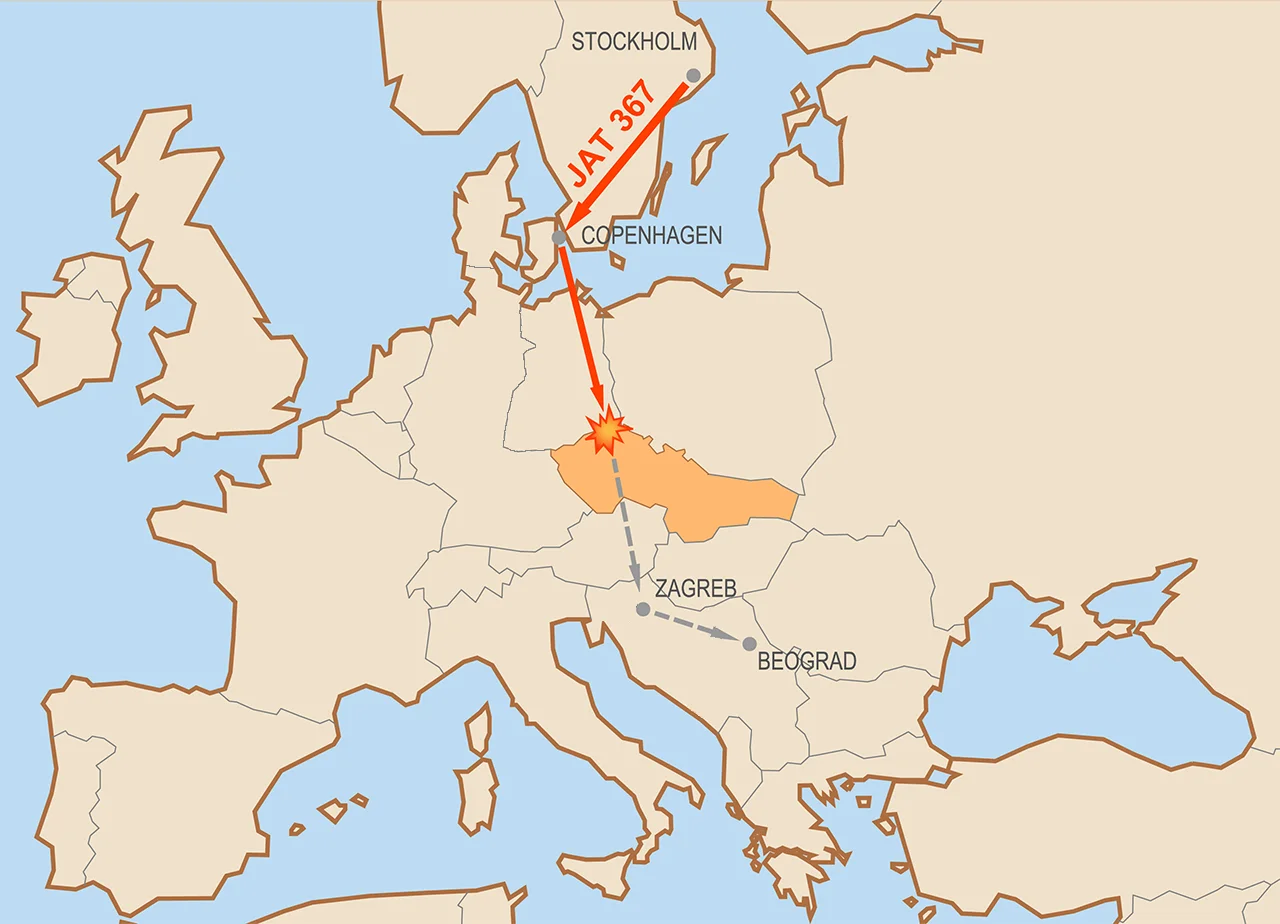

JAT Flight 367
A villager named Bruno Honke heard screaming coming from the wreck. It was the afternoon of 26 January 1972, in the wooded hills near Srbská Kamenice in northern Czechoslovakia, now the Czech Republic, and a broken section of a Yugoslav airliner lay in the snow. Honke had served as a medic in the Second World War. He found a twenty-two-year-old flight attendant, Vesna Vulović, alive inside the fuselage and kept her going until rescuers reached the site. The other twenty-seven people aboard JAT Flight 367 were dead. What happened in the minutes before Honke started running has never been fully settled, and more than fifty years later it is still contested.
The Wrong Vesna
Vulović was not supposed to be working that day. By her own account the airline had confused her with another flight attendant who shared her first name, and she had been flying for only eight months. The DC-9-32, registration YU-AHT, left Stockholm Arlanda at 1:30 in the afternoon bound for Belgrade by way of Copenhagen and Zagreb. It landed in Copenhagen an hour later, where Vulović and her colleagues took it over. She remembered watching from the terminal as the inbound passengers came off. One man struck her, and struck others, as unusually agitated. "It was not only me that noticed him either," she said later. "Other crew members saw him, as did the station manager in Copenhagen. I think it was the man who put the bomb in the baggage."
Somewhere Above Hinterhermsdorf
Captain Ludvik Razdrih and First Officer Ratko Mihić took the aircraft southeast across Germany. Shortly after passing the Hermsdorf radio beacon, near Hinterhermsdorf in what is now the municipality of Sebnitz, the DC-9 came apart. It broke into three pieces, spun out of control and came down across the border in the hills near Srbská Kamenice. Twenty-seven people died on impact: the two pilots, the rest of the crew, and the passengers who had boarded in Stockholm and Copenhagen for an ordinary winter flight home. Almost none of their names are remembered outside their families. The story that travelled the world was the one about the woman who lived, which is its own kind of loss for the twenty-seven who did not.
The Briefcase and the Phone Call
The Czechoslovak Civil Aviation Authority concluded that a briefcase bomb had destroyed the aircraft. Yugoslav authorities suspected émigré Croatian nationalists, and there was reason to look that way: on the same day, a bomb went off aboard a train running from Vienna to Zagreb, injuring six. The following day a man identifying himself as a Croatian nationalist telephoned the Swedish newspaper Kvällsposten and claimed responsibility for bringing down Flight 367. No one was ever arrested. In October 2024 the Swedish investigative programme Kalla fakta returned to the case; reporter Tonchi Percan obtained declassified Yugoslav security service files naming seven exiled Croats linked to the Bugojno group who had lived in Sweden and Germany, with intelligence on each drawn from dozens of separate agents. Three of those men were still alive in 2024. Two denied any involvement. The third said he could not remember.
What the Record Cannot Settle
The official account has been challenged for decades. In 1997 the Czech aviation periodical Letectví a kosmonautika suggested the aircraft had been shot down in error by Czechoslovak air defences, and in January 2009 the German broadcaster Tagesschau carried an investigation by Peter Hornung and Pavel Theiner concluding it was "extremely likely" that a MiG had destroyed the DC-9 only a few hundred metres above the ground, mistaking it for a hostile aircraft as it attempted a forced landing. They cited villagers in Srbská Kamenice who described seeing the plane burning but still intact below the cloud base, a Serbian aviation expert who thought the debris field far too compact for a fall from altitude, and reports of a second aircraft. A Guinness World Records representative told the newspaper Die Tageszeitung that Guinness appeared to have been "duped by this swindle just like the rest of the media." Czech specialists pushed back hard, arguing that airspace violations were handled by interceptors rather than missiles, that a launch would have been seen and heard by thousands, that between 150 and 200 people would have had to keep the secret, that the dive described was not aerodynamically possible, and that the main wreckage pieces lay more than 1.5 kilometres apart. The radar operator on duty that day pointed out in 2009 that West German air defence would have registered any Czechoslovak fighters in the air.
A Record She Never Asked For
Vulović lay in a coma for twenty-seven days and woke temporarily paralysed from the waist down. She learned to walk again. She said she remembered nothing between greeting passengers and waking in hospital, and that she had been told she was found in the middle section of the aircraft rather than the tail. Guinness credited her with the highest fall survived without a parachute, 10,160 metres, and Paul McCartney presented her with the award. MythBusters later tested the fall and concluded that survival was possible depending on how the wreckage came down; deep snow and dense trees near Srbská Kamenice may have done the rest. She lived until 2016 and disliked being treated as a miracle. A memorial now stands near the crash site, in the hills where Bruno Honke went looking for the sound.
From the Air
The crash site lies at 50.81 N, 14.34 E, in the hills above Srbská Kamenice in the Czech Republic, about 4 nm south of the German border and on the southern approaches to Bohemian Switzerland National Park. The aircraft was last over the Hermsdorf beacon near Hinterhermsdorf, Saxony, roughly 7 nm north. Best appreciated between 3,000 and 6,000 feet AGL, where the sandstone gorges of the Elbe valley and the Kamenice river cut clearly through the forest; the Bastei bridge lies about 14 nm northwest. Nearest airports are Ústí nad Labem (LKUL) and Dresden (EDDC), with Prague (LKPR) about 43 nm south. The region holds low stratus and valley fog through the winter months, as it did on the day of the crash.
Nearby Stories
- Moritzburg Castle 2.8 km away
- Zittau 3 km away
- Bautzen 13 km away
- Upper Market Square (Görlitz) 16 km away
- Kaditz Lime Tree 22 km away
- The Defenestration of Prague: The Thrown Men Who Started a Thirty Years' War 61 km away
- The Anschluss: When Austria Vanished Overnight 279 km away
- The Battle of Vienna: The Cavalry Charge That Saved a Continent 289 km away