
Bautzen
Ask a German what Bautzen is known for and you will get one of two answers, and neither of them is the town. The first is mustard. Bautz'ner Senf has been made here for generations and holds around 65 percent of the market across the eastern German states, which is the kind of number that turns a brand into shorthand for a place. The second answer is the prisons. Bautzen's penitentiaries were notorious throughout East Germany - Bautzen I, still in operation today, and the secret Bautzen II, where the Stasi held prisoners of conscience. Both answers are accurate. Both leave out a walled medieval town standing on a rock above the river Spree, a skyline bristling with towers, and the fact that every street sign here is written twice, in two different languages.
A Skyline of Towers
The old town sits on a plateau with the Spree curling below it, and the city wall runs along the steep embankment above the water - a defensive line that has survived largely because the ground did the hard work. Ortenburg Castle holds the high end. Within the walls, the Reichenturm leans hard enough to count as one of the steepest still-passable leaning towers north of the Alps, and visitors climb it anyway. The Alte Wasserkunst went up in 1558 to lift the Spree's water into the town and is one of the oldest preserved waterworks anywhere in central Europe; it now works as a museum and a viewing platform. The Hexenhaus, the Witch's House, dates from 1604 and is the oldest surviving dwelling in Bautzen. St Peter's Cathedral is odd in a way nothing else in eastern Germany quite matches: Catholics and Protestants have shared the same building for centuries, worshipping at opposite ends.
Budyšin
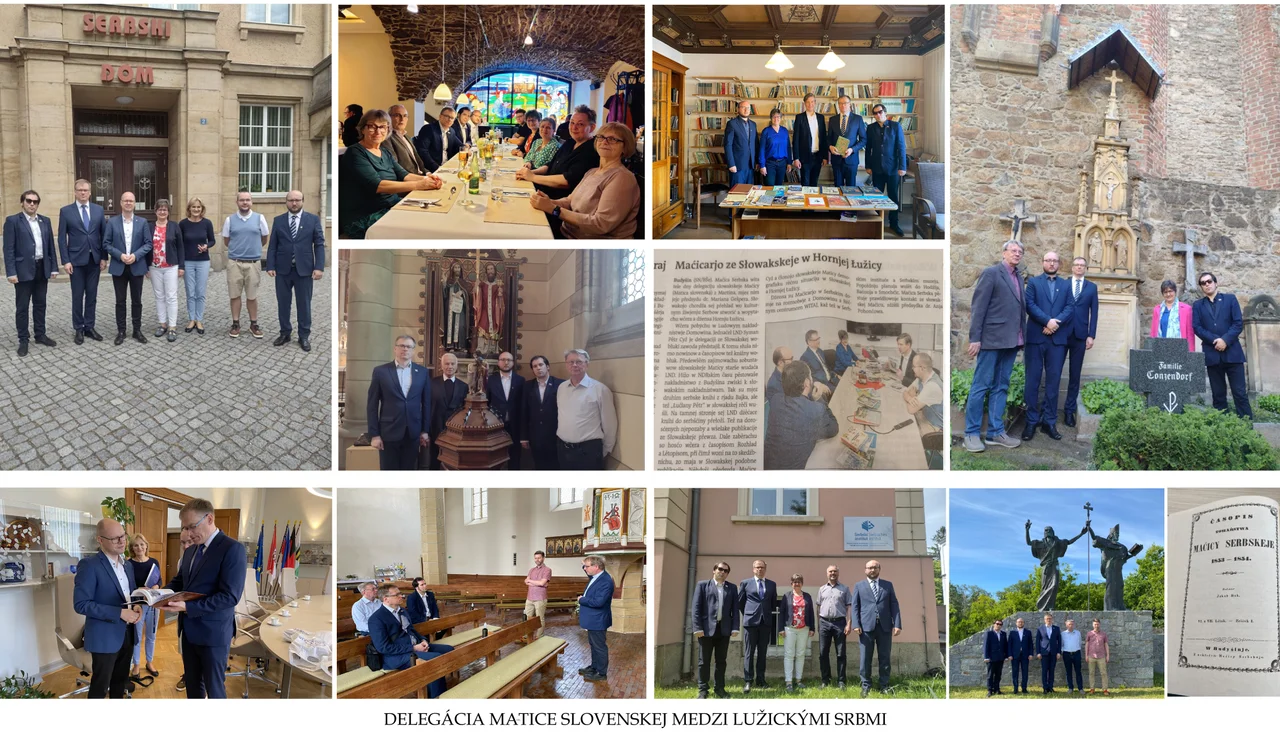
The town has a second name, and it is the older one. Budyšin appears in the written record in 1002, when a Sorbian stronghold called Budusin was named as the centre of Upper Lusatia. The Sorbs are a West Slavic people, and they have been here longer than most of the borders that have crossed them - over the centuries Bautzen has belonged to Poland, Bohemia, Hungary, Saxony, Germany and East Germany, while the Sorbs stayed put. About a tenth of the city speaks Upper Sorbian today, which is why the street signs are bilingual and why Bautzen counts as the cultural capital of Sorbian Germany. The Serbski muzej, the Sorbian Museum, holds the collection. Look for the diacritics on the signs and you begin to see a country inside a country, sharing the same cobbles.
The Easter Capital
Nothing in the Bautzen year comes close to Easter, which is why the town gets called Germany's Easter capital without much argument. Sorbian Easter eggs are the visible part, made by specialised techniques and beautiful enough to sustain their own market in the weeks before the holiday. The Osterreiten is the part people travel for: processions of riders in formal dress moving between villages on Easter Sunday, singing, carrying the news of the resurrection from one parish to the next. There is Eierschieben, egg-rolling, for anyone who prefers their traditions less solemn. The rest of the calendar keeps up. Ptači kwas, the Wedding of the Birds, falls on 25 January. Summer brings an open-air theatre season and the Bautzener Frühling street festival, and the whole thing runs in two languages at once.
What the Walls Also Held
Bautzen has been fought over repeatedly, and the town's name attaches to more than one battle. Napoleon won here in 1813. In April 1945, over ten days between the 21st and the 30th, it was fought over again as the Eastern Front closed. During the war a subcamp of the Groß-Rosen concentration camp operated in the town, holding prisoners as forced labour. Afterwards came the prisons that made the name notorious across the German Democratic Republic. Bautzen I is a working penitentiary still. Bautzen II, the one the state preferred not to discuss, held people whose crime was disagreement, and since 1993 it has been a memorial rather than a jail - open to visitors, with the cells left as they were. Both places have their own tellings, and both are within walking distance of the medieval streets.
Ponds, Water and Mustard
Step outside the walls and Upper Lusatia turns flat, wet and quietly strange. The Upper Lusatian Heath and Pond Landscape biosphere reserve covers 21,800 hectares and holds more than 240 ponds, most of them dug centuries ago for carp and now doing duty as one of the better bird landscapes in Germany. The Bautzen reservoir handles the water sports. South of town the Upper Lusatian Highlands make for easy day walks, and in the Kleinwelka district there is a hedge maze billed as the largest in the country. Back in the centre, the kitchens cook Sorbian and Lusatian - meat, gravy, potatoes, done well - and the local beer is genuinely hard to find outside a handful of bars. The mustard, on the other hand, is everywhere. Some reputations are earned honestly.
From the Air
Bautzen lies at 51.18 N, 14.42 E, in Upper Lusatia on the A4 / European Route E40 corridor between Dresden and Görlitz. Best viewed between 1,500 and 3,000 feet AGL. From the air the old town reads as a dense cluster of towers on a bluff on the west bank of the Spree, with the river bending sharply below it and open farmland in every direction - there is no comparable vertical relief for miles, which makes the town centre a reliable visual fix. The Bautzen reservoir is a large open water body immediately north of town, and the Upper Lusatian pond landscape to the north and northwest shows as hundreds of small rectangular water bodies, an unmistakable pattern from altitude. Dresden (EDDC) is about 25 nm west; Prague (LKPR) roughly 66 nm south; Görlitz lies 22 nm east along the motorway. A small general-aviation airfield serves the town. Autumn and winter fog forms readily over the pond landscape and can sit well past mid-morning.
Nearby Stories
- Kromlau Azalea and Rhododendron Park 4.8 km away
- Königstein Fortress 6.4 km away
- 2001 American Memorial 10 km away
- Stalag Luft III 17 km away
- Zittau 18 km away
- Jizera Dark-Sky Park 22 km away
- Hellerau 26 km away
- Czocha Castle 27 km away