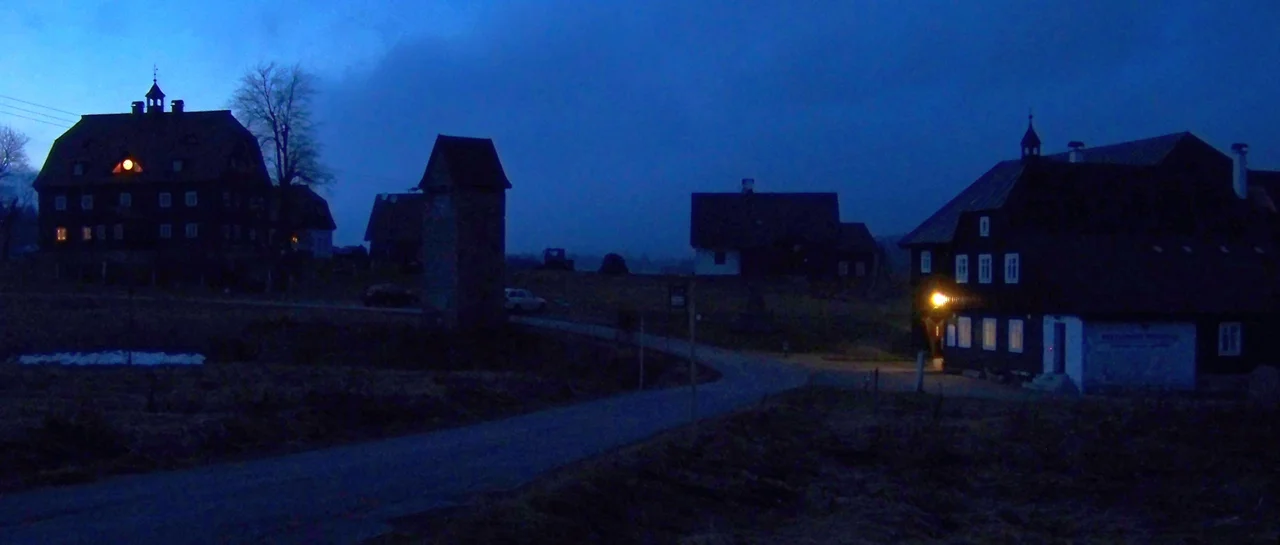

Jizera Dark-Sky Park
Most protected landscapes advertise what they have. This one publishes what it has lost. The Jizera Dark Sky Park - Jizerská oblast tmavé oblohy on the Czech side of the ridge, Izerski Park Ciemnego Nieba on the Polish - states plainly that the night sky over the hamlet of Jizerka is about twice as bright as a sky with no artificial light in it, and that a genuinely natural night effectively no longer exists anywhere in densely populated Central Europe. The admission is the whole idea. On 4 November 2009, during the United Nations International Year of Astronomy, Czech and Polish institutions jointly declared 75 square kilometres of nearly uninhabited mountain the first transnational dark-sky preserve - not because the sky here is pristine, but because it is close to the best that remains, and because somebody has to keep score.
A Border Through Empty Ground
The initiative came from the Astronomical Institute of the University of Wrocław, and it grew into an unusually crowded partnership: the Czech Academy of Sciences, the Czech nature protection agency, the administration of the Jizera Mountains protected area, forest districts on both sides of the frontier, and the regional authority in Liberec. What they were protecting is a stretch of the Western Sudetes with almost nobody in it. On the Czech side the park runs from the hamlet of Jizerka up to Smrk, at 1,124 metres the highest summit of the Bohemian Jizera Mountains. On the Polish side it follows the High Jizera ridge and wraps around the Jizera Meadow and the settlement of Orle. The international border runs straight through the middle of it, which is why the two countries had to agree - a light switch on one side of a line does not respect the line.
Bortle Four
Astronomers grade night skies on the Bortle scale, running from a genuinely primeval sky at one end to the washed-out orange of a city centre at the other. The Jizera park sits at level four, and reaches level three when conditions are exceptional. That means the Milky Way is unmistakably there, structure and all, while the horizon still glows in several directions. Stand on the ridge on a clear night and you can name the sources: Liberec and Jablonec nad Nisou to the south, Tanvald beyond them, Jelenia Góra to the east. The influence of a city's lighting reaches tens of kilometres into country that has none of its own. The park exists partly so that people can come and see that for themselves, which is a harder argument to dismiss than a chart.
The Cold Pole
The Jizera Meadow lies at 840 to 880 metres in the valley of the Jizera River, and it is one of the coldest places in Poland - the country's cold pole, by most reckonings. On 3 February 2012 the meadow recorded minus 36 degrees Celsius. Sub-zero temperatures have been logged in every month of the year, and snow can lie into May. The cause is not altitude but shape: at night, cold air drains off the surrounding slopes and pools in the basin, which has nowhere to send it. Climatically the meadow behaves like ground 600 metres higher in the Karkonoše. For an observer this is a mixed blessing. Cold, dry, settled air is exactly the air you want between your eye and a galaxy. It is also the air that ends the evening early.
The Villages That Went Out
The darkness here was not designed. It was left behind. People first came to Jizerka in the 15th century hunting gemstones, calling the place Klein Iser; glassworks opened in 1828, and at its peak the settlement held around 450 people with a school, a pub, a sawmill, a bakery and a blacksmith. The wood-fired furnaces closed in 1911, undercut by coal-fired factories down in the valleys, and tourism moved into the empty houses. On the Polish meadow the village of Gross-Iser was demolished in the 1950s; only the mountain hostel now known as Chata Górzystów still stands. Along this whole frontier, communities emptied when their German-speaking inhabitants were expelled after 1945, and much of the high ground was never resettled. Jizerka today has no public street lighting at all. What looks like conservation is, in large part, the shape of an absence.
Going to Look
On the Polish side the preserve anchors an astro-tourism project called Astro Izery; on the Czech side, Jizerka's Panský dům and the Chata Pyramida sit in a settlement that simply goes dark after sunset. Paved paths reach the meadow from Świeradów-Zdrój, and hiking and ski trails cross the ridge in every direction - these are the mountains the Jizerská 50 cross-country race is run in every winter. The lookout tower on Smrk has been rebuilt, and from the top the view carries east to Sněžka in the Giant Mountains and west across the Lusatian Highlands as far as the cooling towers at Boxberg in Germany. Which is the park's argument in one glance: from the darkest ground in the region, you can still see what is making the rest of it bright.
From the Air
The Jizera Dark Sky Park centres on roughly 50.845 N, 15.359 E, straddling the Czech-Polish border along the main ridge of the Jizera Mountains in the Western Sudetes. Terrain rises to 1,124 metres (3,688 ft) at Smrk on the Czech side, with the Polish summit a metre lower; plan minimum safe altitudes accordingly, and expect mechanical turbulence and lee-side sink when the wind is strong across the ridge. Best viewed by day between 3,000 and 6,000 feet, where the pattern is legible: dense dark spruce forest, open peat bogs and the pale grass of the Jizera Meadow in its basin, with the Jizera River draining south. The lookout tower on Smrk is a usable visual fix. At night this area is the striking one - a black hole in an otherwise well-lit Central European plain, ringed by the glow of Liberec, Jablonec nad Nisou, Tanvald and Jelenia Góra, and correspondingly short of ground references for visual navigation. Prague (LKPR) lies about 61 nm southwest, Wrocław (EPWR) roughly 60 nm east-northeast and Dresden (EDDC) about 63 nm northwest. The range records well above-average precipitation; the station at Nová Louka logged 345.1 mm in a single day on 30 July 1897, still a European record. Expect rapid cloud build-up on the ridge and hard winter icing.
Nearby Stories
- Oybin 5.4 km away
- Zgorzelec 20 km away
- Bautzen II 23 km away
- Krzeszow Abbey 25 km away
- Lubiaz Abbey 47 km away
- The Defenestration of Prague: The Thrown Men Who Started a Thirty Years' War 65 km away
- Auschwitz: The Site of Industrialized Murder 248 km away
- The Battle of Vienna: The Cavalry Charge That Saved a Continent 276 km away