
Zgorzelec
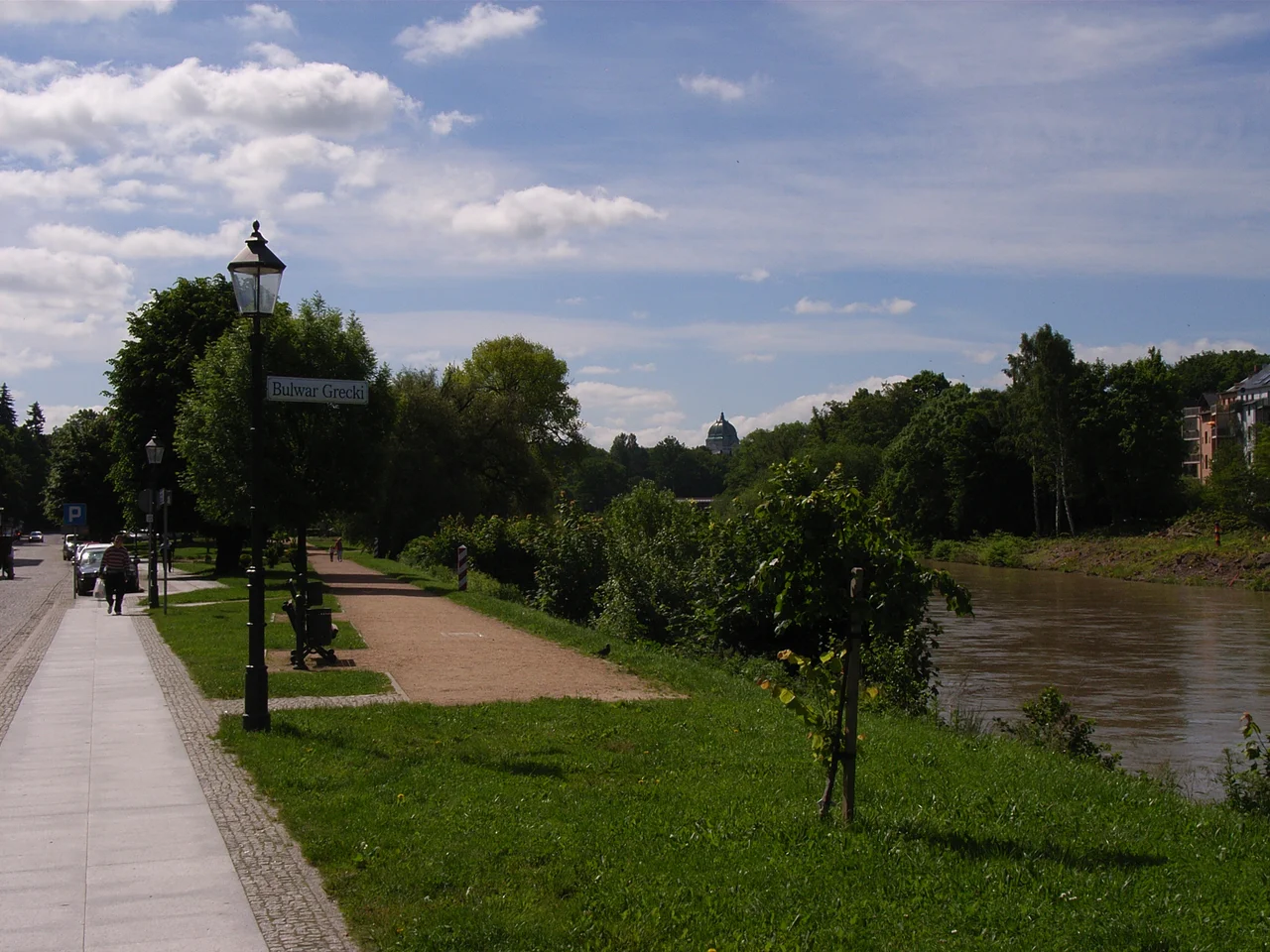
There is a riverside promenade in this Polish border town called Bulwar Grecki - Greek Boulevard. It runs along the Lusatian Neisse with a clear view across to Germany, and the name is not decoration. From 1948 Poland took in refugees from the Greek Civil War, and about ten thousand of them were settled here, in a town that had itself only just been invented. Until 1945 Zgorzelec was simply the east bank of Görlitz, a German town that had grown on both sides of its river for seven hundred years. Then the Potsdam Agreement drew the Polish border down the middle of the Neisse, and the people on the eastern side were ordered out. Almost nobody who lives in Zgorzelec today is descended from anybody who lived here in 1944. That is the town's whole story, and it is worth telling in the order it happened.
One Town, Two Names
Before 1945 there is no separate history to tell: everything that happened to Görlitz happened here. A settlement called Goreliz appears in a document of the German king Henry IV in 1071, in the region of Upper Lusatia. It grew rich on the Via Regia, the great east-west trade road, and from 1346 it was the wealthiest member of the Six-City League alongside Bautzen, Kamenz, Lubań, Löbau and Zittau. Sovereignty changed hands the way it does in Central Europe: the Margraviate of Meissen, then Poland under Bolesław the Brave from 1002, back to Meissen in 1031, Bohemia from 1075, the Piast duchy of Jawor in 1319, Hungary under Matthias Corvinus in 1469, Bohemia again in 1490. The Congress of Vienna handed the whole thing to Prussia in 1815, which filed it under the Province of Silesia. The east bank was the poorer, newer, more industrial side.
Quartet for the End of Time
On 26 August 1939, days before the invasion of Poland, the Germans opened a temporary camp on the eastern outskirts. It became Stalag VIII-A, and the first 8,000 Polish prisoners of war arrived on 7 September. Polish civilians were held there too, including women - activists and members of the intelligentsia seized in the Intelligenzaktion, held in transit before deportation to forced labour or to the concentration camps. Prisoners of a dozen further nationalities followed. One of the French prisoners was the composer Olivier Messiaen, captured in June 1940, who wrote the Quatuor pour la fin du temps in the camp and performed it there on 15 January 1941 with three fellow prisoners: Henri Akoka on clarinet, Jean le Boulaire on violin, Étienne Pasquier on cello. Perhaps four hundred prisoners and guards heard it. In February 1945 the camp was evacuated on foot, and men who could not keep walking were shot. A memorial stands on the site.
The Order to Leave
Polish operation groups crossed on 10 to 12 May 1945 to secure the east bank, and Polish administration was formally installed on 21 May. On 2 June the military closed the bridge to stop Germans returning to their homes. Early on the morning of 21 June the roughly 8,800 Germans still living on the eastern side were ordered out of their houses. The people who replaced them had mostly been moved by force themselves, from the eastern provinces Poland had just lost to the Soviet Union - one displacement feeding another along the whole width of the continent. They inherited a town without a centre. The stations, the utilities, the public buildings and the market squares were all on the German bank, and the bridges had been blown up on the night of 7 May.
Ten Thousand Greeks
Then came the Greeks. The communist side lost the Greek Civil War in 1949, and Poland admitted thousands of partisans and their families; the largest group of them was settled in Zgorzelec, where empty German housing stood waiting. At its height the Greek community here ran into the thousands, with its own schools, a retirement home and a factory that employed its members. Most eventually went back to Greece. Roughly sixty people of Greek descent remain, which still makes this the largest Greek community in Poland - enough to have built the Orthodox church of Saints Constantine and Helen in 2002, to have twinned the town with Naousa in 1998, and to have kept an international Greek song festival running here every year since 1999. It is an odd sound to carry across a Lusatian river, and it has been carrying for three-quarters of a century.
The Hall Where the Border Was Signed
On the Polish bank stands a vast domed hall built by the Germans as the Oberlausitzer Gedenkhalle, designed by Hugo Behr and opened by Kaiser Wilhelm II on 28 November 1902 to celebrate the emperors and the unification of Germany. On 6 July 1950 Otto Grotewohl and Józef Cyrankiewicz met inside it and signed the agreement recognising the Oder-Neisse line as the border between East Germany and Poland. The building is now the Miejski Dom Kultury, the municipal house of culture. Below it the old town bridge, destroyed at ten o clock on the night of 7 May 1945, reopened for pedestrians on 20 October 2004. Görlitz and Zgorzelec declared themselves a joint Europastadt in 1998, hold combined council sessions, and came second to Essen in the race to be European Capital of Culture for 2010. About 29,000 people live on the Polish side.
From the Air
Zgorzelec lies at 51.153 N, 15.000 E, immediately east of Görlitz across the Lusatian Neisse, at roughly 200 metres above sea level. Best read between 2,000 and 4,000 feet AGL, where the two towns resolve as a single urban footprint cut cleanly in half by the river - the dense medieval core with its towers on the German bank, a looser grid of nineteenth and twentieth century blocks on the Polish. The domed Miejski Dom Kultury and its surrounding park are the most conspicuous landmark on the eastern side; the A4 motorway crosses the Neisse just north of the town and is the easiest line to follow inbound. Flugplatz Görlitz (EDBX, 750 m grass) sits about 5 km west of the river, so a circuit from it crosses an international border - check airspace before manoeuvring. Dresden (EDDC) is roughly 57 nm west and Wrocław (EPWR) about 71 nm east. Terrain is gentle; the basalt cone of the Landeskrone south-west of Görlitz is the only significant relief in view. Morning valley haze along the Neisse is common between spring and autumn.
Nearby Stories
- Zittau 13 km away
- Pravčická brána 14 km away
- Lusatia 16 km away
- Branitz Palace 27 km away
- Sorbian Settlement Area 31 km away
- Krzeszow Abbey 50 km away
- Lubiaz Abbey 70 km away
- Nazi War Crimes in Occupied Poland 249 km away